
Level:
Correct: 0
Incorrect: 0
Marks: 0/0
Exam Practice
Course:
Topics:
Avg
score:
–
Topics
done:
0/27

Development of the atomic model

Practise 13 exam-style questions on Development of the atomic model for Edexcel GCSE Combined Science (Physics Paper 1). Write your answer as you would in the exam and get it marked in seconds against the mark scheme, point by point, with the Study Helper on hand if you get stuck.

  • 13 questions
  • 1–6 marks each
  • Instant marking
  • No sign-up needed
13 questions, marked as you go

Sample questions with model answers

Here are 4 of the questions in this topic, each with a model answer, an explanation of why it earns the marks and the mark scheme an examiner would use.

Question 1

1 mark

In the alpha particle scattering experiment, alpha particles were fired at a very thin sheet of gold foil.

Which observation showed that most of an atom is empty space?

Choose your answer.

  • A most passed straight through
  • B some were deflected slightly
  • C a few were deflected a lot
  • D very few bounced back

Model answer

A

Explanation

If most alpha particles pass straight through a gold foil hundreds of atoms thick without being deflected, most of the volume of each atom must be empty space. The large deflections and the few that bounced back are the evidence for a tiny, dense, positive nucleus. Match each observation to its own conclusion.

Mark scheme
  1. 1 mark

    A / most passed straight through (1)

    The only correct answer is A: most alpha particles went through the foil without being deflected, so they met nothing in most of the space they passed through. B is not correct because small deflections show that the alpha particles passed fairly near something that repelled them; C is not correct because large deflections show that the positive charge is concentrated in a small region; D is not correct because alpha particles bouncing back show that the nucleus is very small and contains most of the mass, not that the atom is mostly empty. Accept the letter or the option. If more than one option is given, do not award the mark.
Question 2

2 marks

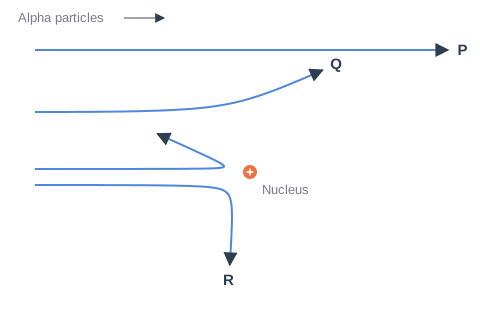
Figure 1 shows the paths of some alpha particles as they pass a gold nucleus.

Explain why the alpha particles are deflected away from the nucleus, and why the alpha particle on path R is deflected through a larger angle than the alpha particle on path Q.

Diagram of alpha particle scattering: alpha particles travel from left to right towards a small positive nucleus at the centre. Path P goes straight past the nucleus at a large distance. Path Q bends slightly as it passes the nucleus. One path heads almost straight at the nucleus and is deflected back the way it came (through about 155°). Path R bends sharply as it passes close to the nucleus.

Model answer

The alpha particles and the gold nucleus are both positively charged, so the nucleus repels each alpha particle and pushes it away. Path R passes much closer to the nucleus than path Q. The repulsive force is larger when the alpha particle is closer to the nucleus, so the alpha particle on path R has a larger force on it and is deflected through a larger angle.

Explanation

The deflection is caused by repulsion between two positive charges, and the force grows rapidly as the distance between them gets smaller. Only alpha particles that pass very close to the tiny nucleus are deflected through large angles, which is why so few are. A common error is to say that the alpha particles bounce off electrons or are attracted to the nucleus.

Mark scheme
  1. 1 mark

    the alpha particles and the nucleus are both positively charged, so the nucleus repels the alpha particles (1)

    Mark the two points independently. allow like charges repel; allow there is a force of repulsion between them; do not accept the nucleus attracts the alpha particles / the alpha particles bounce off the electrons.

  2. 1 mark

    R passes closer to the nucleus than Q, and the closer an alpha particle passes, the larger the (repulsive) force on it, so the larger its deflection (1)

    The figure shows that R passes closer, so 'R is closer to the nucleus' on its own does not score: the link between a smaller distance and a larger force (or a larger deflection caused by a larger force) is needed. allow ORA (Q passes further away, so the force on it is smaller); do not accept 'R hits the nucleus'.

Question 3

3 marks

In the alpha particle scattering experiment, a very small number of the alpha particles fired at a thin gold foil bounced back towards the source.

Rutherford later said that this was 'almost as incredible as if you fired a 15-inch shell at a piece of tissue paper and it came back and hit you.'

Explain what this result showed about the part of the atom that turned the alpha particles back.

Model answer

The alpha particles are positively charged, so the part of the atom that turned them back must also be positively charged and repel them. To turn a fast alpha particle right round, the force must be very large, so this positive charge must be concentrated in a very small space, not spread out as in the plum pudding model. It must also contain most of the mass of the atom, so that it is not simply pushed out of the way. Because only a very few alpha particles came back, most of them missed this part, so it must be tiny compared with the atom. So the atom has a very small, very dense, positively charged nucleus.

Explanation

Rutherford's shell and tissue paper comparison shows why the result was a shock: in the plum pudding model nothing in the atom could stop a fast, heavy alpha particle. Bouncing back needs a large, concentrated positive charge and a large mass, and the rarity of it shows the nucleus is tiny - so the nucleus is small, dense and positive. Answers that only say 'there is a nucleus' miss the size, mass and charge.

Mark scheme
  1. 1 mark

    it is positively charged, so it repels the (positive) alpha particles (1)

    An explanation linking any three from the four points; max 3. Mark each point independently. allow like charges repel; do not accept the nucleus is negative / attracts the alpha particles.

  2. 1 mark

    its (positive) charge is concentrated in a very small space, so the (repulsive) force on an alpha particle that comes close to it is very large / large enough to turn the alpha particle back (1)

    allow the charge is not spread out (as in the plum pudding model), so the force is strong enough to reverse the alpha particle; ignore 'concentrated' with no reference to the charge or the force.

  3. 1 mark

    it contains most of the mass of the atom / it has a much greater mass than an alpha particle (so it is not pushed away itself) (1)

    allow it is very heavy / massive / dense; allow 'like a wall, not tissue paper'.

  4. 1 mark

    it is very small compared with the atom, because only a very few alpha particles came close enough to it to bounce back (1)

    the reason (very few bounced back / most missed it) is needed; ignore 'small' with no comparison or reason.

Question 4

4 marks

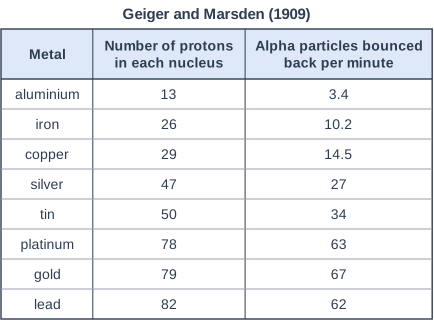
In 1909, Geiger and Marsden fired alpha particles at plates of different metals, under the same conditions. They counted how many alpha particles bounced back from each plate each minute.

The table shows their results, with the number of protons in each nucleus of each metal.

A student says: 'The results show that the more protons there are in a nucleus, the more alpha particles bounce back.'

Evaluate the student's statement. Use the data and the nuclear model of the atom in your answer.

Geiger and Marsden (1909). Table with columns "Metal", "Number of protons in each nucleus", "Alpha particles bounced back per minute". Metal: aluminium; Number of protons in each nucleus: 13; Alpha particles bounced back per minute: 3.4 | Metal: iron; Number of protons in each nucleus: 26; Alpha particles bounced back per minute: 10.2 | Metal: copper; Number of protons in each nucleus: 29; Alpha particles bounced back per minute: 14.5 | Metal: silver; Number of protons in each nucleus: 47; Alpha particles bounced back per minute: 27 | Metal: tin; Number of protons in each nucleus: 50; Alpha particles bounced back per minute: 34 | Metal: platinum; Number of protons in each nucleus: 78; Alpha particles bounced back per minute: 63 | Metal: gold; Number of protons in each nucleus: 79; Alpha particles bounced back per minute: 67 | Metal: lead; Number of protons in each nucleus: 82; Alpha particles bounced back per minute: 62.

Model answer

The data mostly support the statement. Aluminium, with 13 protons, bounced back only 3.4 alpha particles per minute, while gold, with 79 protons, bounced back 67 per minute, and the number rises steadily from aluminium through iron, copper, silver and tin to platinum and gold. In the nuclear model, a nucleus with more protons has a greater positive charge, so it repels the positive alpha particles more strongly and turns more of them back. However, lead has the most protons (82) but bounced back fewer alpha particles (62 per minute) than gold (67) or platinum (63). So the statement is true for most of the metals, but the pattern is not exact - other factors, or uncertainty in the counts, must also affect the number bounced back.

Explanation

These are real results from 1909: a bigger positive charge on the nucleus gives a bigger repulsive force, so more alpha particles are turned back from metals with more protons. A good evaluation quotes data that support the statement and data that do not (lead), then reaches a judgement. Students often give a judgement without data, or say the nucleus attracts the alpha particles.

Mark scheme
  1. 1 mark

    the data mostly support the statement: the number bounced back rises from aluminium (13 protons, 3.4 per minute) to gold (79 protons, 67 per minute) (1)

    An answer including any four from the five points; max 4. Mark each point independently. Data must be quoted for MP1 (at least two metals with their numbers of protons and counts, or a clear description of the trend with values).

  2. 1 mark

    more protons means a greater (positive) charge on the nucleus (1)

    allow a nucleus with more protons is more positive.

  3. 1 mark

    so the force of repulsion on the (positive) alpha particles is greater, so more of them are turned back (1)

    allow alpha particles are repelled more strongly / are deflected through larger angles; do not accept the nucleus attracts the alpha particles.

  4. 1 mark

    but lead has the most protons (82) and fewer alpha particles bounced back from it (62 per minute) than from gold (67) or platinum (63) (1)

    allow the pattern is not perfect: lead does not fit; allow platinum and gold have almost the same number of protons and similar counts.

  5. 1 mark

    judgement: the statement is generally true / true for most of the metals, but not exactly, so other factors (or uncertainty in the counts) must also affect the number bounced back (1)

    the judgement must be supported by data (MP1 or MP4 seen); allow 'mostly supported but lead is an exception'; allow other factors such as impurities in the lead sample (Geiger and Marsden themselves suggested this) or the counts being uncertain / random; a judgement alone scores 0.

Ready to try the rest? Every answer you write is marked against the mark scheme, so you can see exactly where the marks are.

Study Helper Hints first, answers after you try

Stuck on this one? Ask for a hint and I’ll point you in the right direction, without giving the answer away. Once you’ve checked your answer, I’ll show you how the marks are awarded.