Has the role of individuals been the main factor in the development of workers' rights in Britain?
Explain your answer with reference to the role of individuals and other factors. Use a range of examples from across your study of Power and the people: c1170 to the present day.
[16 marks] [SPaG 4 marks]
Model answer
Individuals have played an important part in the development of workers' rights, as leaders who inspired others and as reformers in Parliament. However, I do not think they have been the main factor. Workers' rights advanced or retreated mainly because of economic conditions and the actions of governments, and the leaders who succeeded were those whose ideas fitted those conditions.
In the Middle Ages individuals led protests but did not decide the outcome. Wat Tyler and John Ball led the Peasants' Revolt of 1381, demanding the end of serfdom and fair wages, but Tyler was killed and Ball executed. Serfdom declined over the next century because the Black Death had created a shortage of labour, which gave peasants the bargaining power to demand wages and freedom. Here the economy mattered far more than any individual.
In the early nineteenth century individuals made a bigger difference, often through Parliament and public campaigns. Factory reformers such as Richard Oastler, Michael Sadler and Lord Ashley, later Lord Shaftesbury, exposed the conditions of child workers and helped bring the Factory Act of 1833, the Mines Act of 1842 and the Ten Hours Act of 1847. Robert Owen inspired the Grand National Consolidated Trades Union in 1834, but it collapsed within months, and George Loveless and the other Tolpuddle Martyrs were transported. Their pardon in 1836 came through mass petitions rather than the efforts of one person. Governments, meanwhile, decided what was legal: the Combination Acts of 1799-1800 had banned unions until their repeal in 1824.
In the later nineteenth century individuals led the growth of 'new unionism'. Annie Besant's article on the Bryant and May factory helped the match girls win their strike in 1888, and Ben Tillett, John Burns and Tom Mann led the dockers to victory in 1889. Yet these successes depended on collective action and public support, and on wider changes: the growth of industry had created huge numbers of unskilled workers, and laws such as the Trade Union Act of 1871 and the Trade Disputes Act of 1906 gave unions legal protection.
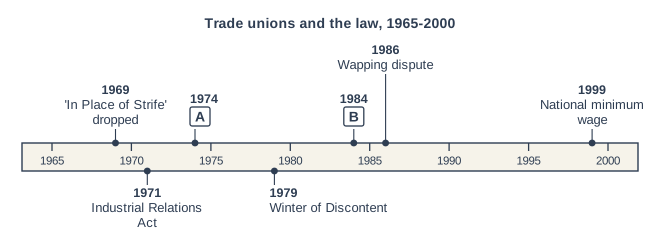
In the twentieth century individuals were important on both sides, but government and the economy were decisive. In 1926 A.J. Cook rallied the miners with the slogan 'Not a penny off the pay, not a second on the day', but Baldwin's government, well prepared, defeated the General Strike. War transformed the position of workers: union membership rose to over 8 million by 1920, and in the Second World War the union leader Ernest Bevin became Minister of Labour, making unions partners in government. Full employment after 1945 gave unions great power, until the economic problems of the 1970s. Barbara Castle introduced the Equal Pay Act in 1970, but her attempt to reform the unions in 'In Place of Strife' failed. In the 1980s Margaret Thatcher, determined to curb union power, passed a series of laws and defeated Arthur Scargill's miners in 1985. Her success owed much to high unemployment and the decline of heavy industry, which weakened the unions anyway. In 1999 Tony Blair's government introduced a national minimum wage, a major new right decided by government.
In conclusion, individuals have been important as leaders, campaigners and symbols, and some, such as Shaftesbury, Bevin, Castle and Thatcher, made a real difference. But the main factors in the development of workers' rights were economic conditions, which decided how much bargaining power workers had, and the laws made by governments. Individuals succeeded when they worked with these forces and failed when they worked against them.
Explanation
Leaders such as Tyler, Owen, Shaftesbury, Besant, Tillett, Cook, Bevin, Castle, Thatcher and Scargill shaped events, but economic conditions (the Black Death, industrialisation, full employment, the 1980s decline) and government laws usually decided workers' rights. Level 4 sustains a judgement with examples from across the whole period; SPaG is marked separately.