Has government been the main factor in deciding the success or failure of protest in Britain?
Explain your answer with reference to government and other factors. Use a range of examples from across your study of Britain: Power and the people: c1170 to the present day.
[16 marks] [SPaG 4 marks]
Model answer
Government has usually been the main factor in deciding whether protest succeeded or failed, because the state held the power either to grant change or to crush the protesters. However, the decisions governments made were often shaped by other factors, such as the strength and unity of the protest, war and public opinion.
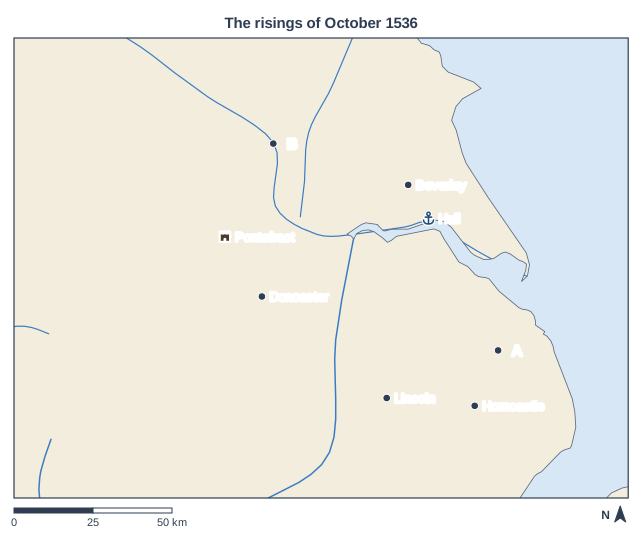
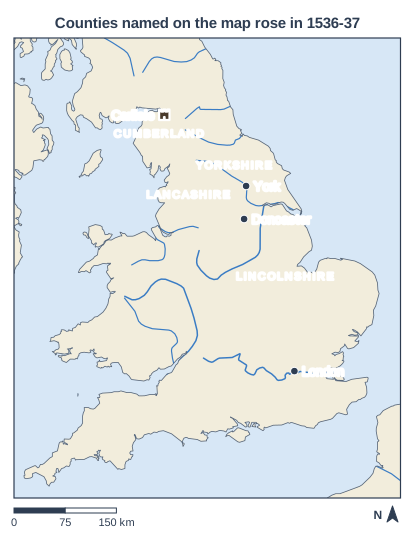
In many cases a determined government defeated protest through deception and force. In 1381 Richard II met the rebels at Mile End and Smithfield and promised to end serfdom, but once they had gone home the charters were cancelled and rebels such as John Ball were executed. Henry VIII used the same tactics against the Pilgrimage of Grace. With perhaps 30,000 pilgrims facing the Duke of Norfolk's 8,000 men, Henry offered a pardon and a parliament at York, but after Bigod's Rising in January 1537 he executed about 200 people, including Robert Aske, and reorganised the Council of the North. In the nineteenth century the government rejected the Chartist petitions of 1839, 1842 and 1848, sent troops to the north and swore in tens of thousands of special constables in 1848. In 1926 Baldwin's government had prepared for a General Strike, using volunteers and the British Gazette, and the TUC called the strike off after nine days. In 1984-1985 Margaret Thatcher's government built up coal stocks and organised policing on a national scale, and the miners were defeated.
When governments were weak, or chose to concede, protest succeeded. King John was forced to seal Magna Carta in 1215 because most of the barons had turned against him. Charles I's lack of money after the Bishops' Wars forced him to recall Parliament in 1640 and accept the Long Parliament's reforms. Earl Grey's Whig government passed the Great Reform Act in 1832, after the Days of May and the threat to create new peers, and Peel repealed the Corn Laws in 1846. In 1918 Lloyd George's coalition gave the vote to most women over 30.
However, other factors often decided how governments acted. The organisation and unity of protesters mattered: the Anti-Corn Law League's money and organisation helped to win repeal, while divisions between moral and physical force Chartists, and the NUM's failure to hold a national ballot in 1984, weakened those campaigns. War was often decisive. The New Model Army's victory at Naseby in 1645 decided the Civil War, French help after Saratoga allowed the Americans to win independence, and women's work in the First World War made it easier for the government to grant the vote in 1918. Individuals and chance also played a part: the death of Wat Tyler at Smithfield left the rebels leaderless, and Aske's trust in Henry led him to send the pilgrims home. The economy mattered too, as prosperity in the 1850s took away much of Chartism's support.
Overall, government was usually the main factor, because only the state could grant or refuse change, and a strong, united government, such as Henry VIII's in 1537 or Thatcher's in 1985, could defeat even a large protest. But governments were not acting alone: they conceded when war, financial weakness or well-organised pressure made resistance too costly. Government decided the outcome, but other factors decided how strong the government was.
Explanation
Strong and determined governments (Henry VIII in 1537, Baldwin in 1926, Thatcher in 1984-85) defeated protest, while weak or willing ones conceded (John in 1215, Grey in 1832, Lloyd George in 1918). Level 4 weighs this against the protesters' organisation, war and other factors, reaching a sustained judgement.