Has government been the main factor in the development of parliamentary democracy in Britain?
Explain your answer with reference to government and other factors. Use a range of examples from across your study of Power and the people: c1170 to the present day.
[16 marks] [SPaG 4 marks]
Model answer
Government has been essential to the development of parliamentary democracy, because every major change had to be passed by Parliament and accepted by the monarch. However, governments rarely acted on their own initiative. They usually changed the system because they needed money, wanted party advantage or feared what would happen if they did not, so pressure from outside was usually the main factor.
Government played a direct role in many key developments. Medieval kings called parliaments because they needed taxes, and Edward I's parliaments, such as the Model Parliament of 1295, regularly included knights and burgesses, helping to establish the Commons. Henry VIII used Parliament to pass the laws of the Reformation in the 1530s, which increased its importance. In the 19th century governments passed all the major reforms: Earl Grey's Great Reform Act of 1832, Disraeli's Second Reform Act of 1867, and Gladstone's Ballot Act of 1872 and Third Reform Act of 1884. In the 20th century Asquith's government passed the Parliament Act of 1911, limiting the power of the unelected Lords and introducing pay for MPs, Lloyd George's coalition passed the 1918 Representation of the People Act, and Baldwin's government gave women the vote on equal terms in 1928.
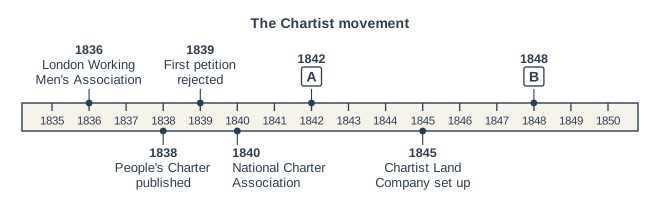
However, governments often acted only because of protest and pressure. Magna Carta in 1215 was forced on King John by rebel barons, and Simon de Montfort called his Parliament of 1265 after defeating Henry III in war. In 1830 Wellington's government refused any reform, and Grey's Act was passed only after the riots of 1831 and the Days of May in 1832, when the political unions threatened a run on the banks. Chartism failed at the time, but five of its six points later became law, showing that its pressure set the agenda. The Reform League's Hyde Park demonstrations in 1866-67 and the long campaign of the suffragists and suffragettes after 1897 also pushed governments to act.
War has been another major factor. The Civil War led to the execution of Charles I in 1649 and the abolition of the monarchy and the Lords, and although the monarchy returned in 1660, the conflict established that kings could not rule without Parliament. The First World War made the 1918 Act possible, because soldiers needed to be given the vote and women's war work had changed attitudes.
The economy and ideas also drove change. Industrialisation created a middle class and an industrial working class who demanded representation, while ideas of democracy and equality, from the Levellers to Paine's Rights of Man and the Charter, gave campaigners clear aims. Governments often responded to these changes for their own reasons: the Whigs wanted to win the loyalty of the middle class to prevent revolution, and Disraeli wanted to 'dish the Whigs'.
Overall, government was the means by which parliamentary democracy developed, because only governments could change the law. But it was not the main factor, because governments usually acted when protest, war, economic change and new ideas made reform necessary or advantageous. Even government's own reasons - the need for money or for votes - were responses to wider pressures. The main driving force was the pressure on government, not government itself.