Level:
Correct: 0
Incorrect: 0
Marks: 0/0
Exam Practice
Subject:
Topics:
Avg
score:
–
Topics
done:
0/12

Divine Right and parliamentary authority

Practise 35 exam-style questions on Divine Right and parliamentary authority for AQA GCSE History (Power and the people). Write your answer as you would in the exam and get it marked in seconds against the mark scheme, point by point, with an AI tutor on hand if you get stuck.

  • 35 questions
  • 1–20 marks each
  • Instant marking
  • No sign-up needed
20 questions, marked as you go

Sample questions with model answers

Here are 4 of the questions in this topic, each with a model answer, an explanation of why it earns the marks and the mark scheme an examiner would use.

Question 1

2 marks

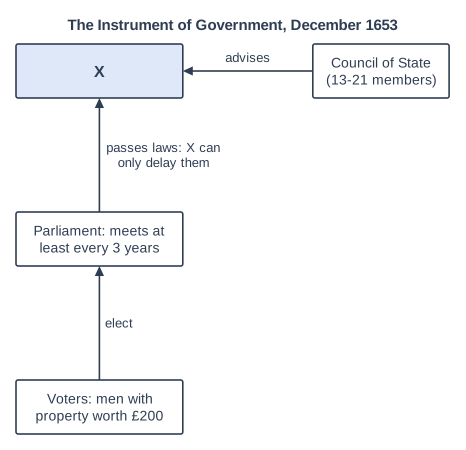
Figure 1 shows the system of government set up by the Instrument of Government in December 1653. Name the position labelled X and the person who first held it.

The Instrument of Government, December 1653. Block diagram with four parts in five rows. Top row, left to right: a box labelled X (shaded) and a box "Council of State (13-21 members)". Third row: a box "Parliament: meets at least every 3 years". Bottom row: a box "Voters: men with property worth £200". Connections: an arrow from "Council of State (13-21 members)" to box X, labelled "advises"; an arrow from "Voters: men with property worth £200" to "Parliament: meets at least every 3 years", labelled "elect"; an arrow from "Parliament: meets at least every 3 years" to box X, labelled "passes laws: X can only delay them".

Model answer

X is the Lord Protector, and the first person to hold the position was Oliver Cromwell.

Explanation

The Instrument of Government (1653) was Britain's first written constitution. It made Cromwell Lord Protector for life, ruling with a Council of State and a Parliament that had to meet at least every three years; in practice Cromwell clashed with his parliaments and relied on the army.

Mark scheme
  1. 1 mark

    X: the Lord Protector.

    Accept 'Protector'.

  2. 1 mark

    Oliver Cromwell.

Question 2

8 marks

Source A: from the official record of the trial of Charles I in Westminster Hall on 20 January 1649, when the King was asked to answer the charge that he was a tyrant and traitor who had made war on his people.

Charles said: 'I would know by what power I am called hither... I would know by what authority, I mean lawful; there are many unlawful authorities in the world, thieves and robbers by the highways.' He said that he had a trust 'committed to me by God, by old and lawful descent', and that he would not betray it by answering 'a new unlawful authority'.

How useful is Source A to an historian studying why the trial of Charles I was controversial?

Explain your answer using Source A and your contextual knowledge.

Model answer

Source A is very useful for studying why the trial of Charles I was controversial because it records the King's main objection in his own words. Charles refused to answer the charge and demanded to know 'by what authority, I mean lawful', he had been brought before the court, comparing it to 'thieves and robbers by the highways'. This was the central problem with the trial: there was no law or precedent for putting a king on trial. The court had been set up by the Rump Parliament after Pride's Purge in December 1648, when soldiers had excluded the MPs who wanted to negotiate with the King, and the House of Lords had refused to agree. Of the 135 commissioners named to try him, many stayed away, including Sir Thomas Fairfax, and only 59 signed the death warrant. Charles's question therefore pointed to a real weakness in the court's legitimacy.

The provenance adds to the source's value but also needs care. It comes from the official record of the trial, which was published by the new regime, so it is unlikely to have exaggerated the strength of the King's case. However, Charles's words reflect his own beliefs and purpose. He claimed a trust 'committed to me by God, by old and lawful descent', which shows that he still believed in the Divine Right of Kings and would not accept that he was accountable to his subjects. He also wanted to appear as the defender of the law and of his people's liberties, which helped royalists portray him as a martyr after his execution.

The source does not show the other side of the argument. The army and the Rump argued that the King had broken his trust by making war on his people twice, including the Second Civil War of 1648, when he had allied with the Scots, and many soldiers called him 'that man of blood'. Overall, Source A is very useful for showing why the trial was controversial, but it presents only the King's case.

Explanation

Charles's refusal to plead shows the central objection to the trial: that no lawful authority could try a king. A Level 4 answer supports this with context (Pride's Purge, the Rump acting without the Lords, only 59 of 135 commissioners signing) and evaluates Charles's Divine Right beliefs and purpose as provenance.

Mark scheme
  1. 8 marks

    Levels of response (8 marks).
    Level 4 (7-8 marks): Complex evaluation of Source A with a sustained judgement about how useful it is for studying why the trial was controversial, based on both content and provenance and supported by accurate contextual knowledge, e.g. it is very useful because it records the King's central objection - that no court had lawful authority to try a monarch - which was strengthened by Pride's Purge, the refusal of the House of Lords and the fact that only 59 of 135 commissioners signed the death warrant; but Charles's words reflect his own belief in Divine Right and his wish to appear a martyr, and the source does not show why the army believed the trial was necessary (the Second Civil War, Charles's deal with the Scots, the 'man of blood').
    Level 3 (5-6 marks): Developed evaluation of Source A based on its content and/or provenance, supported by relevant contextual knowledge, e.g. explains Charles's challenge to the court's authority and links it to Pride's Purge or the Rump's creation of the High Court of Justice; or explains how Charles's beliefs and purpose affect the source.
    Level 2 (3-4 marks): Simple evaluation based on content and/or provenance, e.g. it is useful because it shows Charles refused to accept the court; or it is useful because it was recorded at the trial.
    Level 1 (1-2 marks): Basic analysis of Source A: identifies or copies some of its content, or makes general comments about its provenance (e.g. 'it is biased') without explaining them.
    0 marks: nothing worthy of credit.

    Indicative content (not a checklist; credit other valid points): Content: Charles refused to plead, denying the court's lawful authority; he compared it to 'thieves and robbers'; he claimed his authority came from God and hereditary descent - the Divine Right of Kings - which no 'new' authority could judge. Context: after the Second Civil War (1648), in which Charles had allied with the Scots (the Engagement, 1647), the army called him 'that man of blood'; Pride's Purge (6 December 1648) removed MPs who wanted to negotiate, leaving the Rump; the Rump set up a High Court of Justice by its own authority after the House of Lords refused; there was no legal precedent for trying a king; 135 commissioners were named but many stayed away, including Fairfax, and only 59 signed the death warrant; John Bradshaw presided; Charles refused to plead throughout and was not allowed to speak after sentence; he was executed on 30 January 1649. Provenance: the official record, published by the new regime, yet it records Charles's challenge; Charles had a clear purpose - to deny the court's legitimacy and present himself as defending the laws and liberties of the people; his legal point was strong, but it rested on his belief in Divine Right. Limits: shows Charles's case, not the court's argument that the King was accountable to the people and had broken his trust by making war on them; does not show public opinion, the role of Cromwell and the army, or the reaction afterwards (Eikon Basilike, the groan of the crowd). Judgement: very useful for the main legal and constitutional objection, which made the trial controversial then and since; less useful for why it happened.

Question 3

8 marks

Explain the significance of the Commonwealth and Protectorate (1649-1660) for the relationship between Parliament and the monarchy.

Model answer

The Commonwealth and Protectorate were significant for the relationship between Parliament and the monarchy because they showed both that the monarchy could be abolished and that governing without it was very difficult. In 1649 the Rump Parliament abolished the monarchy and the House of Lords and declared England a Commonwealth. For the first time Parliament ruled without a king, which showed that the monarchy was not a fixed part of God's order but could be removed by human decision.

However, the years that followed showed the problems of government without a monarch. The Rump was unpopular and slow to reform, and in April 1653 Cromwell dissolved it with soldiers. The Barebones Parliament also failed, and the Instrument of Government of December 1653, Britain's first written constitution, made Cromwell Lord Protector. Cromwell could not work with his parliaments either, dissolving them in 1655 and 1658, and he relied on the army, especially under the Major-Generals. In 1657 Parliament offered him the crown in the Humble Petition and Advice. He refused the title, but accepted a second chamber and the right to name his successor, so the Protectorate was becoming more like a monarchy. This suggests that many in Parliament had come to believe that a king, limited by law, was the best way to keep order.

In the long term the period shaped the settlement that followed. After Cromwell's death the regime collapsed, and Charles II was restored in 1660 after promising in the Declaration of Breda to leave disputed issues to Parliament. The prerogative courts were not restored and the King depended on Parliament for money. The governing classes now feared both republican chaos and military rule, so they supported a monarchy that worked with Parliament. When James II threatened this balance, the Glorious Revolution of 1688 and the Bill of Rights of 1689 confirmed that Parliament, not the monarch, held supreme power.

Explanation

The republic showed that the monarchy could be abolished, but conflict between Cromwell and his parliaments and the offer of the crown in 1657 showed how hard it was to govern without one. Level 4 explains significance at the time and in the long term (the Restoration on Parliament's terms and the Bill of Rights).

Mark scheme
  1. 8 marks

    Levels of response (8 marks).
    Level 4 (7-8 marks): Complex explanation of more than one aspect of the significance of the Commonwealth and Protectorate (e.g. at the time and in the long term), supported by specific, accurate knowledge, e.g. they showed that Britain could be governed without a king, but the conflicts between Cromwell and his parliaments, the reliance on the army and the offer of the crown in 1657 showed how hard it was to govern without one; this led to the Restoration of 1660 on terms that left the monarch dependent on Parliament, a balance confirmed by the Bill of Rights (1689).
    Level 3 (5-6 marks): Developed explanation of aspects of the significance, supported by relevant knowledge, e.g. explains the problems of the Rump and the Protectorate or the terms of the Restoration.
    Level 2 (3-4 marks): Simple explanation of one aspect, e.g. it was important because there was no king for eleven years.
    Level 1 (1-2 marks): Basic explanation: general statements about the Commonwealth and Protectorate or a description of events with little explanation of significance.
    0 marks: nothing worthy of credit.

    Indicative content (not a checklist; credit other valid points): At the time: the monarchy and the House of Lords were abolished (March 1649) and England declared a Commonwealth (May 1649), governed by the Rump and a Council of State; Cromwell dissolved the Rump by force (April 1653); the Nominated Assembly ('Barebones Parliament', July-December 1653) failed; the Instrument of Government (December 1653), Britain's first written constitution, made Cromwell Lord Protector with a Council and a Parliament meeting at least every three years; Cromwell dissolved his parliaments (1655, 1658) and used the Major-Generals (1655-57); the Humble Petition and Advice (1657) offered him the crown - he refused the title but accepted a second chamber and the right to name his successor, recreating something like a monarchy; the regime rested on the army. Collapse: after Cromwell's death (1658) Richard Cromwell resigned (1659); General Monck marched from Scotland and recalled the Long Parliament; Charles II's Declaration of Breda (April 1660) promised a pardon and to leave disputed matters to Parliament; the Convention Parliament restored him (May 1660). Long term: the prerogative courts were not restored; the King needed Parliament for money; fear of both republican chaos and military rule made the governing classes support a monarchy limited by Parliament; the Glorious Revolution (1688) and the Bill of Rights (1689) established Parliament's supremacy; a model of a written constitution. Since: the only period without a monarch in British history; debated as a failed experiment or as proof that monarchy rests on consent.

Question 4

20 marks

Has the role of the individual been the main factor in bringing about political change in Britain?

Explain your answer with reference to the role of the individual and other factors. Use a range of examples from across your study of Britain: Power and the people: c1170 to the present day.

[16 marks] [SPaG 4 marks]

Model answer

Individuals have played a very important part in bringing about political change, because rulers and their opponents made the decisions that shaped how and when change happened. However, individuals usually succeeded only when wider factors such as war, economic change, religion or mass protest created the right conditions, so the role of the individual was important but rarely the main factor.

Some individuals clearly brought about major changes. Simon de Montfort led the barons against Henry III, defeated him at Lewes in 1264 and summoned the Parliament of 1265, which included knights and burgesses for the first time. Henry VIII, with Thomas Cromwell, broke with Rome, made himself Supreme Head of the Church and dissolved the monasteries; when the Pilgrimage of Grace challenged him in 1536, his deception and the execution of about 200 rebels strengthened royal authority. Oliver Cromwell led the New Model Army to victory, played a central role in the execution of Charles I and ruled as Lord Protector. In the nineteenth century Earl Grey pushed through the Great Reform Act of 1832, Peel repealed the Corn Laws in 1846, and Disraeli passed the Second Reform Act in 1867. In the twentieth century Lloyd George's People's Budget led to the Parliament Act of 1911, and Margaret Thatcher's trade union laws changed the balance of power between unions and government.

Individuals could also bring about change through their mistakes. Charles I's belief in the Divine Right of Kings, his Personal Rule and his attempt to arrest the Five Members in 1642 helped to cause the Civil War. Robert Aske's trust in Henry VIII led him to disband the pilgrims, which allowed Henry to crush the rising.

However, these individuals depended on wider factors. Grey succeeded in 1832 because industrial change had created new towns without MPs and because the riots of 1831 and the Days of May made reform seem necessary. Lloyd George's government gave women the vote in 1918 largely because of the First World War and the years of campaigning before it. Henry VIII's Reformation was made possible by Parliament and by religious change across Europe, and Charles I's defeat owed more to Parliament's control of London and its money than to Cromwell alone. Religion was crucial in the 1530s and 1640s, and ideas of democracy, spread by the Chartists and suffrage campaigners, explain why the vote was extended. Mass movements also mattered: the Anti-Corn Law League's organisation helped persuade Peel, and the suffrage campaign involved hundreds of thousands of people, not just the Pankhursts.

Individuals who opposed the government often failed when conditions were against them. The Levellers' leaders, such as John Lilburne, could not overcome the army leaders, and the Chartist leaders could not persuade Parliament. This suggests that individuals were most effective when they held power or when wider forces were on their side.

Overall, individuals were often decisive in shaping the timing and form of political change, as Henry VIII, Cromwell and Grey show. But the main causes of change lay in wider factors, especially war, economic change, religion and ideas, which created the opportunities that individuals used. The role of the individual was therefore an important factor, but not the main one.

Explanation

Individuals such as de Montfort, Henry VIII, Cromwell, Grey and Lloyd George shaped political change, but usually succeeded only when war, economic change, religion or mass protest created the conditions. Level 4 weighs individuals against these factors with examples across the period and a sustained judgement.

Mark scheme
  1. 16 marks

    Levels of response (16 marks).
    Level 4 (13-16 marks): Complex explanation of the role of individuals (both rulers and their opponents) and of other factors (e.g. war, the economy, religion, ideas, mass protest, government) in bringing about political change, leading to a sustained judgement about whether individuals were the main factor; uses a range of accurate, detailed examples from across the period (e.g. Simon de Montfort, Henry VIII, Charles I, Oliver Cromwell, Earl Grey, Disraeli, Emmeline Pankhurst, Lloyd George, Margaret Thatcher).
    Level 3 (9-12 marks): Developed explanation of the role of the individual and at least one other factor, with specific examples from more than one period; a judgement is reached but may not be fully sustained.
    Level 2 (5-8 marks): Simple explanation of the role of the individual and/or other factors, with some relevant examples, perhaps from a narrow part of the period or with little linking to the question.
    Level 1 (1-4 marks): Basic explanation of one or more factors, with limited or general knowledge; the answer may be largely descriptive.
    0 marks: nothing worthy of credit.

    Indicative content (not a checklist; credit other valid points): Individuals: Simon de Montfort - the Provisions of Oxford (1258), victory at Lewes (1264), the Parliament of 1265 with knights and burgesses; Henry VIII and Thomas Cromwell - the break with Rome and the Royal Supremacy (1534), the dissolution, crushing the Pilgrimage of Grace (1536-37) and reorganising the Council of the North; Charles I - his belief in Divine Right, the Personal Rule and the attempt to arrest the Five Members (1642) helped cause the Civil War; Oliver Cromwell - Naseby, the regicide, the Protectorate (1653-58); Earl Grey - the Great Reform Act (1832), threatening to create peers; Robert Peel - repeal of the Corn Laws (1846); Disraeli - the Second Reform Act (1867); William Wilberforce - abolition of the slave trade (1807); Emmeline Pankhurst - the WSPU (1903) and militancy; Lloyd George - the People's Budget (1909), the 1918 Act; Margaret Thatcher - trade union laws (1980, 1982, 1984) and defeat of the miners (1985). Other factors: war (the Civil War; the First World War and votes for women); the economy (the Crown's need for money; industrialisation and the 1832 Act; depression and Chartism); religion (the Reformation; Laud and the Scottish Prayer Book; 1688); ideas (representation, democracy, equality); mass protest and organisation (Chartism, the Anti-Corn Law League, the suffrage movement, the miners); government and party politics. Distinguish: individuals often shaped the timing and form of change, while deeper causes were economic, religious and political; individuals succeeded when conditions allowed (Grey after the Days of May; Lloyd George after the war) and failed when they did not (the Levellers; Aske). Possible judgements on either side, if sustained.

  2. 4 marks

    SPaG. High performance (4 marks): spells and punctuates with consistent accuracy; uses rules of grammar with effective control of meaning overall; uses a wide range of specialist terms as appropriate.
    Intermediate performance (2-3 marks): spells and punctuates with considerable accuracy; uses rules of grammar with general control of meaning overall; uses a good range of specialist terms as appropriate.
    Threshold performance (1 mark): spells and punctuates with reasonable accuracy; uses rules of grammar with some control of meaning and any errors do not significantly hinder meaning overall; uses a limited range of specialist terms as appropriate.
    0 marks: the student writes nothing, or the response does not relate to the question, or errors severely hinder meaning.

    SPaG marks are awarded only if the answer relates to the question.

Ready to try the rest? Every answer you write is marked against the mark scheme, so you can see exactly where the marks are.

AI Tutor Hints first, answers after you try

Hi! Stuck? Ask me for a hint and I’ll help you work it out. Once you’ve checked your answer I can explain exactly where the marks are.