Have ideas such as equality and democracy been the main factor in people challenging authority in Britain?
Explain your answer with reference to ideas and other factors. Use a range of examples from across your study of Power and the people: c1170 to the present day.
[16 marks] [SPaG 4 marks]
Model answer
Ideas such as equality and democracy have often shaped the demands of people who challenged authority, but I do not think they have usually been the main reason why people challenged authority. In most cases the challenge was sparked by economic hardship, religious change or the actions of rulers. Ideas became more important over time, especially from the seventeenth century, but even then they usually worked together with other grievances.
In the Middle Ages challenges to authority were mainly caused by money and the behaviour of kings. The barons who rebelled against King John in 1215 were angry about heavy taxes such as scutage, the cost of his failed wars in France and his arbitrary treatment of them. Magna Carta defended their rights and set out the principle that the king was under the law, but it was not based on ideas of equality or democracy. The Peasants' Revolt of 1381 did involve ideas: John Ball preached 'When Adam delved and Eve span, who was then the gentleman?', and the rebels demanded an end to serfdom. Yet the revolt was triggered by economic grievances: the Statute of Labourers of 1351 had tried to hold down wages after the Black Death, and the third poll tax of 1380 was the final straw.
In the Tudor period religion and the economy were more important than ideas of equality. The Pilgrimage of Grace in 1536 was caused by the dissolution of the monasteries and changes to religion, together with taxes, enclosure and bad harvests, and hatred of Thomas Cromwell. The rebels, led by Robert Aske, saw themselves as loyal subjects asking Henry VIII to remove evil advisers, not as challengers of the social order.
Ideas became much more important in the seventeenth and eighteenth centuries. The English Revolution began over money, religion and power: Ship Money, Laud's religious reforms and Charles I's belief in the Divine Right of Kings. But the war produced radical ideas: the Levellers, led by John Lilburne, argued in the Agreement of the People and the Putney Debates of 1647 that power came from the people and that most men should vote. In America, the slogan 'no taxation without representation' and Thomas Paine's Common Sense turned a quarrel over taxes into a revolution based on the idea that all men are created equal, which in turn inspired British radicals.
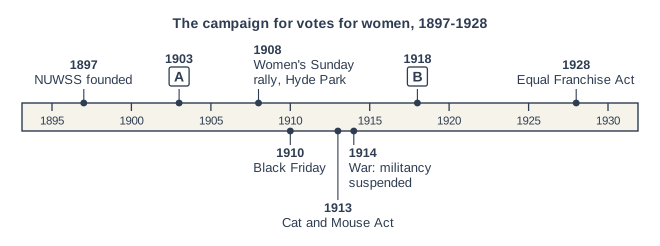
In the nineteenth and twentieth centuries ideas of democracy were central to the great campaigns, but economic hardship usually drove mass support. The radicals at Peterloo in 1819 demanded parliamentary reform, but the crowd of about 60,000 was swollen by poverty and high bread prices after the Corn Law of 1815. The Chartists' six points were a democratic programme, yet Chartism was strongest in years of depression, such as 1839 and 1842, and one Chartist called it a 'knife and fork question'. The suffrage movement is the clearest case of a challenge driven mainly by ideas: the suffragists and suffragettes demanded equal political rights for women, and their motive was principle rather than hunger. By contrast, the General Strike of 1926 was mainly about miners' wages and hours, and the Brixton riots of 1981 grew out of unemployment, poor housing and resentment of heavy-handed policing, although ideas of racial equality shaped the response.
In conclusion, ideas such as equality and democracy have been very important in giving challenges to authority their aims and in turning protests into movements, from John Ball to the Levellers, the Chartists and the suffragettes. However, they were the main factor only in some cases, especially the campaign for votes for women. More often people challenged authority because of economic hardship, religious change or the actions of rulers, and ideas gave shape to anger that these grievances had created.
Explanation
Ideas drove the Levellers, the American Revolution, the Chartists' programme and the suffrage campaign, but economic grievances (1381, 1536, Peterloo, Chartism, 1926, 1981), religion (1536, 1640s) and rulers' actions (1215) usually sparked challenges. Level 4 sustains a judgement across the whole period; SPaG is marked separately.