Has the economy been the main factor in causing protest and rebellion in Britain?
Explain your answer with reference to the economy and other factors. Use a range of examples from across your study of Power and the people: c1170 to the present day.
[16 marks] [SPaG 4 marks]
Model answer
Economic grievances, such as heavy taxation, low wages and hardship, have caused many of the most important protests and rebellions in British history. However, protest has also been driven by religion, by the actions of governments and by new ideas about rights and equality, and economic problems were often most powerful when they combined with these other factors.
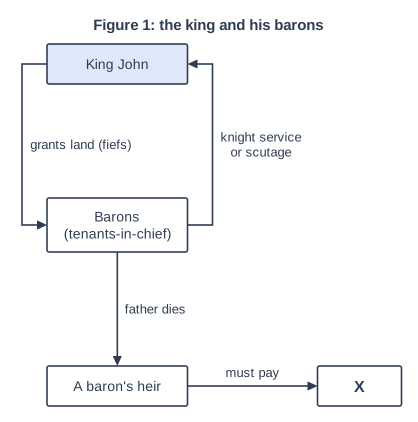
The rebellion against King John shows the importance of the economy, especially taxation. John needed money to win back Normandy, which he had lost in 1204, so he took scutage about 11 times, charged reliefs as high as the 10,000 marks demanded of Nicholas de Stuteville in 1205, sold the marriages of widows and heiresses, and in 1207 taxed a thirteenth of income and moveable goods. Many barons fell deeply into debt to the Crown. When John demanded the scutage of Poitou in 1214, the northern barons refused and the rebellion began. Many clauses of Magna Carta were economic: clause 2 limited reliefs to £100 for an earl's or a baron's heir, clause 8 protected widows, and clause 12 banned scutage without the common counsel of the kingdom.
The economy was also central to the Peasants' Revolt of 1381. After the Black Death of 1348-49 killed perhaps a third or more of the population, labourers could demand higher wages, but the Statute of Labourers of 1351 tried to hold wages at old levels. The poll taxes of 1377, 1379 and 1380, the last charging a shilling a head, were the final straw. In later centuries economic hardship caused protest again and again: post-war depression and high bread prices under the Corn Laws led to the mass meeting at Peterloo in 1819; the Chartists drew support from distressed workers in the industrial north; and the General Strike of 1926 was called in support of miners facing wage cuts and longer hours.
However, the economy was not always the main cause. Religion was the main reason for the Pilgrimage of Grace in 1536, when tens of thousands of northerners marched under the banner of the Five Wounds of Christ to protest against the dissolution of the monasteries, although taxation and enclosure added to their anger. Religion also mattered in the 1640s, when Puritans opposed Archbishop Laud's changes to the Church.
The actions of governments were also important. The barons in 1215 were angry not just at the cost of John's rule but at his arbitrary punishments, his use of hostages and the death of Matilda de Braose and her son in his prison, which is why clause 39 promised that no free man would be imprisoned without lawful judgement. Charles I's belief in the Divine Right of Kings and his eleven years of Personal Rule, collecting ship money without Parliament, turned a financial dispute into a constitutional one. In 1981 the Brixton riots followed unemployment, but the immediate cause was resentment at heavy-handed policing, which the Scarman Report later criticised.
Finally, ideas drove some of the most important protests. John Ball's preaching about equality inspired the rebels of 1381, the Levellers demanded votes for most men in the 1640s, and the campaign for women's suffrage after 1897 was about equal rights rather than economic hardship.
In conclusion, the economy has been the most common cause of protest and rebellion, especially taxation in the medieval period and wages and working conditions in the industrial age, and it was the trigger in 1215, 1381 and 1926. However, economic grievances usually became rebellion when they were combined with anger at unjust government or with new ideas about rights. The economy was the main factor, but rarely the only one.
Explanation
Economic grievances lie behind 1215 (scutage, reliefs), 1381 (the Statute of Labourers, poll taxes), Peterloo, Chartism and 1926, but religion (1536), unjust government (John's arbitrary rule, Charles I, Brixton policing) and ideas (Ball, the Levellers, suffrage) also caused protest. Level 4 needs a sustained judgement with examples from across the whole period.