
Level:
Correct: 0
Incorrect: 0
Marks: 0/0
Exam Practice
Course:
Topics:
Avg
score:
–
Topics
done:
0/15

Types and properties of electromagnetic waves

Practise 23 exam-style questions on Types and properties of electromagnetic waves for AQA GCSE Combined Science (Foundation Physics Paper 2). Write your answer as you would in the exam and get it marked in seconds against the mark scheme, point by point, with the Study Helper on hand if you get stuck.

  • 23 questions
  • 1–6 marks each
  • Instant marking
  • No sign-up needed
20 questions, marked as you go

Sample questions with model answers

Here are 4 of the questions in this topic, each with a model answer, an explanation of why it earns the marks and the mark scheme an examiner would use.

Question 1

1 mark

A ray of light travels from air into a glass block. The ray meets the surface of the block along the normal, at 90° to the surface.

What happens to the direction of the ray as it enters the glass?

Choose your answer.

  • It bends towards the normal
  • It bends away from the normal
  • It bends along the surface
  • It does not change direction

Model answer

It does not change direction

Explanation

Refraction changes the direction of a ray only when the ray meets a boundary at an angle to the normal. Along the normal the angle of incidence is 0°, so the ray carries straight on into the glass. A ray entering glass from air at an angle bends towards the normal; many students give that answer without noticing that this ray is along the normal.

Mark scheme
  1. 1 mark

    It does not change direction

    If more than one option is given, 0 marks. A ray that travels along the normal (angle of incidence 0°) passes into the glass without bending. 'It bends towards the normal' is the common wrong answer: that happens when the ray meets the glass at an angle. Light passing from air into glass does not bend away from the normal, and it does not bend along the surface.
Question 2

2 marks

Which two statements are true for all electromagnetic waves?

Give two answers from this list: A, B, C, D, E

A They are longitudinal waves.
B They are transverse waves.
C They all have the same frequency.
D They all travel at the same speed through a vacuum.
E They can only travel through a medium such as air or glass.

Model answer

B and D

Explanation

All electromagnetic waves are transverse, and they all travel at the same speed through a vacuum (space) or air, about 3 × 10⁸ m/s. They do not need a medium - light from the Sun crosses empty space - and each group has a different frequency and wavelength. Choosing A is a common mistake: sound in air is longitudinal, but electromagnetic waves are not.

Mark scheme
  1. 1 mark

    B (they are transverse waves)

    Allow the statement written out in words instead of the letter. This is a list question (right + wrong = wrong): each wrong extra answer (A, C or E) cancels one correct answer, so B, D, E scores 1 mark and A, B, D, E scores 0. A is wrong: sound in air is longitudinal, but all electromagnetic waves are transverse.

  2. 1 mark

    D (they all travel at the same speed through a vacuum)

    Allow the statement written out in words. C is wrong: each group has its own range of frequencies and wavelengths. E is wrong: electromagnetic waves can travel through a vacuum, for example light from the Sun crossing space.

Question 3

2 marks

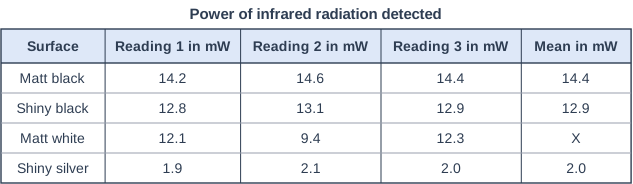
A student measured the infrared radiation emitted by each face of a Leslie cube full of hot water. The table shows her results. One of her readings is anomalous.

Calculate the mean value X for the matt white face.

Power of infrared radiation detected. Table with columns "Surface", "Reading 1 in mW", "Reading 2 in mW", "Reading 3 in mW", "Mean in mW". Surface: Matt black; Reading 1 in mW: 14.2; Reading 2 in mW: 14.6; Reading 3 in mW: 14.4; Mean in mW: 14.4 | Surface: Shiny black; Reading 1 in mW: 12.8; Reading 2 in mW: 13.1; Reading 3 in mW: 12.9; Mean in mW: 12.9 | Surface: Matt white; Reading 1 in mW: 12.1; Reading 2 in mW: 9.4; Reading 3 in mW: 12.3; Mean in mW: X | Surface: Shiny silver; Reading 1 in mW: 1.9; Reading 2 in mW: 2.1; Reading 3 in mW: 2.0; Mean in mW: 2.0.

Model answer

9.4 mW is anomalous, so it is left out.
X = (12.1 + 12.3) ÷ 2
X = 12.2 mW

Explanation

Leave an anomalous result out of a mean, then add the remaining readings and divide by how many there are. Including 9.4 mW gives 11.3 mW, which is lower than both of the good matt white readings - a sign that the anomaly has pulled the mean down.

Mark scheme
  1. 1 mark

    (12.1 + 12.3) ÷ 2, with the anomalous 9.4 left out

    allow 1 mark for 11.3 (or 11.27), the mean of all three readings including the anomalous result.

  2. 1 mark

    X = 12.2 (mW)

    A correct answer with no working scores full marks. Full marks are not awarded for a correct final answer from incorrect working.

Question 4

4 marks

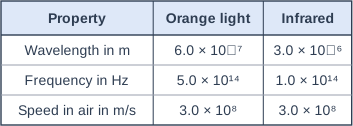
The table gives information about orange light and the infrared from an electric heater.

Compare orange light with infrared.

Use information from the table and your own knowledge.

Table with columns "Property", "Orange light", "Infrared". Property: Wavelength in m; Orange light: 6.0 × 10⁻⁷; Infrared: 3.0 × 10⁻⁶ | Property: Frequency in Hz; Orange light: 5.0 × 10¹⁴; Infrared: 1.0 × 10¹⁴ | Property: Speed in air in m/s; Orange light: 3.0 × 10⁸; Infrared: 3.0 × 10⁸.

Model answer

Orange light and infrared are both electromagnetic waves, so they are both transverse and both transfer energy from a source to an absorber. They travel at the same speed in air, 3.0 × 10⁸ m/s.
Infrared has a longer wavelength than orange light: 3.0 × 10⁻⁶ m compared with 6.0 × 10⁻⁷ m, which is 5 times as long. Infrared has a lower frequency: 1.0 × 10¹⁴ Hz compared with 5.0 × 10¹⁴ Hz, which is 5 times lower.
Our eyes can detect orange light, but they cannot detect infrared.

Explanation

A compare answer must say how the two waves are alike and how they differ, not describe each one separately. The top marks need the size of a difference: 3.0 × 10⁻⁶ ÷ 6.0 × 10⁻⁷ = 5, so the infrared wavelength is 5 times as long and its frequency is 5 times lower. Compare the powers of ten before the numbers in front (10⁻⁶ m is longer than 10⁻⁷ m), and remember that all electromagnetic waves travel at the same speed in air.

Mark scheme
  1. 4 marks

    Levels of response (4 marks).
    Level 2 (3-4 marks): Scientifically relevant features are identified; the way(s) in which they are similar / different is made clear and (where appropriate) the magnitude of the similarity / difference is noted.
    Level 1 (1-2 marks): Relevant features are identified and differences noted.
    No relevant content: 0 marks.

    Indicative content (not a checklist; credit other valid points):
    Similarities
    - both are electromagnetic waves
    - both are transverse waves
    - both transfer energy from a source to an absorber
    - both travel at the same speed in air, 3.0 × 10⁸ m/s
    - both can travel through a vacuum (space)
    Differences
    - infrared has a longer wavelength: 3.0 × 10⁻⁶ m compared with 6.0 × 10⁻⁷ m
    - the wavelength of infrared is 5 times as long
    - infrared has a lower frequency: 1.0 × 10¹⁴ Hz compared with 5.0 × 10¹⁴ Hz
    - the frequency of infrared is 5 times smaller (one fifth)
    - the eye can detect orange light but cannot detect infrared
    - in the spectrum, infrared is next to the red end of visible light, between visible light and microwaves
    To reach Level 2 the answer must give at least one similarity and at least one difference. For 4 marks the size of a difference should be noted (e.g. 5 times the wavelength). An answer that only describes each wave separately, without comparing, stays in Level 1.
    Common errors: saying the two waves travel at different speeds; comparing only the numbers in front of the powers of ten (3.0 and 6.0) and so saying infrared has the shorter wavelength or the higher frequency; saying infrared is not an electromagnetic wave. Full marks only if no incorrect statement contradicts a correct response.

Ready to try the rest? Every answer you write is marked against the mark scheme, so you can see exactly where the marks are.

Study Helper Hints first, answers after you try

Stuck on this one? Ask for a hint and I’ll point you in the right direction, without giving the answer away. Once you’ve checked your answer, I’ll show you how the marks are awarded.