Practise 22 exam-style questions on Electromagnetism for AQA GCSE Combined Science (Foundation Physics Paper 2). Write your answer as you would in the exam and get it marked in seconds against the mark scheme, point by point, with the Study Helper on hand if you get stuck.
22 questions
1–6 marks each
Instant marking
No sign-up needed
20 questions, marked as you go
Sample questions with model answers
Here are 4 of the questions in this topic, each with a model answer, an explanation of why it earns the marks and the mark scheme an examiner would use.
Question 1
1 mark
There is a current in a long solenoid.
Which of these describes the magnetic field inside the solenoid?
Choose your answer.
Strong and uniform
Weak and uniform
Strong and circular
There is no field inside
Model answer
Strong and uniform
Explanation
Inside a solenoid the field lines are straight, parallel and close together, so the field is strong and uniform: it has the same strength and direction everywhere inside. Shaping a wire into a solenoid makes the field of a current much stronger than around a straight wire.
Mark scheme
1 mark
Strong and uniform
If more than one option is given, 0 marks. Inside a solenoid the fields of all the turns add together, so the field is strong and uniform (the same strength and direction everywhere inside). Circular field lines are found around a single straight wire, and there is a field inside the coil.
Question 2
2 marks
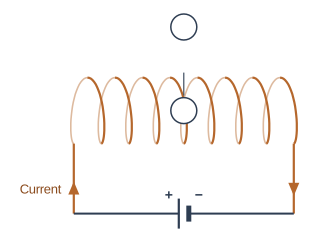
The diagram shows a solenoid connected to a cell. The ends of the solenoid are labelled N and S.
Compass X is inside the solenoid and compass Y is above it. The compass needles are not shown.
Describe the direction in which the north end of the needle will point in: - compass X - compass Y.
Model answer
Compass X: to the right, towards the N end of the solenoid. Compass Y: to the left, towards the S end of the solenoid.
Explanation
Outside a solenoid the field goes from the N end round to the S end, just like the field of a bar magnet, so compass Y points towards S. Field lines are closed loops, so inside the solenoid they carry on from the S end to the N end, and compass X points towards N. Many students think a compass inside the coil points towards S, as it would outside.
Mark scheme
1 mark
compass X: to the right / towards the N end of the solenoid
allow 'along the axis of the solenoid, from the S end to the N end'. do not accept 'towards the S end' for compass X.
1 mark
compass Y: to the left / towards the S end of the solenoid
allow 'parallel to the solenoid, from the N end to the S end'. do not accept 'towards the N end' for compass Y.
Question 3
2 marks
Priya tested whether adding more turns of wire to an electromagnet makes it pick up more paper clips. She used a variable resistor to keep the current the same for every test.
Give two other variables that Priya should keep the same.
Model answer
The iron nail used as the core, and the type and size of the paper clips.
Explanation
A control variable is anything other than the independent variable (the number of turns) that could affect the dependent variable (the number of paper clips picked up). The core, the paper clips and the wire must all stay the same for a fair test. The current is a control variable too, but the question has already given it.
Mark scheme
1 mark
the iron core (nail) used
allow 'the same nail' / 'the same core material' / 'the size of the core'.
1 mark
the type / size / mass of the paper clips
allow 'the same paper clips'.
1 mark
the type / thickness of the wire
allow 'the same insulated wire'.
1 mark
the spacing of the turns / how tightly the wire is wound
allow 'the length of the coil'.
1 mark
the way the paper clips are picked up (e.g. the nail dipped to the same depth in the same pile of clips)
max 2. This is a list question: each wrong or contradictory extra answer cancels a correct one; neutral extra answers are not penalised. ignore the current (it is given in the question). do not accept the number of turns (the independent variable) or the number of paper clips picked up (the dependent variable). ignore 'voltage' / 'potential difference' / 'the power supply'.
Question 4
4 marks
A straight wire with a current in it has a weak magnetic field.
Explain how winding the wire into a solenoid, and then putting an iron core inside the solenoid, increases the magnetic effect of the same current.
Model answer
A current in a wire produces a magnetic field around the wire. When the wire is wound into a solenoid, there are many turns of wire close together, and the magnetic fields of all the turns add together inside the coil. This makes the field inside the solenoid strong and uniform, and outside it the field is like that of a bar magnet. More turns would make it stronger still. Iron is a magnetic material. When an iron core is put inside the solenoid, the field of the solenoid magnetises the iron, so the iron becomes an induced magnet. The field of the magnetised iron adds to the field of the coil, so the field is much stronger. The solenoid with its iron core is an electromagnet.
Explanation
A good answer gives a reason for each change: the fields of the many turns add together, and the iron core is magnetised and adds its own field. The current stays the same, so answers that say the coil or the core 'increases the current' are wrong. Simply writing 'it makes it a stronger magnet' gives no reason and stays in Level 1.
Mark scheme
4 marks
Levels of response (4 marks). Level 2 (3-4 marks): Relevant points (reasons / causes) are identified, given in detail and logically linked to form a clear account. Level 1 (1-2 marks): Points are identified and stated simply, but their relevance is not clear and there is no attempt at logical linking. No relevant content: 0 marks.
Indicative content (not a checklist; credit other valid points): Solenoid - the current produces a magnetic field around every part of the wire - winding the wire into a coil puts many turns close together - the magnetic fields of all the turns add together (combine) inside the coil - so the field inside the solenoid is strong and uniform - outside, the field is like that of a bar magnet, with a north pole at one end and a south pole at the other - more turns (closer together) give a stronger field Iron core - iron is a magnetic material, so it becomes an induced magnet (is magnetised) in the field of the solenoid - the field of the magnetised iron adds to the field of the coil, so the field is much stronger - a solenoid with an iron core is an electromagnet For Level 2, both the solenoid and the iron core must be explained, each with a reason (e.g. the fields of the turns add together; the iron becomes magnetised). Start at the lowest level and use best fit; students do not need to cover every point to reach the top level; full marks only if no statement contradicts a correct one. Common errors: saying that the coil or the iron core increases the current; saying that the iron core is a permanent magnet; writing 'it makes a stronger magnet' with no reason.
Ready to try the rest? Every answer you write is marked against the mark scheme, so you can see exactly where the marks are.
Ctrl + Enter to check
Study HelperHints first, answers after you try
Stuck on this one? Ask for a hint and I’ll point you in the right direction, without giving the answer away. Once you’ve checked your answer, I’ll show you how the marks are awarded.