Level:
Correct: 0
Incorrect: 0
Marks: 0/0
Exam Practice
Course:
Topics:
Avg
score:
–
Topics
done:
0/15

Properties of waves

Practise 23 exam-style questions on Properties of waves for AQA GCSE Combined Science (Foundation Physics Paper 2). Write your answer as you would in the exam and get it marked in seconds against the mark scheme, point by point, with the Study Helper on hand if you get stuck.

  • 23 questions
  • 1–6 marks each
  • Instant marking
  • No sign-up needed
20 questions, marked as you go

Sample questions with model answers

Here are 4 of the questions in this topic, each with a model answer, an explanation of why it earns the marks and the mark scheme an examiner would use.

Question 1

1 mark

Which equation links wave speed, frequency and wavelength?

Choose your answer.

  • wave speed = frequency ÷ wavelength
  • wave speed = wavelength ÷ frequency
  • wave speed = frequency + wavelength
  • wave speed = frequency × wavelength

Model answer

wave speed = frequency × wavelength

Explanation

All waves obey the wave equation: wave speed = frequency × wavelength (v = f λ), with speed in m/s, frequency in Hz and wavelength in m. A quick check: if 10 waves pass each second and each is 2 m long, the wave moves 20 m each second.

Mark scheme
  1. 1 mark

    wave speed = frequency × wavelength

    If more than one option is given, 0 marks. Dividing frequency by wavelength (or wavelength by frequency) or adding them does not give the wave speed: frequency in Hz (waves per second) multiplied by wavelength in m gives m/s.

Question 2

2 marks

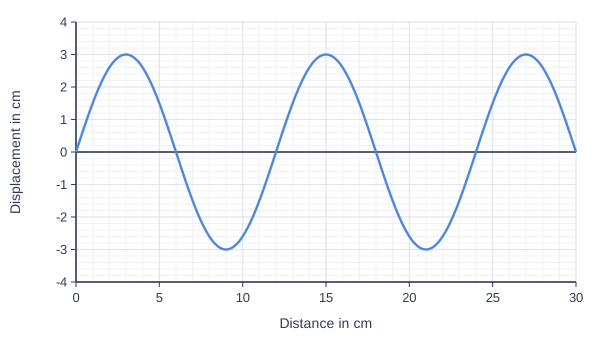
The graph shows the shape of a wave on a rope at one instant.

Determine the amplitude and the wavelength of the wave. Give both answers in cm.

Graph of displacement in cm (y-axis, -4 to 4) against distance in cm (x-axis, 0 to 30), on a grid. A wave is drawn as a smooth, regular sine-shaped curve centred on the zero line; its values can be read from the grid.

Model answer

Amplitude = 3 cm (from the zero line to the top of a crest).
Wavelength = 12 cm (for example, from the crest at 3 cm to the next crest at 15 cm).

Explanation

Read the amplitude from the zero (rest) line to a crest, not from a trough to a crest. Read the wavelength as the horizontal distance for one complete wave, e.g. from one crest to the next, or across 2 waves (24 cm) and divide by 2. Giving 6 cm for either value is the usual mistake.

Mark scheme
  1. 1 mark

    amplitude = 3 (cm)

    allow 3.0 (cm). do not accept 6 cm (the crest-to-trough height).

  2. 1 mark

    wavelength = 12 (cm)

    allow 11.5 to 12.5 (cm). do not accept 6 cm (half a wavelength, from one crossing of the zero line to the next). allow the two answers in either order if each is clearly labelled.

Question 3

2 marks

A student uses a ripple tank. The dipper makes about 15 ripples each second.

The student plans to find the frequency by counting the number of ripples that pass a mark on the side of the tank in 10 seconds, using a stopwatch.

Suggest why this method is not suitable, and suggest a better way to measure the frequency.

Model answer

About 15 ripples pass the mark every second, which is too fast to count accurately by eye. A better way is to film the ripples with a timer in view, play the video back in slow motion and count how many ripples pass a point in a measured time.

Explanation

Frequency is the number of waves passing a point each second, but at about 15 Hz the ripples pass far too fast to count. Slowing them down (a slow-motion video) or 'freezing' them (a stroboscope set to the same frequency) makes the measurement possible. Simply counting for longer does not solve the problem.

Mark scheme
  1. 1 mark

    the ripples pass too quickly to count accurately (about 15 each second / 150 in 10 s)

    allow 'there are too many ripples to count'.

  2. 1 mark

    film the ripples (with a timer in view) and play the video back in slow motion, counting the ripples that pass a point in a measured time / use a stroboscope and adjust its frequency until the ripples appear to stand still: the stroboscope frequency is then the ripple frequency

    for the stroboscope, the ripple frequency is the highest flash frequency at which the ripples appear to stand still; the student need not say 'highest'. ignore 'use a better stopwatch' / 'count for longer' (the ripples would still be too fast to count). do not accept 'use a ruler'.

Question 4

4 marks

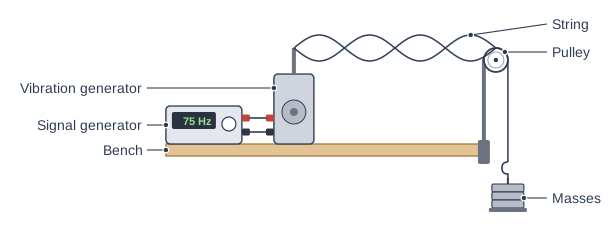
The diagram shows apparatus used to investigate waves on a string. The vibration generator makes the string vibrate at the frequency shown on the signal generator.

The string forms four loops. Each loop is half a wavelength. A student uses a metre rule to measure the length of the vibrating string, from the vibration generator to the pulley:

length of the vibrating string = 960 mm

Calculate the speed of the waves on the string.

Use the equation:

wave speed = frequency × wavelength

Diagram of the apparatus for measuring the speed of waves on a string. A signal generator (display reading 75 Hz) is connected to a vibration generator whose rod is attached to one end of a horizontal string. The string runs over a pulley at the end of the bench to 3 slotted masses hanging on the end. The string shows a standing wave of 4 loops (5 nodes, with nodes at the vibrator end and at the pulley). Labelled parts: Signal generator, Vibration generator, Bench, String, Pulley, Masses.

Model answer

one loop = 960 ÷ 4 = 240 mm
wavelength = 2 × 240 = 480 mm = 0.48 m
wave speed = 75 × 0.48
wave speed = 36 m/s

Explanation

Read the frequency, 75 Hz, from the signal generator. Each loop is half a wavelength, so one wavelength is two loops: 2 × 240 mm = 480 mm = 0.48 m. Then 75 × 0.48 = 36 m/s. Measuring all four loops and dividing gives a more accurate loop length than measuring one loop.

Mark scheme
  1. 1 mark

    wavelength = 2 × (960 ÷ 4) = 480 mm

    allow 'one loop = 240 mm, so wavelength = 480 mm'. a correct answer with no working scores full marks.

  2. 1 mark

    480 mm = 0.48 m

    allow 0.480 m. allow ecf: a correct conversion of their wavelength (e.g. 0.24 m).

  3. 1 mark

    wave speed = 75 × 0.48

    allow ecf from their wavelength. allow a correct substitution using an incorrectly / not converted value (e.g. 75 × 480).

  4. 1 mark

    wave speed = 36 (m/s)

    allow ecf / a correct calculation using an incorrectly / not converted value (e.g. 36 000). full marks are not awarded for a correct final answer from incorrect working. common errors: 18 m/s (taking one loop as a whole wavelength) and 72 m/s (taking the whole string as one wavelength) each score 3 marks.

Ready to try the rest? Every answer you write is marked against the mark scheme, so you can see exactly where the marks are.

Revision notes

Properties of waves

The big idea

Every wave can be described by its amplitude, wavelength, frequency and period. The wave equation links frequency and wavelength to wave speed, and it works for every kind of wave. You also need to describe how to measure the speed of sound in air and the speed of ripples on water.

Describing a wave

Diagram of a transverse wave: a smooth wave drawn either side of a dashed horizontal line through its middle, showing 2.5 complete waves (3 crests and 2 troughs). A horizontal double-headed arrow from the top of one crest to the top of the next crest, labelled "Wavelength". A vertical double-headed arrow beside the wave, from the level of the centre line up to the level of the top of a crest (dashed guide lines), labelled "Amplitude". Pointing to one of the highest points of the wave, labelled "Crest". Pointing to one of the lowest points of the wave, labelled "Trough". At the end of the dashed horizontal line through the middle of the wave, labelled "Rest position".
The amplitude is measured from the rest position to a crest; the wavelength is one complete wave.
TermMeaning
AmplitudeThe maximum displacement of a point on a wave away from its undisturbed (rest) position
Wavelength, \(\lambda\)The distance from a point on one wave to the equivalent point on the adjacent wave, such as crest to crest (or compression to compression)
Frequency, \(f\)The number of waves passing a point each second
Period, \(T\)The time taken for one complete wave to pass a point
Wave speed, \(v\)The speed at which the energy is transferred (or the wave moves) through the medium

Period and frequency are linked by \(\text{period} = \dfrac{1}{\text{frequency}}\), \(T = \dfrac{1}{f}\) (period, \(T\), in seconds, s; frequency, \(f\), in hertz, Hz). This equation is given on the Physics equation sheet.

The wave equation

All waves obey:

\[\text{wave speed} = \text{frequency} \times \text{wavelength} \qquad v = f\lambda\]
  • wave speed, \(v\), in metres per second, m/s
  • frequency, \(f\), in hertz, Hz
  • wavelength, \(\lambda\), in metres, m

You must recall this equation. Convert units first: kHz to Hz (× 1000), MHz to Hz (× 10⁶), cm to m (÷ 100), ms to s (÷ 1000).

The speed of a wave depends on the medium, not the source. At a fixed speed, a higher frequency means a shorter wavelength. Amplitude has no effect on speed, frequency or wavelength.

Waves passing a pier

From the end of a pier, a student sees that the distance from the first crest to the fifth crest is 36 m. A new crest reaches the pier every 3.0 s. Calculate the speed of the waves.

From the first crest to the fifth there are 4 wavelengths, not 5: \(\lambda = 36 \div 4 = 9.0\) m

The period is 3.0 s, so \(f = \dfrac{1}{T} = \dfrac{1}{3.0} = 0.333\ldots\) Hz (keep the unrounded value)

\(v = f\lambda = 0.333\ldots \times 9.0 = 3.0\) m/s

Measuring the speed of waves

Speed of sound in air: two students stand at least 100 m apart (measured with a trundle wheel). One bangs two cymbals together; the other starts a stopwatch on seeing them meet and stops it on hearing the sound. Repeat, find the mean time and use \(\text{speed} = \dfrac{\text{distance}}{\text{time}}\) (recall this, from \(s = vt\)). The long distance makes the time large compared with reaction time; the light arrives almost instantly. Two microphones and a data logger remove the reaction time error.

Required practical: Waves in a ripple tank and on a string

Ripple tank: a motor vibrates a wooden bar (the dipper) to make ripples. A lamp above the tank casts the pattern of ripples onto white paper below.

  • Wavelength: measure across several waves (for example 10) with a ruler on the paper and divide by the number of waves. A stroboscope or a photo "freezes" the pattern.
  • Frequency: count the waves passing a point in 10 s and divide by 10.
  • Speed: \(v = f\lambda\). Keep the frequency low so the waves are easy to see.

Waves on a string: a vibration generator, set by a signal generator, shakes a string that runs over a pulley to hanging masses. Adjust the frequency until a clear standing wave appears.

Diagram of the apparatus for measuring the speed of waves on a string. A signal generator is connected to a vibration generator whose rod is attached to one end of a horizontal string. The string runs over a pulley at the end of the bench to 3 slotted masses hanging on the end. The string shows a standing wave of 3 loops (4 nodes, with nodes at the vibrator end and at the pulley). Labelled parts: Signal generator, Vibration generator, Bench, String, Pulley, Masses.
Three loops make one and a half wavelengths along the string.
  • Each loop is half a wavelength: measure across as many loops as possible, find the length of one loop, then double it.
  • Read the frequency from the signal generator and use \(v = f\lambda\).

Safety: keep the water away from the mains supply and mop up spills; a flashing stroboscope can trigger seizures; keep feet clear of the hanging masses.

Physics only: when sound passes from one medium into another, its frequency stays the same, because it is set by the source. The speed changes, so the wavelength changes in the same proportion (\(v = f\lambda\)). Sound travels fastest in solids and slowest in gases, so its wavelength is longest in solids.

Physics only: sound passing into a lake

A boat's horn makes a sound with a wavelength of 0.50 m in air, where the speed of sound is 340 m/s. The sound passes into a lake, where its wavelength is 2.2 m. Calculate the speed of sound in the water.

Frequency in air: \(f = \dfrac{v}{\lambda} = \dfrac{340}{0.50} = 680\) Hz

The frequency is the same in the water, so \(v = f\lambda = 680 \times 2.2 = 1496 \approx 1500\) m/s (2 significant figures)

Common mistakes

  • Measuring the amplitude from a crest to a trough. That is twice the amplitude: measure from the rest position.
  • Calling crest-to-crest on a displacement-time graph the wavelength. With time on the axis, it is the period.
  • Leaving a wavelength in cm, a frequency in kHz or a period in ms. Convert to m, Hz and s first.
  • Taking one loop of a standing wave as a whole wavelength. One loop is half a wavelength.
  • Saying the frequency changes when sound enters a new medium. The frequency stays the same; the speed and wavelength change.

Exam tip

In calculations, write the equation, substitute the values in the correct units and give the unit with your answer. In a 6-mark method question, name the equipment, say exactly what you measure, how you calculate the speed, and how you make the result more accurate (a long distance, many waves, repeats).

Study Helper Hints first, answers after you try

Stuck on this one? Ask for a hint and I’ll point you in the right direction, without giving the answer away. Once you’ve checked your answer, I’ll show you how the marks are awarded.