
Level:
Correct: 0
Incorrect: 0
Marks: 0/0
Exam Practice
Course:
Topics:
Avg
score:
–
Topics
done:
0/15

Factors affecting braking distance

Practise 21 exam-style questions on Factors affecting braking distance for AQA GCSE Combined Science (Foundation Physics Paper 2). Write your answer as you would in the exam and get it marked in seconds against the mark scheme, point by point, with the Study Helper on hand if you get stuck.

  • 21 questions
  • 1–6 marks each
  • Instant marking
  • No sign-up needed
20 questions, marked as you go

Sample questions with model answers

Here are 4 of the questions in this topic, each with a model answer, an explanation of why it earns the marks and the mark scheme an examiner would use.

Question 1

1 mark

Which is the best estimate of the braking distance of a car travelling at 70 mph on a dry road?

Choose your answer.

  • ~8 m
  • ~80 m
  • ~800 m
  • ~8000 m

Model answer

~80 m

Explanation

The symbol ~ means 'approximately'. The Highway Code's typical braking distance at 70 mph is 75 m, about 19 car lengths, so ~80 m is the best estimate. Knowing rough values like this helps drivers understand why they must leave a big gap at high speeds.

Mark scheme
  1. 1 mark

    ~80 m

    If more than one option is given, 0 marks. Allow '80 m' or 'about 80 m'. The Highway Code gives a typical braking distance of 75 m at 70 mph. ~8 m is closer to the braking distance at about 20 mph (6 m); ~800 m and ~8000 m are far too long.
Question 2

2 marks

The brake pads on a car are badly worn.

Explain why the braking distance of the car is longer than it would be with new brake pads.

Model answer

Worn brake pads produce less friction against the disc, so the braking force is smaller. A smaller braking force gives a smaller deceleration, so the car slows down more slowly and travels further before it stops.

Explanation

The chain of reasoning is: less friction, so a smaller braking force, so a smaller deceleration, so a longer braking distance. Poor condition of the brakes or tyres is a factor that increases braking distance. A common mistake is to say worn brakes increase the thinking distance - the thinking distance depends only on the driver's reaction time and the speed.

Mark scheme
  1. 1 mark

    there is less friction between the brake pads and the disc / wheel, so the braking force is smaller

    Allow 'the brakes do not grip as well, so the braking force is smaller'.

  2. 1 mark

    so the deceleration is smaller / the car slows down more slowly (so it travels further before stopping)

    Do not accept 'the driver reacts more slowly' (worn brakes do not affect reaction time).

Question 3

2 marks

A delivery van is fully loaded with parcels. The driver brakes with the same braking force as when the van is empty.

Explain why the braking distance of the loaded van is longer than the braking distance of the empty van, from the same speed.

Model answer

The loaded van has a greater mass. With the same braking force, F = m a means its deceleration is smaller, so it slows down more slowly and travels further before it stops.

Explanation

For a fixed braking force, acceleration is inversely proportional to mass, so a heavier vehicle decelerates less. Another way to see it: at the same speed the loaded van has more kinetic energy, so the brakes must do more work, and with the same force that needs a longer distance. Either chain of reasoning earns both marks.

Mark scheme
  1. 1 mark

    the loaded van has a greater mass, so (for the same braking force) its deceleration is smaller (F = m a)

    Allow 'the loaded van has more kinetic energy (at the same speed)'.

  2. 1 mark

    so it travels further before it stops / more work must be done, so with the same force the distance must be greater (W = F s)

    Do not accept 'the loaded van is heavier so the driver reacts more slowly'.

Question 4

3 marks

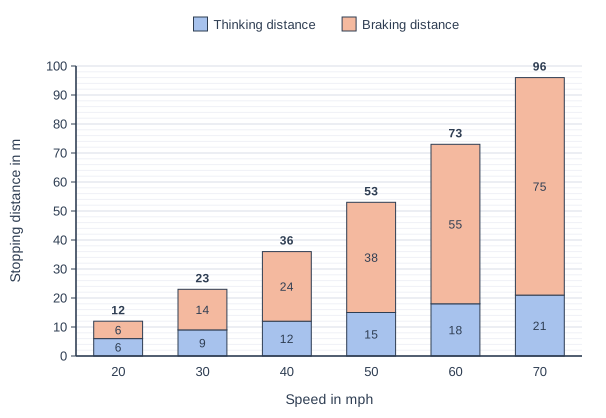
The chart shows the typical stopping distances for a car on a dry road, given in the Highway Code (Department for Transport).

The Highway Code also says that in wet weather 'stopping distances will be at least double those required for stopping on dry roads'.

A car is travelling at 50 mph on a wet road. Assume that:
- its stopping distance is double its stopping distance on a dry road
- the driver's thinking distance is the same as on a dry road.

Calculate the braking distance of the car on the wet road.

Use the equation:

stopping distance = thinking distance + braking distance

Stacked bar chart with 6 vertical bars. The value axis (y-axis) is "Stopping distance in m", from 0 to 100 marked every 10; the bars are labelled along the x-axis, "Speed in mph", from left to right. Each bar is split into 2 parts, shown in the key: Thinking distance (bottom, blue) and Braking distance (top, orange). Values: 20 mph: thinking distance 6 m, braking distance 6 m, total 12 m; 30 mph: thinking distance 9 m, braking distance 14 m, total 23 m; 40 mph: thinking distance 12 m, braking distance 24 m, total 36 m; 50 mph: thinking distance 15 m, braking distance 38 m, total 53 m; 60 mph: thinking distance 18 m, braking distance 55 m, total 73 m; 70 mph: thinking distance 21 m, braking distance 75 m, total 96 m. The value of each part is printed on it. Each bar's total is printed above it.

Model answer

Dry stopping distance at 50 mph = 15 + 38 = 53 m
Wet stopping distance = 2 × 53 = 106 m
stopping distance = thinking distance + braking distance
106 = 15 + braking distance
braking distance = 106 - 15 = 91 m

Explanation

The Highway Code doubles the whole stopping distance, not just the braking distance. A wet road does not change the driver's reaction time, so the thinking distance stays at 15 m and all of the extra distance is braking distance: 106 - 15 = 91 m, about 2.4 times the dry braking distance of 38 m. Doubling only the braking distance (76 m) is the common error. Water reduces the grip between the tyres and the road, so the deceleration is smaller and the car travels further while braking.

Mark scheme
  1. 1 mark

    wet stopping distance = 2 × 53 = 106 (m)

    53 m (15 m + 38 m) is the dry stopping distance at 50 mph read from the chart. Allow 2 × (15 + 38).

  2. 1 mark

    106 = 15 + braking distance

    Substitution mark, using the thinking distance of 15 m read from the chart. Allow braking distance = 106 - 15. Allow ecf from their wet stopping distance.

  3. 1 mark

    braking distance = 91 (m)

    Allow ecf from their wet stopping distance. 76 m scores 1 mark at most: it comes from doubling only the braking distance (2 × 38), which is not what the Highway Code says, or from doubling the thinking distance as well (106 - 30). A correct answer with no working scores full marks (3 marks). Full marks are not awarded for a correct final answer from incorrect working.

Ready to try the rest? Every answer you write is marked against the mark scheme, so you can see exactly where the marks are.

Study Helper Hints first, answers after you try

Stuck on this one? Ask for a hint and I’ll point you in the right direction, without giving the answer away. Once you’ve checked your answer, I’ll show you how the marks are awarded.