
Level:
Correct: 0
Incorrect: 0
Marks: 0/0
Exam Practice
Course:
Topics:
Avg
score:
–
Topics
done:
0/15

Scalar and vector quantities, and contact and non-contact forces

Practise 19 exam-style questions on Scalar and vector quantities, and contact and non-contact forces for AQA GCSE Combined Science (Foundation Physics Paper 2). Write your answer as you would in the exam and get it marked in seconds against the mark scheme, point by point, with the Study Helper on hand if you get stuck.

  • 19 questions
  • 1–6 marks each
  • Instant marking
  • No sign-up needed
19 questions, marked as you go

Sample questions with model answers

Here are 4 of the questions in this topic, each with a model answer, an explanation of why it earns the marks and the mark scheme an examiner would use.

Question 1

1 mark

Which of these describes a vector quantity?

Choose your answer.

  • A mass of 3 kg
  • A temperature of 20 °C
  • An energy of 500 J
  • A force of 6 N to the left

Model answer

A force of 6 N to the left

Explanation

A vector quantity has magnitude and direction. Only the force is given with a direction. Every quantity in the list has a size and a unit, so having a number and a unit does not make a quantity a vector.

Mark scheme
  1. 1 mark

    A force of 6 N to the left

    If more than one option is given, 0 marks. A force of 6 N to the left has a magnitude (6 N) and a direction (to the left), so it is a vector. Mass, temperature and energy have magnitude only, so they are scalars, even though each has a number and a unit.
Question 2

2 marks

Every force between two objects can be sorted into one of two groups: contact forces and non-contact forces.

Describe the difference between a contact force and a non-contact force.

Model answer

For a contact force the objects must be physically touching, for example friction between a shoe and the floor. For a non-contact force the objects are physically separated, for example the gravitational force between the Earth and the Moon.

Explanation

Both kinds of force come from an interaction between two objects; the difference is whether the objects touch. Friction, air resistance, tension and normal contact force are contact forces; gravitational, electrostatic and magnetic forces are non-contact forces. Giving only examples, without saying what the difference is, does not answer the question.

Mark scheme
  1. 1 mark

    contact force: the objects are (physically) touching

    allow 'the objects must touch for the force to act'

  2. 1 mark

    non-contact force: the objects are (physically) separated / do not need to touch

    allow 'acts at a distance' / 'acts across a gap'. Ignore examples given without a description (e.g. 'friction is a contact force and gravity is a non-contact force' scores 0). Do not accept 'a non-contact force does not need another object' (every force comes from an interaction between two objects).

Question 3

2 marks

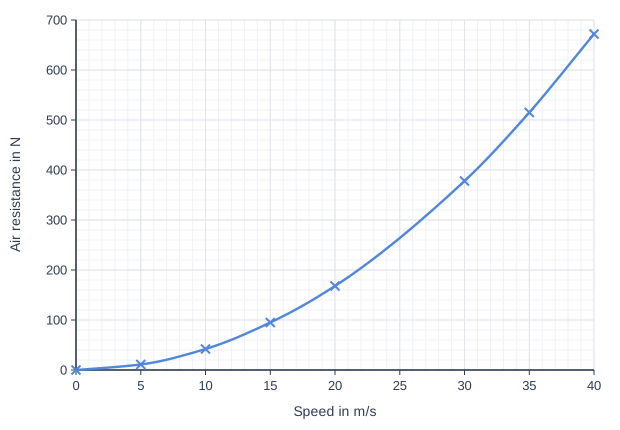
Engineers measured the air resistance acting on a car at different speeds.

The graph shows their results.

Describe how the air resistance on the car changes as the speed of the car increases.

Line graph of Air resistance in N (y-axis, 0 to 700) against speed in m/s (x-axis, 0 to 40). The line is a smooth curve through (0, 0), (5, 11), (10, 42), (15, 95), (20, 168), (30, 378), (35, 515), (40, 672).

Model answer

As the speed increases, the air resistance increases. It increases more and more quickly at higher speeds: doubling the speed from 10 m/s to 20 m/s makes the air resistance four times bigger, from 42 N to 168 N.

Explanation

First give the trend, then describe the shape of the curve. The graph is a curve that gets steeper, so the air resistance is not directly proportional to the speed. Quoting values from the graph is a good way to show this.

Mark scheme
  1. 1 mark

    air resistance increases as speed increases

    ignore 'the air resistance changes'

  2. 1 mark

    it increases more and more quickly (at higher speeds) / the curve gets steeper

    allow 'it is not (directly) proportional to speed'. allow a correct use of data, e.g. doubling the speed from 10 m/s to 20 m/s makes the air resistance 4 times bigger (42 N to 168 N). Do not accept 'air resistance is (directly) proportional to speed'.

Question 4

3 marks

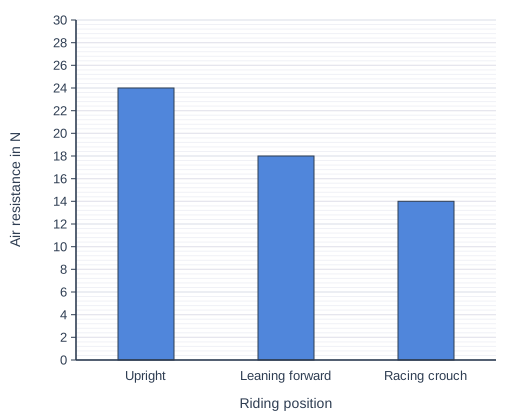
A cyclist rides at a speed of 10 m/s in three different positions.

The bar chart shows the air resistance on the cyclist in each position.

Calculate the percentage decrease in air resistance when the cyclist changes from the upright position to the racing crouch.

Use the equation:

percentage decrease = (decrease in air resistance ÷ air resistance when upright) × 100

Bar chart of Air resistance in N for each riding position: Upright 24, Leaning forward 18, Racing crouch 14.

Model answer

decrease = 24 − 14 = 10 N
percentage decrease = (10 ÷ 24) × 100
percentage decrease = 41.7%

Explanation

Read both bars carefully (24 N and 14 N), find the decrease, then divide by the starting value - the upright position - not by the final value. In the racing crouch the cyclist presents a smaller area to the air, so the air resistance is much smaller.

Mark scheme
  1. 1 mark

    decrease = 24 − 14 = 10 (N)

  2. 1 mark

    percentage decrease = (10 ÷ 24) × 100

    allow ecf from an incorrect decrease or incorrect readings from the bar chart

  3. 1 mark

    percentage decrease = 41.7 (%)

    allow 42 (%) / 41.6 (%). A correct answer with no working scores full marks. Full marks are not awarded for a correct final answer from incorrect working. 71.4 (%), from dividing by 14, scores 1 mark. 58.3 (%), from (14 ÷ 24) × 100, scores 0.

Ready to try the rest? Every answer you write is marked against the mark scheme, so you can see exactly where the marks are.

Study Helper Hints first, answers after you try

Stuck on this one? Ask for a hint and I’ll point you in the right direction, without giving the answer away. Once you’ve checked your answer, I’ll show you how the marks are awarded.