Practise 20 exam-style questions on Transverse and longitudinal waves for AQA GCSE Combined Science (Foundation Physics Paper 2). Write your answer as you would in the exam and get it marked in seconds against the mark scheme, point by point, with the Study Helper on hand if you get stuck.
20 questions
1–6 marks each
Instant marking
No sign-up needed
20 questions, marked as you go
Sample questions with model answers
Here are 4 of the questions in this topic, each with a model answer, an explanation of why it earns the marks and the mark scheme an examiner would use.
Question 1
1 mark
The diagram shows a wave travelling along a stretched slinky spring. The lines show the coils of the spring.
What is the region labelled X?
Choose your answer.
A compression
A rarefaction
A crest
A trough
Model answer
A rarefaction
Explanation
This is a longitudinal wave: the coils are bunched together in some places (compressions) and spread out in others (rarefactions). X is over a region where the coils are furthest apart, so it is a rarefaction. Many students can spot a compression but mislabel the rarefaction - look for where the lines are widest apart.
Mark scheme
1 mark
A rarefaction
If more than one option is given, 0 marks. At X the coils are most spread out, so X is a rarefaction. A compression is where the coils are bunched closest together. A crest and a trough are the highest and lowest points of a transverse wave, not parts of a longitudinal wave.
Question 2
2 marks
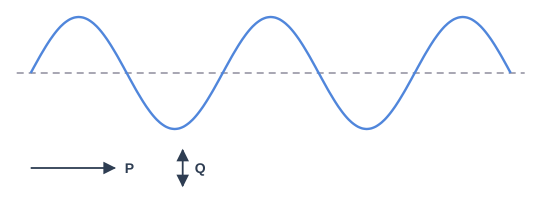
The diagram shows a transverse wave travelling along a rope. The dashed line shows the position of the rope when there is no wave.
Describe what arrow P and arrow Q show.
Model answer
Arrow P shows the direction in which the wave travels, which is the direction of energy transfer. Arrow Q shows the direction in which the rope vibrates: each part of the rope moves up and down as the wave passes.
Explanation
On a wave diagram, a single-headed arrow along the wave shows the direction of travel (energy transfer), and a double-headed arrow shows how the medium vibrates. The rope itself is not carried along in direction P; each piece just moves up and down. Q is not the amplitude, which is measured from the dashed rest line to the top of a crest.
Mark scheme
1 mark
P shows the direction the wave travels / the direction in which the wave transfers energy
allow 'the direction of the wave'. do not accept 'P shows the direction the rope moves' / 'the rope travels to the right' (the rope is not carried along with the wave). do not accept 'P is the wavelength'.
1 mark
Q shows the direction in which the rope vibrates / oscillates / moves up and down (as the wave passes)
allow 'the up and down movement (of the rope or its particles)' / 'the vibration'. do not accept 'Q is the amplitude' (the amplitude is measured from the dashed rest line to the top of a crest) / 'Q is the height of the wave'.
Question 3
2 marks
Ripples on a pond are transverse waves. Sound waves in air are longitudinal waves.
Give two ways in which ripples and sound waves are similar.
Model answer
Both ripples and sound waves transfer energy from one place to another. In both, the material does not travel with the wave: the water or the air particles only vibrate about fixed positions while the wave moves on.
Explanation
Although one is transverse and the other longitudinal, all waves transfer energy without carrying the material (the water or the air) along with them. 'They are both waves' or 'they both travel' is too vague to score.
Mark scheme
1 mark
both transfer energy (from one place to another / away from the source)
1 mark
in both, the material does not travel with the wave / the water and the air (particles) only vibrate about fixed positions / it is the wave and not the water or air that travels
1 mark
both can be described by their amplitude / wavelength / frequency / period / speed
this is one similarity: naming two or more of these properties (e.g. 'both have a wavelength and a frequency') still scores only this one mark. max 2. ignore 'they are both waves' / 'they both travel' / 'they both spread out'. do not accept 'both are transverse' / 'both are longitudinal' / 'both have compressions and rarefactions' / 'both carry water or air with them'. list rule: each wrong statement cancels a correct one.
Question 4
4 marks
A student beats a large drum at one end of a sports hall. The sound travels 40 m to the other end of the hall.
As the sound passes, each air particle moves backwards and forwards. In the middle of the hall, an air particle moves no more than about 0.01 mm from its rest position.
Calculate how many times greater the distance the sound travels is than the greatest distance an air particle moves from its rest position. Give your answer in standard form.
Then explain what your answer shows about sound waves in air.
Model answer
0.01 mm = 0.000 01 m 40 ÷ 0.000 01 = 4 000 000 = 4 × 10⁶ The sound travels about 4 million times further than any air particle moves. The air particles only vibrate backwards and forwards about fixed positions, so the air does not travel across the hall: it is the wave, transferring energy, that travels 40 m.
Explanation
Put both distances in the same unit first: 0.01 mm = 0.000 01 m (or 40 m = 40 000 mm). Dividing gives 4 000 000, which is 4 × 10⁶ in standard form. Forgetting to convert gives 4000. The huge ratio shows that the air particles hardly move while the sound wave crosses the whole hall.
Mark scheme
1 mark
0.01 mm = 0.000 01 m / 40 m = 40 000 mm
allow 1 × 10⁻⁵ m. a correct answer with no working scores full marks for the first three marking points.
allow a correct calculation using an incorrectly / not converted value (e.g. 40 ÷ 0.01 = 4000).
1 mark
4 × 10⁶
allow 4.0 × 10⁶. the answer must be in standard form for this mark. allow ecf: their value correctly written in standard form (e.g. 4 × 10³ from not converting scores this mark and the previous one). full marks are not awarded for a correct final answer from incorrect working.
1 mark
the air particles only vibrate a tiny distance about fixed positions, so the air does not travel with the sound / it is the wave (energy) that travels 40 m, not the air
this mark can be awarded even if the calculation is wrong. do not accept 'the air travels to the other end of the hall'.
Ready to try the rest? Every answer you write is marked against the mark scheme, so you can see exactly where the marks are.
Ctrl + Enter to check
Study HelperHints first, answers after you try
Stuck on this one? Ask for a hint and I’ll point you in the right direction, without giving the answer away. Once you’ve checked your answer, I’ll show you how the marks are awarded.