Practise 24 exam-style questions on Forces and elasticity for AQA GCSE Combined Science (Foundation Physics Paper 2). Write your answer as you would in the exam and get it marked in seconds against the mark scheme, point by point, with the Study Helper on hand if you get stuck.
24 questions
1–6 marks each
Instant marking
No sign-up needed
20 questions, marked as you go
Sample questions with model answers
Here are 4 of the questions in this topic, each with a model answer, an explanation of why it earns the marks and the mark scheme an examiner would use.
Question 1
1 mark
A spring extends by 3.5 cm when a force of 1.5 N acts on it. The limit of proportionality is not exceeded.
Predict the extension of the spring when the force on it is 4.5 N.
Model answer
4.5 N is 3 times 1.5 N, so the extension is 3 × 3.5 cm = 10.5 cm.
Explanation
Below the limit of proportionality, extension is directly proportional to force. The force is three times bigger (4.5 ÷ 1.5 = 3), so the extension is three times bigger: 10.5 cm.
Mark scheme
1 mark
10.5 (cm)
allow 0.105 m. A correct answer with no working scores the mark. 7.0 cm (adding 3.5 cm for the extra force) scores 0.
Question 2
2 marks
Kai stretches a spring and then a strip of polythene cut from a carrier bag. When he removes the force, the spring has been elastically deformed but the polythene strip has been inelastically deformed.
Describe the difference between elastic deformation and inelastic deformation.
Model answer
An elastically deformed object goes back to its original length and shape when the force is removed, as the spring does. An inelastically deformed object does not go back to its original length or shape when the force is removed: the polythene strip stays longer than it was.
Explanation
The difference is what happens after the force is removed. Elastic deformation is temporary: the object returns to its original shape. Inelastic deformation is permanent. Answers that only say an elastic object 'stretches easily' do not score, because both objects stretched.
Mark scheme
1 mark
elastic deformation: the object returns to its original length / shape when the force is removed
allow the spring goes back to its original length; ignore 'it is stretchy' / 'it bounces back' without the idea of the original length or shape
1 mark
inelastic deformation: the object does not return to its original length / shape when the force is removed
allow the polythene stays stretched / is permanently stretched / stays longer; ignore 'it breaks'
Question 3
2 marks
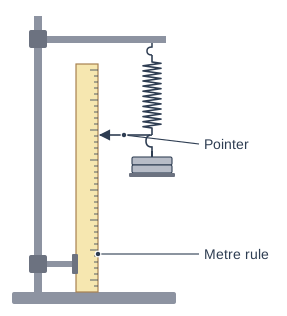
The diagram shows a pointer fixed to the bottom of a spring. A student reads the position of the pointer on the metre rule each time she adds a mass.
Suggest two things the student should do to make her readings of the pointer position accurate.
Model answer
She should read the scale with her eye level with the pointer, so that there is no parallax error. She should also wait until the spring has stopped bouncing before taking each reading.
Explanation
Looking at the pointer from above or below makes it appear against the wrong mark on the scale (parallax). A bouncing spring gives a reading that changes. A vertical, fixed metre rule close to the pointer also helps. Repeating readings reduces the effect of random errors but does not make each reading more accurate.
Mark scheme
1 mark
read the scale with her eye level with the pointer (to avoid parallax error)
Any two from the points listed, max 2. allow look at the pointer at right angles to the scale. List rule: each wrong or contradictory extra answer cancels a correct one. Ignore 'repeat the readings' (this does not make a single reading more accurate) and 'use a more accurate ruler'.
1 mark
wait until the spring stops moving / bouncing before taking the reading
1 mark
make sure the metre rule is vertical
allow use a set square / plumb line to check the rule is vertical
1 mark
fix / clamp the metre rule so it does not move during the investigation
1 mark
have the metre rule close to the pointer
allow make sure the pointer is horizontal
Question 4
4 marks
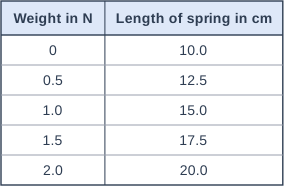
A student investigated how the length of a spring changed when weights were hung from it. The table shows her results.
Determine the spring constant of the spring. Use the result for a weight of 1.5 N.
Use the equation:
force = spring constant × extension
Model answer
extension = 17.5 - 10.0 = 7.5 cm 7.5 cm = 0.075 m 1.5 = k × 0.075 k = 1.5 ÷ 0.075 k = 20 N/m
Explanation
The table gives the length of the spring, not its extension. The extension is the length minus the original length with no weight (10.0 cm), so it is 7.5 cm, or 0.075 m. Then k = 1.5 ÷ 0.075 = 20 N/m. Using the length instead of the extension is the most common error in this practical, and it scores no marks.
Mark scheme
1 mark
extension = 17.5 - 10.0 = 7.5 (cm)
allow a correct extension from another row of the table used with its own weight in the later steps (e.g. 20.0 - 10.0 = 10.0 cm for 2.0 N). Do not allow this mark or any later mark unless an extension (length - 10.0 cm) is used: using the length of the spring (17.5 cm / 0.175 m) in place of the extension scores 0 for the whole question (8.6 (N/m) scores 0). An extension worked out with an arithmetic slip in the subtraction can still earn the later marks (ecf).
1 mark
7.5 cm = 0.075 m
allow a correct conversion of their (incorrectly calculated) extension
1 mark
1.5 = k × 0.075
allow k = 1.5 ÷ 0.075. Allow ecf from an incorrectly calculated extension; allow a correct substitution using an incorrectly / not converted value of extension (e.g. 1.5 = k × 7.5)
1 mark
k = 20 (N/m)
allow a correct calculation using an incorrectly calculated extension (ecf) or an incorrectly / not converted value of extension: not converting 7.5 cm gives 0.2 and scores 3 marks. 0.05, from dividing the extension by the force (0.075 ÷ 1.5), scores 2 marks (for the extension and its conversion). A correct answer with no working scores full marks. Full marks are not awarded for a correct final answer from incorrect working.
Ready to try the rest? Every answer you write is marked against the mark scheme, so you can see exactly where the marks are.
Ctrl + Enter to check
Study HelperHints first, answers after you try
Stuck on this one? Ask for a hint and I’ll point you in the right direction, without giving the answer away. Once you’ve checked your answer, I’ll show you how the marks are awarded.