
Level:
Correct: 0
Incorrect: 0
Marks: 0/0
Exam Practice
Course:
Topics:
Avg
score:
–
Topics
done:
0/15

The distance-time relationship and acceleration

Practise 24 exam-style questions on The distance-time relationship and acceleration for AQA GCSE Combined Science (Foundation Physics Paper 2). Write your answer as you would in the exam and get it marked in seconds against the mark scheme, point by point, with the Study Helper on hand if you get stuck.

  • 24 questions
  • 1–6 marks each
  • Instant marking
  • No sign-up needed
20 questions, marked as you go

Sample questions with model answers

Here are 4 of the questions in this topic, each with a model answer, an explanation of why it earns the marks and the mark scheme an examiner would use.

Question 1

1 mark

A raindrop falls through the air at its terminal velocity.

Which statement is correct?

Choose your answer.

  • Its weight is zero
  • The air resistance on it is zero
  • The resultant force on it is downwards
  • The resultant force on it is zero

Model answer

The resultant force on it is zero

Explanation

An object falling through a fluid first accelerates because of its weight. As it speeds up, the air resistance increases until it equals the weight. The resultant force is then zero, so the raindrop falls at a constant velocity: its terminal velocity.

Mark scheme
  1. 1 mark

    The resultant force on it is zero

    If more than one option is given, 0 marks. At terminal velocity the air resistance is equal to the weight, so the forces balance. The raindrop still has weight and air resistance still acts on it; a downward resultant force would make it accelerate.
Question 2

2 marks

An electric scooter speeds up from 2.0 m/s to 8.0 m/s in 4.0 s.

Calculate the acceleration of the scooter.

Use the equation:

acceleration = change in velocity ÷ time taken

Model answer

change in velocity = 8.0 - 2.0 = 6.0 m/s
a = 6.0 ÷ 4.0
a = 1.5 m/s²

Explanation

The change in velocity is the final velocity minus the initial velocity, 6.0 m/s, not the final velocity alone. Dividing by the time gives 1.5 m/s²: the scooter's velocity increases by 1.5 m/s every second.

Mark scheme
  1. 1 mark

    a = (8.0 - 2.0) ÷ 4.0

    allow a = 6.0 ÷ 4.0

  2. 1 mark

    a = 1.5 (m/s²)

    A correct answer with no working scores full marks. Full marks are not awarded for a correct final answer from incorrect working. 2.0 (m/s²) (8.0 ÷ 4.0) scores 0.

Question 3

2 marks

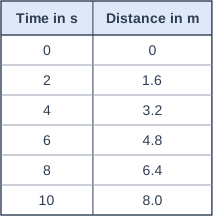
A student measured how far a model boat had travelled across a pond every 2 s. The table shows the results.

The student plots a distance-time graph of the results.

Describe the line on the graph and what it shows about the motion of the boat.

Table with columns "Time in s", "Distance in m". Time in s: 0; Distance in m: 0 | Time in s: 2; Distance in m: 1.6 | Time in s: 4; Distance in m: 3.2 | Time in s: 6; Distance in m: 4.8 | Time in s: 8; Distance in m: 6.4 | Time in s: 10; Distance in m: 8.0.

Model answer

The line is straight, slopes upwards and goes through the origin. This shows that the boat moves at a constant speed: it travels 1.6 m every 2 s, which is 0.8 m/s.

Explanation

The distance increases by the same amount (1.6 m) in each 2 s interval, so the points lie on a straight line through the origin. A straight distance-time line means a constant speed, equal to its gradient: 1.6 ÷ 2 = 0.8 m/s. A straight distance-time line does not mean constant acceleration.

Mark scheme
  1. 1 mark

    a straight line (sloping upwards) through the origin

    allow a straight line with a constant gradient. Ignore 'it goes up' on its own.

  2. 1 mark

    the boat moves at a constant speed

    allow a constant speed of 0.8 m/s / the same distance every 2 s. Do not accept 'constant acceleration' or 'accelerating'.

Question 4

4 marks

A car joins a motorway along a slip road. It accelerates uniformly from 13 m/s over a distance of 200 m.

acceleration = 1.5 m/s²

Calculate the velocity of the car at the end of the slip road. Give your answer to 2 significant figures.

Use the equation:

(final velocity)² - (initial velocity)² = 2 × acceleration × distance

Model answer

v² - 13² = 2 × 1.5 × 200
v² - 169 = 600
v² = 769
v = √769 = 27.73 m/s
v = 28 m/s (2 significant figures)

Explanation

Substitute, then add the initial velocity squared (169) to both sides: v² = 769. The equation gives v², so take the square root to get 27.73 m/s, then round to 2 significant figures: 28 m/s. Leaving out the initial velocity treats the car as starting from rest and scores no marks; forgetting the square root is the other common error.

Mark scheme
  1. 1 mark

    v² - 13² = 2 × 1.5 × 200

    allow v² = 13² + (2 × 1.5 × 200)

  2. 1 mark

    v² = 769

    allow v = √769

  3. 1 mark

    v = 27.7(3) (m/s)

    allow 27.7 to 27.8

  4. 1 mark

    v = 28 (m/s)

    this mark is for a correctly rounded (2 significant figures) value of v, and can only be awarded if the equation given is used (with the initial velocity squared) and a value of v is calculated; allow it after an arithmetic slip that follows a correct substitution. A correct answer with no working scores full marks. Full marks are not awarded for a correct final answer from incorrect working. 769 (v², not square rooted) scores 2 marks; 27.7 (not rounded) scores 3 marks; 24 (m/s), from leaving out the initial velocity (v² = 2 × 1.5 × 200 = 600), scores 0, because the equation given has not been used.

Ready to try the rest? Every answer you write is marked against the mark scheme, so you can see exactly where the marks are.

Study Helper Hints first, answers after you try

Stuck on this one? Ask for a hint and I’ll point you in the right direction, without giving the answer away. Once you’ve checked your answer, I’ll show you how the marks are awarded.