'The Corfu crisis was the most serious failure of the League of Nations in the 1920s.'
How far do you agree with this statement?
Explain your answer.
[16 marks] [SPaG 4 marks]
Model answer
The Corfu crisis was a very serious failure for the League in the 1920s, because it showed that a great power could defy the League and be rewarded. However, there were other failures, such as Vilna and the lack of progress on disarmament, and it is important to compare them. I will argue that Corfu was the most serious failure of the 1920s because of what it revealed about the League's ability to deal with great powers.
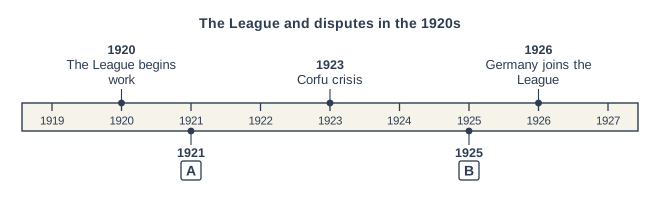
The Corfu crisis began on 27 August 1923, when the Italian General Tellini was murdered on Greek soil while marking the Greek-Albanian border. Mussolini demanded an apology, 50 million lire in compensation and the execution of the killers. When Greece did not meet all his demands, Italy bombarded and occupied Corfu, killing civilians, many of them refugees. Greece appealed to the League, but Mussolini argued that the League had no right to deal with the matter and threatened to leave. The League suggested that Greece should pay compensation to be held by the League until the killers were found, but the Conference of Ambassadors overruled this and made Greece pay the full 50 million lire directly to Italy. This was very serious, because the aggressor was a Great Power with a permanent seat on the Council, and it was rewarded for using force against a member state. Britain and France were not willing to confront Mussolini, and small countries learned that the League might not protect them.
However, the dispute over Vilna could be seen as an even more serious failure. In 1920 Polish troops seized Vilna, the historic capital of Lithuania. The League asked Poland to withdraw, but it refused, and France, Poland's ally, would not put pressure on it. In 1923 the Conference of Ambassadors recognised Vilna as Polish. Unlike Corfu, where Italy withdrew after a month, the result of Vilna was permanent: a state had changed a border by force and kept its gains. On the other hand, Poland was not a great power, and the crisis happened in the League's first year, before its methods were established.
There were also failures of a different kind. The Covenant required members to reduce their armaments, but the League made little progress on disarmament in the 1920s. In 1923 France and Belgium, two leading members, occupied the Ruhr without the League acting. In 1925 Britain rejected the Geneva Protocol, which would have strengthened the League's system for settling disputes. These failures showed that the leading members would not let the League restrict their own actions.
In conclusion, I largely agree with the statement. Vilna had a more permanent result, and the lack of disarmament weakened the League in the long term, but Corfu was the most serious failure because it showed openly that a Great Power could ignore the League, have the League's decision overruled and be rewarded. The League's success over Bulgaria in 1925 restored some confidence, but the lesson of Corfu was not forgotten, least of all by Mussolini, who invaded Abyssinia in 1935.
Explanation
A Level 4 essay explains Corfu in detail and compares it with other failures (Vilna, the Ruhr, disarmament) using clear criteria such as who was involved and how lasting the result was. The judgement should be sustained: for example, arguing that Corfu was worst because a great power openly defied the League, even though Vilna's result was more permanent.