Level:
Correct: 0
Incorrect: 0
Marks: 0/0
Exam Practice
Subject:
Topics:
AQA GCSE History (Conflict and tension 1918-1939) Smart practice A mixed round aimed at your weak spots
Unit 1
Part one: Peacemaking
Unit 2
Part two: The League of Nations and international peace
Unit 3
Part three: The origins and outbreak of the Second World War
Avg
score:
–
Topics
done:
0/9

Diplomacy outside the League

Practise 44 exam-style questions on Diplomacy outside the League for AQA GCSE History (Conflict and tension 1918-1939). Write your answer as you would in the exam and get it marked in seconds against the mark scheme, point by point, with an AI tutor on hand if you get stuck.

  • 44 questions
  • 1–20 marks each
  • Instant marking
  • No sign-up needed
20 questions, marked as you go

Sample questions with model answers

Here are 4 of the questions in this topic, each with a model answer, an explanation of why it earns the marks and the mark scheme an examiner would use.

Question 1

2 marks

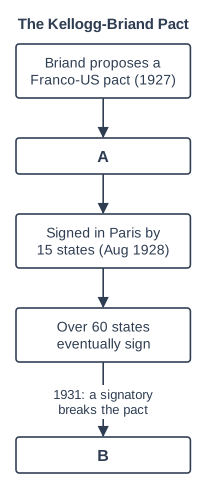
Figure 1 shows the history of the Kellogg-Briand Pact.

What should replace A and B?

The Kellogg-Briand Pact. Flow chart of 5 boxes joined by arrows, read from top to bottom. The first box is "Briand proposes a Franco-US pact (1927)", which leads to box A, which leads to "Signed in Paris by 15 states (Aug 1928)", which leads to "Over 60 states eventually sign", which leads (along an arrow labelled "1931: a signatory breaks the pact") to box B.

Model answer

A is Kellogg's proposal that the pact should be open to all nations, not just France and the USA. B is Japan's invasion of Manchuria in 1931.

Explanation

Briand first proposed a pact between France and the USA in April 1927, hoping to tie America to France's security. Kellogg turned it into a general pact open to everyone, which committed the USA to nothing. Japan, an original signatory, invaded Manchuria in 1931, claiming self-defence - the first major breach.

Mark scheme
  1. 1 mark

    A: Kellogg proposed (in December 1927) that the pact should be open to all nations rather than just France and the USA.

    Accept: the USA suggested a multilateral pact / a pact for many countries.

  2. 1 mark

    B: Japan invaded Manchuria (1931).

    Accept: the Mukden incident / Japanese attack on Manchuria (China).

Question 2

4 marks

Source A: from a leaflet published by an American peace society in September 1928. (Written for practice.)
'Ten years ago the world's youth lay dead in the fields of France. Today, in Paris, the nations have solemnly declared that war is no longer a lawful way to settle their quarrels. For the first time, America stands side by side with Europe in the cause of peace. Write to your senator! Tell him that the American people want this treaty, and want it now.'

Source A supports the Kellogg-Briand Pact. How do you know?

Explain your answer by referring to Source A and your contextual knowledge.

Model answer

Source A supports the Kellogg-Briand Pact because it presents it as a historic step towards peace. It reminds readers that 'ten years ago the world's youth lay dead in the fields of France', and contrasts this with the declaration in Paris that 'war is no longer a lawful way to settle their quarrels'. This reflects the terms of the pact, signed in Paris in August 1928, in which the signatories renounced war 'as an instrument of national policy' and agreed to settle disputes by peaceful means. The leaflet is also proud that 'America stands side by side with Europe in the cause of peace'. This was significant because the USA had refused to join the League of Nations, and the pact, proposed by the American Secretary of State Frank Kellogg together with Briand, allowed the USA to work for peace without taking on any binding commitments. The provenance confirms its support: it was published by an American peace society, part of a strong movement in the USA to 'outlaw' war, and its purpose was to persuade readers to 'write to your senator' so that the Senate would ratify the treaty. This campaign was successful, as the Senate approved the pact by 85 votes to 1 in January 1929.

Explanation

A Level 2 answer explains the source's positive language and its appeal to readers, and supports it with context: the terms of the pact, the USA's absence from the League and the Senate's vote. Explaining that a peace society's leaflet was meant to persuade shows understanding of provenance.

Mark scheme
  1. 4 marks

    Levels of response (4 marks).
    Level 2 (3-4 marks): Developed analysis of Source A, explaining how its content and/or provenance shows support for the pact (e.g. the contrast with the dead of the war, the claim that war is no longer lawful, pride in America's role, the appeal to write to senators; a peace society campaigning for ratification), supported by relevant contextual knowledge such as the signing in Paris in August 1928, the terms of the pact, the American peace movement or the Senate's vote.
    Level 1 (1-2 marks): Simple analysis of Source A, identifying basic features of its content or provenance (e.g. 'it wants the treaty passed'), with little or no contextual knowledge.
    0 marks: nothing worthy of credit.

    Indicative content (not a checklist; credit other valid points): content - recalls the slaughter of the war to show why the pact matters; claims that the nations have declared war 'no longer a lawful way' to settle quarrels; celebrates America standing 'side by side with Europe' in the cause of peace; urges readers to write to their senators to demand the treaty. Provenance - a leaflet by an American peace society in September 1928, just after the signing; its purpose was to persuade Americans to press the Senate to ratify. Context - the pact was signed in Paris on 27 August 1928 by 15 states; it renounced war 'as an instrument of national policy' and promised peaceful settlement; Briand had proposed a Franco-American pact in 1927, and Kellogg widened it; there was a strong 'outlawry of war' movement in the USA; the USA had not joined the League, so the pact was a way to work for peace without commitments; the US Senate approved it by 85 votes to 1 in January 1929; Kellogg received the Nobel Peace Prize (1929).

Question 3

12 marks

Study Sources B and C.

Source B: Austen Chamberlain, the British Foreign Secretary, who helped to negotiate the Locarno treaties and received the Nobel Peace Prize for his part, described the treaties as:
'the real dividing line between the years of war and the years of peace.'

Source C: from a private memorandum by an official of the Polish Foreign Ministry, November 1925. (Written for practice.)
'Our Western friends congratulate themselves. But at Locarno Germany accepted the Rhine frontier and refused to accept the Vistula. Britain guarantees Strasbourg but not Danzig. Germany will now seek to change our frontier by pressure and propaganda, and one day perhaps by force. We must rely on France, and France has just been given what she most wanted in the west.'

How useful are Sources B and C to an historian studying reactions to the Locarno treaties?

Explain your answer using Sources B and C and your contextual knowledge.

Model answer

Source B is useful because it shows the optimistic reaction to Locarno in Britain and western Europe. Chamberlain called the treaties 'the real dividing line between the years of war and the years of peace', suggesting that the bitterness left by the war and the Treaty of Versailles had finally been overcome. This reflects the 'spirit of Locarno': for the first time since the war, Germany had negotiated as an equal and freely accepted its borders with France and Belgium, and it was agreed that Germany would join the League of Nations. The provenance makes it valuable as evidence of the official British view, since Chamberlain was the Foreign Secretary who negotiated the treaties. However, it also limits its reliability. Chamberlain had a strong personal and political interest in presenting Locarno as a historic success, and he received the Nobel Peace Prize for it. His statement says nothing about the weaknesses of the treaties, and with hindsight it was far too optimistic, since Hitler broke Locarno in 1936.

Source C is useful because it shows a very different reaction from eastern Europe. The Polish official points out that 'Germany accepted the Rhine frontier and refused to accept the Vistula', and that 'Britain guarantees Strasbourg but not Danzig'. This is accurate: the Rhineland Pact guaranteed only Germany's western borders, while Germany signed only arbitration treaties with Poland and Czechoslovakia, and Britain refused to make any commitment in the east. The official fears that Germany will try to change the frontier 'by pressure and propaganda, and one day perhaps by force', which matches Stresemann's aim of recovering Danzig and the Polish Corridor. The provenance increases its value: a private memorandum is likely to reveal genuine Polish fears rather than polite public statements. As a Polish official, he represents the country with most to lose, so he may overlook the value of the French treaty promising help to Poland, but his fears proved well founded.

Overall, the two sources are very useful together because they show the contrasting reactions to Locarno: optimism and relief in the West, and anxiety in the East. Source B is limited by its author's interest in the treaties' success, while Source C, though a national view, was more far-sighted. An historian would also need evidence of German reactions, which ranged from Stresemann's hopes to nationalist fury.

Explanation

Level 4 needs a judgement about both sources based on content AND provenance: Chamberlain's verdict shows Western optimism but comes from one of the treaties' architects with a stake in their success, while the private Polish memo reveals the eastern states' justified fears. The best answers note what is missing, such as German reactions.

Mark scheme
  1. 12 marks

    Levels of response (12 marks).
    Level 4 (10-12 marks): Complex evaluation of both sources, reaching a sustained judgement about their usefulness for studying reactions to Locarno, based on their content AND provenance (e.g. B as the optimistic view of one of the treaties' architects, which reflects Western opinion but has reasons to exaggerate; C as a private Polish view that reveals the fears of the eastern states), supported by relevant contextual knowledge.
    Level 3 (7-9 marks): Developed evaluation of both sources based on their content and/or provenance, supported by relevant contextual knowledge.
    Level 2 (4-6 marks): Simple evaluation of one or both sources based on content and/or provenance, with some contextual knowledge.
    Level 1 (1-3 marks): Basic analysis of one or both sources, mainly describing what they say, with limited knowledge.
    0 marks: nothing worthy of credit.

    Indicative content (not a checklist; credit other valid points): Source B content - presents Locarno as the end of the post-war era of hostility and the start of real peace; reflects the 'spirit of Locarno'. Source B provenance - Chamberlain, British Foreign Secretary, helped negotiate Locarno and won the Nobel Peace Prize (1925) - so he had a strong personal and political interest in praising it; a public statement; it reflects the British and Western reaction and the relief that Britain's commitment was limited to the west. Source C content - Germany accepted the western frontier but not the eastern (Vistula, Danzig); Britain guaranteed the west only; fears German pressure and possibly force; dependence on France. Source C provenance - a private memo by a Polish official, so likely to reveal genuine fears rather than public statements; Poland had most to lose; but a national perspective that may underestimate the value of arbitration and France's treaty commitment. Context - Rhineland Pact (Germany, France, Belgium; Britain and Italy guarantors); arbitration treaties only with Poland and Czechoslovakia; French treaties with Poland and Czechoslovakia; Britain refused eastern commitments; Stresemann's aims to recover Danzig and the Corridor peacefully; German-Polish tariff war (1925); Germany joined the League (1926); Nobel prizes for Briand and Stresemann (1926); later Hitler exploited the eastern borders (1938-39) and broke Locarno (1936). Judgement - the sources show contrasting reactions - Western optimism and Eastern anxiety; B is limited by its author's interest and hindsight shows it was too optimistic, while C proved far-sighted; together very useful, though neither gives the German reaction.

Question 4

20 marks

'Diplomacy outside the League of Nations did more to keep the peace in the 1920s than the League itself.'

How far do you agree with this statement?

Explain your answer.

[16 marks] [SPaG 4 marks]

Model answer

In the 1920s, peace was kept partly by the League of Nations and partly by agreements made directly between governments, such as the Locarno treaties and the Kellogg-Briand Pact. I will argue that diplomacy outside the League did more to keep the peace, because it dealt with the relationships between the great powers on which European peace really depended, although the two often worked together.

The League made a real contribution. It settled several disputes that might have led to war: the Aaland Islands between Sweden and Finland in 1921, Upper Silesia between Germany and Poland in 1921, and the Greek invasion of Bulgaria in 1925, when it ordered a ceasefire and a Greek withdrawal. Its agencies also reduced the causes of conflict: Nansen's Refugees Committee returned about 400,000 prisoners of war, and League loans rescued the economies of Austria and Hungary. However, the League failed when great powers were involved. Poland kept Vilna after seizing it in 1920, Mussolini was rewarded after occupying Corfu in 1923, and the League did nothing when France and Belgium occupied the Ruhr in 1923. It also made little progress on disarmament.

Diplomacy outside the League dealt with exactly these great-power problems. The Washington Naval Conference of 1921-22 limited battleship fleets and prevented a naval arms race between the USA, Britain and Japan. The Dawes Plan of 1924 ended the Ruhr crisis by rescheduling reparations and providing American loans, which the League could not have done because the USA was not a member. Most importantly, the Locarno treaties of 1925 reconciled France and Germany. Germany freely accepted its western borders, Britain and Italy guaranteed them, and the 'spirit of Locarno' led to the Kellogg-Briand Pact of 1928, the Young Plan of 1929 and the early withdrawal of Allied troops from the Rhineland. These agreements involved the USA and Germany, two great powers that were outside the League for some or all of the decade.

However, this diplomacy had limits too. Locarno left Germany's eastern borders unguaranteed, and the Kellogg-Briand Pact had no means of enforcement. The two forms of peacekeeping were also linked: Locarno led to Germany joining the League in 1926 with a permanent seat on the Council, which strengthened the League, and the Locarno treaties gave the League Council the task of judging violations.

In conclusion, I largely agree with the statement. The League settled disputes between smaller states and did valuable humanitarian work, but the greatest threat to peace in the 1920s was the hostility between France and Germany and the economic chaos of the early 1920s. These were tackled by the Dawes Plan and Locarno, not by the League. The League worked best when this diplomacy had created a co-operative atmosphere, so diplomacy outside the League did more to keep the peace.

Explanation

A Level 4 essay explains the League's contribution (Aaland, Upper Silesia, Bulgaria, agencies) and its failures, and compares it with diplomacy outside the League (Washington, Dawes, Locarno, Kellogg-Briand). A sustained judgement might argue that outside diplomacy tackled the great-power rivalries that threatened major war, while recognising that the two were linked.

Mark scheme
  1. 16 marks

    Levels of response (16 marks).
    Level 4 (13-16 marks): Complex explanation of the contribution to peace of diplomacy outside the League (e.g. the Washington Naval Treaty, the Dawes Plan, Locarno, the Kellogg-Briand Pact, the Young Plan) and of the League itself (disputes and agencies), comparing them by clear criteria, leading to a sustained judgement, supported by a range of accurate, specific knowledge.
    Level 3 (9-12 marks): Developed explanation of both diplomacy outside the League and the work of the League, supported by accurate knowledge.
    Level 2 (5-8 marks): Simple explanation of diplomacy outside the League or the work of the League, supported by some relevant knowledge.
    Level 1 (1-4 marks): Basic explanation of one or more agreements or events, with limited knowledge.
    0 marks: nothing worthy of credit.

    Indicative content (not a checklist; credit other valid points): Diplomacy outside the League - Washington Naval Conference (1921-22): naval limits and a ten-year halt on battleships; Dawes Plan (1924): reparations rescheduled, American loans, French withdrawal from the Ruhr; Locarno (1925): western borders accepted and guaranteed, Germany brought back as an equal, 'spirit of Locarno'; Kellogg-Briand Pact (1928): war renounced by 15 states, the USA involved; Young Plan (1929) and early Rhineland evacuation (1930); these dealt with the great-power relationships (France and Germany, the USA) on which European peace depended; limits - Locarno left eastern borders unguaranteed, Kellogg-Briand had no enforcement, and the Conference of Ambassadors sometimes undermined the League (Vilna, Corfu). The League - settled the Aaland Islands (1921), Upper Silesia (1921), Bulgaria (1925) and Mosul (1926); agencies: refugees, prisoners of war, health, slavery, loans to Austria and Hungary; but failed over Vilna (1920-23) and Corfu (1923) and did nothing over the Ruhr (1923); disarmament made little progress. Links - Locarno strengthened the League by bringing Germany in (1926) and its treaties gave the League Council a role; the two worked together. Possible judgements - diplomacy outside the League did more, because it dealt with the great powers whose rivalry threatened major war; or the League did more because it settled actual disputes and conflicts; or they complemented each other.

  2. 4 marks

    SPaG. High performance (4 marks): spells and punctuates with consistent accuracy; uses rules of grammar with effective control of meaning overall; uses a wide range of specialist terms as appropriate.
    Intermediate performance (2-3 marks): spells and punctuates with considerable accuracy; uses rules of grammar with general control of meaning overall; uses a good range of specialist terms as appropriate.
    Threshold performance (1 mark): spells and punctuates with reasonable accuracy; uses rules of grammar with some control of meaning and any errors do not significantly hinder meaning overall; uses a limited range of specialist terms as appropriate.
    0 marks: the student writes nothing, or the response does not relate to the question, or errors severely hinder meaning.

    SPaG marks are awarded only if the answer relates to the question.

Ready to try the rest? Every answer you write is marked against the mark scheme, so you can see exactly where the marks are.

AI Tutor Hints first, answers after you try

Hi! Stuck? Ask me for a hint and I’ll help you work it out. Once you’ve checked your answer I can explain exactly where the marks are.