
Level:
Correct: 0
Incorrect: 0
Marks: 0/0
Exam Practice
Subject:
Topics:
AQA GCSE History (Conflict and tension 1918-1939) Smart practice A mixed round aimed at your weak spots
Unit 1
Part one: Peacemaking
Unit 2
Part two: The League of Nations and international peace
Unit 3
Part three: The origins and outbreak of the Second World War
Avg
score:
–
Topics
done:
0/9

Impact of the treaty and wider settlement

Practise 45 exam-style questions on Impact of the treaty and wider settlement for AQA GCSE History (Conflict and tension 1918-1939). Write your answer as you would in the exam and get it marked in seconds against the mark scheme, point by point, with an AI tutor on hand if you get stuck.

  • 45 questions
  • 1–20 marks each
  • Instant marking
  • No sign-up needed
20 questions, marked as you go

Sample questions with model answers

Here are 4 of the questions in this topic, each with a model answer, an explanation of why it earns the marks and the mark scheme an examiner would use.

Question 1

2 marks

Figure 1 shows the population of Czechoslovakia by nationality, according to the census of 1921.

Identify one problem that this created for the new state of Czechoslovakia, and explain it.
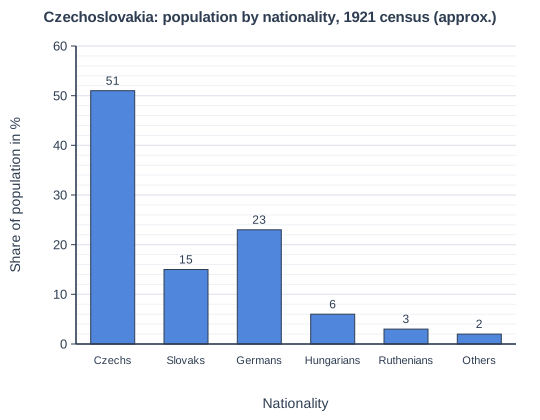
Czechoslovakia: population by nationality, 1921 census (approx.). Bar chart of share of population in % for each nationality: Czechs 51, Slovaks 15, Germans 23, Hungarians 6, Ruthenians 3, Others 2.

Model answer

One problem was the large German minority. Germans made up about 23% of the population - more than the Slovaks - and most lived in the Sudetenland. They had wanted to join Austria or Germany in 1918-19 and resented being ruled by Czechs, so they were not loyal to the new state, a grievance that Hitler later exploited in 1938.

Explanation

Czechs were only about half of the population, so Czechoslovakia contained large minorities: Germans, Slovaks (who felt dominated by the Czechs), Hungarians and Ruthenians. The first mark is for a problem; the second for explaining it with detail.

Mark scheme
  1. 1 mark

    Identifies a valid problem, e.g. a large German minority (about 23%, around 3 million people) who did not want to be ruled by Czechs / Slovaks resented Czech domination / a Hungarian minority that Hungary wanted back / it was hard to build a united nation from so many groups.

    Accept any valid problem linked to the mix of nationalities.

  2. 1 mark

    Explains the problem with specific detail, e.g. the Sudeten Germans had wanted to join Austria or Germany in 1918-19 and resented Czech rule, which later allowed Hitler to claim the Sudetenland (1938) / Slovaks complained the government in Prague was dominated by Czechs and ignored Slovak demands for self-government / Hungary refused to accept the loss of Slovakia and Ruthenia under the Treaty of Trianon.

    The second mark is for developing the problem identified.

Question 2

4 marks

Source A: a poster produced in Hungary in 1920, soon after the Treaty of Trianon was signed. (Written for practice.)

The poster shows a map of the old Kingdom of Hungary. The small area left to Hungary by the Treaty is coloured red, white and green. The much larger areas taken away are coloured black and labelled 'Transylvania', 'Upper Hungary' (Slovakia) and 'the South'. Chains hang from the black areas. In large letters across the bottom is the slogan: 'Nem, nem, soha!' ('No, no, never!')

Source A opposes the Treaty of Trianon. How do you know?

Explain your answer by referring to Source A and your contextual knowledge.

Model answer

Source A opposes the Treaty of Trianon because it shows how much land Hungary lost. The small area left to Hungary is shown in the national colours, while the much larger areas taken away are black, as if in mourning, with chains hanging from them as though their people were prisoners. The slogan 'No, no, never!' shows that Hungarians refused to accept the losses. The Treaty of Trianon in 1920 took about two-thirds of Hungary's territory: Transylvania went to Romania, Slovakia to Czechoslovakia and lands in the south to Yugoslavia, leaving over 3 million Hungarians living in other states.

The provenance also shows its opposition. It was produced in Hungary in 1920, just after the Treaty was signed, to unite the nation in rejecting it. Hungarians felt that self-determination had been ignored for them, and winning back the lost lands became the main aim of Hungary's government in the years that followed.

Explanation

Level 2 links the poster's map and slogan to specific knowledge of Trianon (the scale of the losses, Transylvania, Hungarians left abroad) and/or its purpose in 1920. Quoting the slogan without knowledge is Level 1.

Mark scheme
  1. 4 marks

    Levels of response (4 marks).
    Level 2 (3-4 marks): Developed analysis of Source A based on its content and/or provenance, supported by relevant contextual knowledge, e.g. explains that the map contrasts the small area left to Hungary with the large black areas taken away and that 'No, no, never!' rejects the losses, linking this to the loss of about two-thirds of Hungary's territory, including Transylvania to Romania and Slovakia to Czechoslovakia, which left over 3 million Hungarians in other states; and/or explains that a Hungarian poster in 1920 aimed to rally the nation to refuse to accept the Treaty.
    Level 1 (1-2 marks): Simple analysis of the source based on content and/or provenance, e.g. 'it says no, never' or 'it is Hungarian so it would be against the Treaty'.
    0 marks: nothing worthy of credit.

    Indicative content (not a checklist; credit other valid points): Content: the small area left in national colours contrasts with the much larger black (mourning) areas; chains show the lost lands as captive; 'No, no, never!' is a refusal to accept the Treaty. Context: the Treaty of Trianon (June 1920) took about two-thirds of the territory of the Kingdom of Hungary; Transylvania went to Romania; Slovakia and Ruthenia to Czechoslovakia; Croatia and areas in the south (part of the Banat and the Bačka) to Yugoslavia; Burgenland to Austria; over 3 million Hungarians were left living in neighbouring states, against the principle of self-determination; Hungary lost its access to the sea (Fiume) and much of its industry, timber and minerals; its army was limited to 35,000; Hungary had been through Béla Kun's communist regime and a Romanian occupation of Budapest in 1919; Horthy's government made revision of Trianon its main aim; the Little Entente (Czechoslovakia, Yugoslavia, Romania) was formed to resist Hungarian claims; Hungary later sided with Italy and Germany to win land back (1938-41). Provenance: produced in Hungary in 1920, just after the Treaty, when anger was at its height; propaganda designed to unite Hungarians in rejecting the losses; 'No, no, never!' became a widely used slogan.

Question 3

12 marks

Source B: from 'The Economic Consequences of the Peace', a book by John Maynard Keynes published in December 1919. Keynes had been the senior British Treasury official at the Paris Peace Conference but resigned in June 1919 because he disagreed with the reparations terms. The book became a bestseller in Britain and the USA. He argued that Clemenceau had aimed at a 'Carthaginian peace' - one designed to crush Germany permanently - and that the Treaty would ruin the economy of Europe.

Source C: from a speech by a Conservative MP in the House of Commons debate on the Treaty of Versailles in July 1919. (Written for practice.)

'The men who voted for this government last December asked for three things: that Germany should admit her guilt, that she should never again threaten us by land or sea, and that she should pay. This Treaty gives them all three. Some clever gentlemen now tell us it is too harsh. I wonder whether they would say so to a widow in my constituency.'

How useful are Sources B and C to an historian studying British reactions to the Treaty of Versailles?

Explain your answer using Sources B and C and your contextual knowledge.

Model answer

Source B is useful because it shows the most influential British criticism of the Treaty. Keynes argued that Clemenceau had aimed at a 'Carthaginian peace' designed to crush Germany, and that the Treaty, especially its reparations, would ruin Europe's economy. The provenance makes it valuable: Keynes was an economist and a senior Treasury official at the conference, so he had expert, inside knowledge. His book became a bestseller, and it helped to change British opinion, so that during the 1920s many people came to believe Germany had been treated unfairly, which later encouraged support for appeasement. However, Keynes had resigned in protest, so he was strongly committed to one side, and in 1919 his view was that of a minority, shared mainly by people on the left such as the Labour Party and the Daily Herald.

Source C is useful because it shows the majority reaction in 1919. The MP says the Treaty gives voters what they asked for in the December 1918 election: German guilt, security and reparations. This matches the election campaign, when politicians promised to 'make Germany pay', and the Treaty's terms: Article 231, the end of the German navy at Scapa Flow and reparations, of which Britain was later to receive 22%. Parliament approved the Treaty by a large majority, and Lloyd George was welcomed home by cheering crowds, so the speech is probably typical of British opinion at the time. However, it is a political speech designed to persuade, and its emotional appeal to widows shows it is one-sided. His mention of 'clever gentlemen' who call the Treaty too harsh is itself useful evidence that criticism was already being heard.

Overall, Source C is more useful for showing how most British people reacted in 1919, while Source B is more useful for understanding the criticism that grew in importance over time. Together they show that British reactions were divided, and that the balance between them shifted during the 1920s.

Explanation

Level 4 weighs both: B is the influential but minority expert criticism, from a committed insider; C represents the majority view in Parliament in 1919 but is a persuasive political speech. The best answers note that British opinion shifted towards Keynes's view over time.

Mark scheme
  1. 12 marks

    Levels of response (12 marks).
    Level 4 (10-12 marks): Complex evaluation of both sources, with a sustained judgement about their usefulness for studying British reactions, based on content and provenance and supported by contextual knowledge, e.g. explains that B represents the influential expert criticism of the Treaty as too harsh, from an insider whose resignation shows his commitment, while C represents the majority view in Parliament and among voters in 1919 that the Treaty fulfilled the 1918 election promises, and weighs how representative each is and how British opinion changed over time.
    Level 3 (7-9 marks): Developed evaluation of both sources based on content and/or provenance, supported by relevant contextual knowledge.
    Level 2 (4-6 marks): Simple evaluation of one or both sources based on content and/or provenance, e.g. 'Source B is useful because Keynes was at the conference'.
    Level 1 (1-3 marks): Basic analysis of one or both sources: describes their content or makes general comments about provenance.
    0 marks: nothing worthy of credit.
    0 marks: nothing worthy of credit.

    Indicative content (not a checklist; credit other valid points): Source B content: the Treaty was a 'Carthaginian peace' aimed at crushing Germany, and would ruin Europe's economy. Provenance: Keynes was an economist and a senior Treasury official at the conference - expert inside knowledge; he resigned in protest, so he was strongly committed to one side; a bestseller, so it shaped British and American opinion, encouraging the view that the Treaty was unjust; it shows an influential minority view in 1919. Source C content: the Treaty meets voters' demands - German guilt, security, reparations; dismisses critics; emotional appeal to war widows. Provenance: a Conservative MP in the Commons debate in July 1919 - reflects the majority view in Parliament and probably among voters; a political speech, so persuasive and one-sided; the reference to 'clever gentlemen' suggests criticism was already being heard. Context: the December 1918 'coupon election' - slogans 'make Germany pay' and 'hang the Kaiser'; Eric Geddes's promise to squeeze Germany 'until the pips squeak'; Lloyd George was welcomed home by cheering crowds and the Treaty was approved by a large majority; Britain gained its aims - the German navy destroyed (Scapa Flow), colonies as mandates, reparations (22%); critics included the Labour Party and the Daily Herald (Dyson's '1940 Class' cartoon) and Lloyd George himself had warned against a harsh peace (Fontainebleau Memorandum); opinion moved during the 1920s towards Keynes's view, encouraging later support for revising the Treaty and appeasement. Judgement: C is more representative of reactions in 1919; B more significant for how attitudes changed; together they show the range of British reactions.

Question 4

20 marks

'The main weakness of the peace settlement was that it created new states containing large minorities.'

How far do you agree with this statement?

Explain your answer.

[16 marks] [SPaG 4 marks]

Model answer

The minorities in the new states were certainly a serious weakness of the peace settlement. The peoples of central and eastern Europe were so mixed that no borders could match nationalities exactly. Czechoslovakia contained about 3 million Germans, around 23% of its population, mainly in the Sudetenland, as well as Hungarians and Ruthenians, and many Slovaks resented rule from Prague. About a third of Poland's people were not Polish, including Ukrainians, Jews, Belarusians and Germans. Yugoslavia was divided by tensions between Serbs and Croats. Over 3 million Hungarians were left in Romania, Czechoslovakia and Yugoslavia. These minorities weakened the new states from within and gave their neighbours grievances: Hungary refused to accept Trianon, and Germany resented the Germans placed under Polish and Czech rule. The minority treaties supervised by the League gave little real protection. Above all, in 1938 Hitler used the Sudeten Germans as his excuse to dismember Czechoslovakia.

However, there were other weaknesses that were arguably more important. The most dangerous was German resentment of the Treaty of Versailles. Germans saw it as a Diktat, rejected the war guilt clause, and resented reparations, the loss of territory and the limits on their armed forces. Because Germany remained united, with the largest population in central Europe and most of its industry, this resentment was a threat to the whole settlement. It weakened the Weimar Republic and was exploited by Hitler.

A second major weakness was that the settlement lacked the support of two great powers. The US Senate rejected the Treaty and the USA never joined the League, while Soviet Russia was excluded from the settlement. This left enforcement to Britain and France, who disagreed: France wanted strict enforcement and occupied the Ruhr in 1923, while Britain increasingly thought the Treaty too harsh. Dissatisfied victors, such as Italy with its 'mutilated victory', and the success of Turkey in overturning the Treaty of Sèvres by force, showed that the settlement could be challenged.

These weaknesses were linked. The minorities problem was dangerous mainly because powerful, resentful states such as Germany could exploit it, and because Britain and France were unwilling to enforce the settlement.

Overall, I disagree that minorities were the main weakness, although they were a serious one that no settlement could have avoided. The main weakness was that the settlement left Germany both resentful and potentially powerful, while the absence of the USA and the divisions between Britain and France meant there was no one prepared to defend it. Minorities only became a fatal problem when a strong and determined Germany decided to exploit them.

Explanation

Level 4 weighs the minorities problem (Czechoslovakia, Poland, Yugoslavia, Hungarians abroad) against other weaknesses (German resentment, the absence of the USA and the USSR, weak enforcement, dissatisfied victors) and explains links between them, reaching a sustained judgement.

Mark scheme
  1. 16 marks

    Levels of response (16 marks).
    Level 4 (13-16 marks): Complex explanation of the problems caused by minorities in the new states and of other weaknesses (German resentment, the absence of the USA and the USSR, weak enforcement, dissatisfied victors, economic problems), showing how they were linked, leading to a sustained judgement about the main weakness, supported by a range of accurate, specific knowledge.
    Level 3 (9-12 marks): Developed explanation of the minorities problem and at least one other weakness, supported by relevant knowledge, but without a sustained judgement.
    Level 2 (5-8 marks): Simple explanation of the minorities problem or other weaknesses, e.g. 'there were lots of Germans in Czechoslovakia'.
    Level 1 (1-4 marks): Basic explanation: general statements with limited knowledge.
    0 marks: nothing worthy of credit.

    Indicative content (not a checklist; credit other valid points): For: the peoples of central and eastern Europe were mixed, so borders could not match nationalities; Czechoslovakia contained about 3 million Germans (about 23%) as well as Hungarians and Ruthenians, and Slovaks resented Czech dominance; about a third of Poland's people were not Polish (Ukrainians, Jews, Belarusians, Germans); Yugoslavia had tensions between Serbs and Croats and minorities; over 3 million Hungarians lived in Romania, Czechoslovakia and Yugoslavia; minorities gave neighbouring states grievances and claims - Hungary's revisionism, Germany's claims to the Sudetenland and the Corridor; disputes over Teschen, Vilna, Memel; minority treaties supervised by the League were weak; Hitler used the Sudeten Germans in 1938. Against - other weaknesses: German resentment of the Treaty of Versailles as a Diktat (war guilt, reparations, territory, disarmament) was the most dangerous, because Germany remained potentially the strongest power in Europe; the USA rejected the Treaty and never joined the League, and Soviet Russia was excluded, so the settlement lacked support from two great powers; enforcement depended on Britain and France, who disagreed (France strict, Britain more lenient, e.g. over the Ruhr in 1923); dissatisfied victors - Italy ('mutilated victory', Fiume) and Japan (racial equality rejected); reparations damaged the European economy and led to the Ruhr crisis; economic weakness of the new states (Austria needed a League loan; tariff barriers); the new states were small and weak between Germany and the USSR; Turkey overturned Sèvres, showing the settlement could be revised by force. Links: minorities made German and Hungarian grievances stronger; the weakness of enforcement meant minorities' complaints could be exploited. Possible judgements: minorities were a serious and unavoidable weakness, but German resentment combined with the lack of enforcement was the main weakness; or minorities were the weakness Hitler exploited most effectively.

  2. 4 marks

    SPaG. High performance (4 marks): spells and punctuates with consistent accuracy; uses rules of grammar with effective control of meaning overall; uses a wide range of specialist terms as appropriate.
    Intermediate performance (2-3 marks): spells and punctuates with considerable accuracy; uses rules of grammar with general control of meaning overall; uses a good range of specialist terms as appropriate.
    Threshold performance (1 mark): spells and punctuates with reasonable accuracy; uses rules of grammar with some control of meaning and any errors do not significantly hinder meaning overall; uses a limited range of specialist terms as appropriate.
    0 marks: the student writes nothing, or the response does not relate to the question, or errors severely hinder meaning.

    SPaG marks are awarded only if the answer relates to the question.

Ready to try the rest? Every answer you write is marked against the mark scheme, so you can see exactly where the marks are.

AI Tutor Hints first, answers after you try

Hi! Stuck? Ask me for a hint and I’ll help you work it out. Once you’ve checked your answer I can explain exactly where the marks are.