Level:
Correct: 0
Incorrect: 0
Marks: 0/0
Exam Practice
Subject:
Topics:
AQA GCSE History (Elizabethan England) Smart practice A mixed round aimed at your weak spots
Unit 1
Part one: Elizabeth's court and Parliament
Unit 2
Part two: Life in Elizabethan times
Unit 3
Part three: Troubles at home and abroad
Unit 4
Part four: The historic environment of Elizabethan England
Avg
score:
–
Topics
done:
0/10

Mary Queen of Scots

Practise 41 exam-style questions on Mary Queen of Scots for AQA GCSE History (Elizabethan England). Write your answer as you would in the exam and get it marked in seconds against the mark scheme, point by point, with an AI tutor on hand if you get stuck.

  • 41 questions
  • 1–16 marks each
  • Instant marking
  • No sign-up needed
20 questions, marked as you go

Sample questions with model answers

Here are 4 of the questions in this topic, each with a model answer, an explanation of why it earns the marks and the mark scheme an examiner would use.

Question 1

2 marks

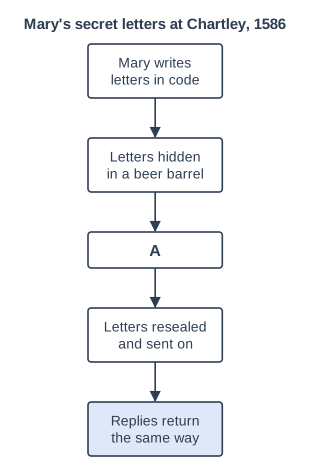
Figure 1 is a flow chart showing how Mary Queen of Scots' secret letters were handled at Chartley in 1586.

Name the Catholic double agent who set up this way of carrying Mary's letters, and describe what happened at the stage labelled A.

Mary's secret letters at Chartley, 1586. Flow chart of 5 boxes joined by arrows, read from top to bottom. The first box is "Mary writes letters in code", which leads to "Letters hidden in a beer barrel", which leads to box A, which leads to "Letters resealed and sent on", which leads to "Replies return the same way" (shaded).

Model answer

The double agent was Gilbert Gifford. At stage A the letters were secretly handed to Walsingham's agents, and his codebreaker Thomas Phelippes decoded and copied them before they were resealed and sent on, so Walsingham read everything Mary wrote and received.

Explanation

Walsingham let the beer-barrel post run from January 1586 so that he could read all Mary's correspondence. When Mary replied to Anthony Babington on 17 July 1586 approving his plan, Walsingham had written evidence to try her under the Act for the Queen's Safety; Phelippes is believed to have added a forged postscript asking Babington for the names of the six gentlemen who were to kill Elizabeth.

Mark scheme
  1. 1 mark

    The double agent: Gilbert Gifford.

    Accept Gifford. Do not accept Walsingham, Phelippes, Babington or Ballard.

  2. 1 mark

    Stage A: the letters were secretly passed to Walsingham's agents, who opened them and had them decoded and copied (by Thomas Phelippes) before they were sent on.

    Accept 'Walsingham's codebreaker Phelippes decoded them' / 'Walsingham read and copied the letters'. 'They were read by Walsingham' alone is enough. Do not accept 'the letters were delivered to Babington' without the interception.

Question 2

8 marks

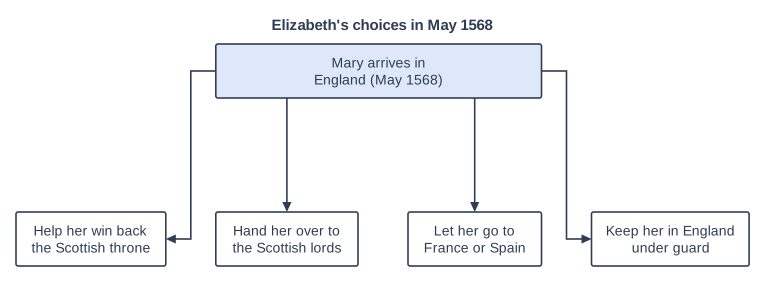
Figure 1 shows the choices Elizabeth faced when Mary Queen of Scots arrived in England.

Write an account of the ways in which Elizabeth dealt with Mary Queen of Scots in the years 1568-1569.

Elizabeth's choices in May 1568. Block diagram with five parts in three rows. Top row: a box "Mary arrives in England (May 1568)" (wide, shaded). Bottom row, left to right: a box "Help her win back the Scottish throne", a box "Hand her over to the Scottish lords", a box "Let her go to France or Spain" and a box "Keep her in England under guard". Connections: an arrow from "Mary arrives in England (May 1568)" to "Help her win back the Scottish throne"; an arrow from "Mary arrives in England (May 1568)" to "Hand her over to the Scottish lords"; an arrow from "Mary arrives in England (May 1568)" to "Let her go to France or Spain"; an arrow from "Mary arrives in England (May 1568)" to "Keep her in England under guard".

Model answer

When Mary landed at Workington on 16 May 1568 she expected Elizabeth to help her win back her throne. Instead she was taken to Carlisle Castle and guarded by Sir Francis Knollys. Elizabeth refused to meet her until she had been cleared of any part in Darnley's murder, and in July Mary was moved to Bolton Castle in Yorkshire, further from the Scottish border.

Elizabeth's reasons came from the choices shown in Figure 1. Helping Mary back to her throne would mean war with the Protestant government of the Earl of Moray, England's ally. Handing her over to the Scottish lords might lead to her death, setting an example that subjects could kill their queen. Letting her go to France or Spain might bring her back with a Catholic army. Keeping her under guard in England seemed the least dangerous choice.

To justify this, Elizabeth held an inquiry, which opened at York in October 1568 and moved to Westminster later that year. Moray's commissioners produced the Casket Letters, which they said proved Mary had helped plan Darnley's murder. Mary refused to accept that a queen could be judged and was not allowed to appear in person. In January 1569 the inquiry ended with nothing proved against either side. This suited Elizabeth: Moray stayed in power in Scotland, and Mary stayed in custody without being condemned.

In early 1569 Mary was moved to Tutbury under the Earl of Shrewsbury. During the year some nobles planned for her to marry the Duke of Norfolk, England's leading noble; Elizabeth forbade it and sent Norfolk to the Tower in October. In November the Northern Earls rebelled, hoping to free Mary, so she was hurried south to Coventry. The rising collapsed by December and about 450 rebels were executed. By the end of 1569 Elizabeth's temporary solution had become a long imprisonment.

Explanation

Elizabeth rejected restoring Mary, handing her over or letting her go abroad, held her at Carlisle and Bolton, used the York-Westminster inquiry (and the Casket Letters) to justify keeping her without a verdict, and tightened control after the Norfolk marriage plan and the Northern Rebellion. Level 4 explains why each step was taken and what followed.

Mark scheme
  1. 8 marks

    Levels of response (8 marks).
    Level 4 (7-8 marks): A coherent, well-organised account with complex analysis of causation and consequence, e.g. explains why Elizabeth rejected the other choices and kept Mary in custody, how the York and Westminster inquiry was used to justify this, and how the Norfolk marriage plan and the Northern Rebellion led to tighter control, with precise knowledge.
    Level 3 (5-6 marks): A developed account of several ways Elizabeth dealt with Mary, analysing causation or consequence, with specific knowledge.
    Level 2 (3-4 marks): A simple account of one or two actions, e.g. keeping Mary under guard, with some analysis.
    Level 1 (1-2 marks): A basic, general account with little specific knowledge.
    0 marks: nothing worthy of credit.

    Indicative content (not a checklist; credit other valid points): Arrival - Mary landed at Workington (16 May 1568) and was taken to Carlisle Castle, guarded by Sir Francis Knollys and Lord Scrope; Elizabeth refused to meet her until she had been cleared of Darnley's murder; she was moved to Bolton Castle in Yorkshire (July 1568), further from the border. The choices - restoring her risked war with Moray's Protestant government; handing her over risked her death and a precedent against monarchs; letting her go to France or Spain risked a Catholic invasion; so she was kept in England. The inquiry - opened at York (October 1568), moved to Westminster (late 1568); Moray's commissioners produced the Casket Letters; Mary refused to accept that a queen could be judged and was not allowed to appear in person; it ended (January 1569) with nothing proved against Mary or the lords, so Moray continued as regent and Mary stayed in custody. 1569 - moved to Tutbury (February 1569) under the Earl of Shrewsbury; the plan for her to marry the Duke of Norfolk, backed by some councillors; Elizabeth forbade it and Norfolk was sent to the Tower (October 1569); the Northern Rebellion (November 1569) aimed to free her; she was moved south to Coventry; the rising collapsed by December and about 450 rebels were executed. Analysis - each step turned a temporary solution into long-term captivity.

Question 3

8 marks

Write an account of the ways in which the Babington Plot led to the execution of Mary Queen of Scots.

Model answer

In December 1585 Mary was moved to Chartley under the strict guard of Sir Amyas Paulet, who had stopped all her secret letters. In January 1586 Gilbert Gifford, a Catholic double agent working for Walsingham, offered Mary a secret post: letters were hidden in beer barrels delivered to the house. Every letter was secretly copied and decoded by Walsingham's codebreaker, Thomas Phelippes, so Walsingham could read all her correspondence.

Meanwhile a Catholic priest, John Ballard, and a young gentleman, Anthony Babington, planned a foreign invasion, a Catholic rising, Mary's rescue and the murder of Elizabeth by six gentlemen. In July 1586 Babington wrote to Mary explaining the plan, and on 17 July she replied, approving it. Phelippes is believed to have added a forged postscript asking for the names of the six gentlemen. Walsingham now had written proof of Mary's support for a plot to kill the queen.

In August Ballard and Babington were arrested, Mary's papers at Chartley were seized, and in September Babington and thirteen others were executed. Because of the Act for the Queen's Safety of 1585, Mary could now be tried for a plot made in her favour. She was moved to Fotheringhay and tried there on 14-15 October 1586 by a commission of more than thirty peers, councillors and judges. She argued that a queen could not be tried under English law and denied plotting Elizabeth's death, but she was found guilty at Westminster on 25 October.

Elizabeth still hesitated. Parliament petitioned her to execute Mary, but she gave what she called an 'answer answerless'. Under pressure, she had the sentence proclaimed in December, and on 1 February 1587 she signed the death warrant and gave it to her secretary, William Davison. The Privy Council sent it to Fotheringhay without telling her, and Mary was executed on 8 February 1587.

Explanation

The beer-barrel trap produced Mary's letter of 17 July 1586, which allowed her trial under the 1585 Act at Fotheringhay (October 1586); pressure from Parliament and the Council led to the warrant (1 February 1587) and execution (8 February). Level 4 explains how each stage caused the next.

Mark scheme
  1. 8 marks

    Levels of response (8 marks).
    Level 4 (7-8 marks): A coherent, well-organised account with complex analysis of causation and consequence, e.g. explains how Walsingham's trap produced written evidence of Mary's approval of the plot, how this allowed her trial under the Act for the Queen's Safety, and how pressure from Parliament and the Council led from the verdict to the death warrant and execution, with precise knowledge.
    Level 3 (5-6 marks): A developed account of several stages from the plot to the execution, analysing causation or consequence, with specific knowledge.
    Level 2 (3-4 marks): A simple account of the plot or the trial, with some analysis.
    Level 1 (1-2 marks): A basic, general account with little specific knowledge.
    0 marks: nothing worthy of credit.

    Indicative content (not a checklist; credit other valid points): Mary moved to Chartley (December 1585) under Sir Amyas Paulet; Gilbert Gifford's beer-barrel post (from January 1586), with every letter copied and decoded by Thomas Phelippes; the plot - organised by the priest John Ballard and Anthony Babington: foreign invasion, Catholic rising, Mary's rescue, the murder of Elizabeth by six gentlemen; Babington's letter to Mary (July 1586) and her reply (17 July 1586) approving the plan; a postscript asking for the names of the six is believed to have been forged by Phelippes; Ballard and then Babington arrested (August 1586); Mary's papers seized at Chartley; Babington and thirteen others executed (September 1586); Mary moved to Fotheringhay (September 1586); trial (14-15 October 1586) before a commission of more than 30 peers, privy councillors and judges under the Act for the Queen's Safety (1585); Mary denied plotting Elizabeth's death and said a queen could not be tried by English law; verdict of guilty (25 October, Star Chamber); Parliament petitioned for execution (November 1586); Elizabeth's 'answer answerless'; sentence proclaimed (December 1586); Elizabeth signed the warrant (1 February 1587) and gave it to her secretary William Davison; the Privy Council sent it to Fotheringhay without telling her; Mary executed (8 February 1587). Analysis - the plot provided proof, the 1585 Act the legal means and Parliament and the Council the pressure.

Question 4

16 marks

'Walsingham's spy network was the main reason why the plots involving Mary Queen of Scots failed.'

How far do you agree with this statement? Explain your answer.

Model answer

Walsingham's spy network was the main reason why the later plots involving Mary failed, and it was the network that finally ended the threat by trapping Mary herself. However, the earlier plots failed for other reasons, and a deeper reason for failure throughout was the lack of real support from foreign powers and English Catholics.

The case for the statement is strongest for the 1580s. Sir Francis Walsingham, Principal Secretary from 1573, built up a network of agents in England and abroad, with codebreakers such as Thomas Phelippes and double agents such as Gilbert Gifford. In 1583 his agents watched Francis Throckmorton and the French embassy for months before arresting him with lists of Catholic supporters and of harbours where a French army under the Duke of Guise could land. In 1586 Walsingham went further: Gifford set up the beer-barrel post at Chartley, every letter was copied and decoded, and the Babington plotters were arrested before they could act. Mary's letter of 17 July 1586 gave the evidence for her trial, and her execution in 1587 ended the plots for good.

However, the earlier threats were defeated in other ways. The Northern Rebellion of 1569 failed because few Catholics joined it and the royal army under the Earl of Sussex drove the rebels back to Scotland. The Ridolfi Plot of 1571 was uncovered before Walsingham became Secretary, by William Cecil's investigation and a good deal of luck: Mary's messenger Charles Bailly was arrested at Dover with letters, and money Norfolk sent to Scotland was handed to the authorities.

A more fundamental reason was that the foreign help the plotters relied on never came. The Duke of Alba doubted Ridolfi's plan, the Duke of Guise was taken up with France's religious wars, and Philip II was cautious until the mid-1580s. Every plot depended on an invasion, so without one they were unlikely to succeed even if they had not been discovered.

Most English Catholics also stayed loyal. Few rose in 1569, and most did not want a foreign army to put Mary on the throne. The plotters themselves were often young and careless, like Babington and his friends.

Finally, the government's own strength mattered. Mary was a closely guarded prisoner, moved often and placed under the strict Sir Amyas Paulet in 1585. Laws such as the Treason Act of 1571, the Bond of Association of 1584 and the Act for the Queen's Safety of 1585 deterred plotters, and the Spanish ambassadors de Spes and Mendoza were expelled for their part in plots.

Overall, I agree only partly. Walsingham's network was the main reason why the Throckmorton and Babington Plots failed, and it alone made it possible to end the danger by convicting Mary. But earlier plots were defeated by Cecil, luck and the royal army, and all the plots suffered from the lack of foreign and English Catholic support, which meant they were unlikely to succeed whatever Walsingham did.

Explanation

Walsingham's agents uncovered Throckmorton (1583) and controlled Babington (1586), but the Northern Rebellion and the Ridolfi Plot were defeated by the royal army, Cecil and luck, and all the plots suffered from the lack of foreign help and English Catholic support, Mary's close guard and new laws. Level 4 weighs these factors and reaches a sustained judgement.

Mark scheme
  1. 16 marks

    Levels of response (16 marks).
    Level 4 (13-16 marks): Complex explanation of the role of Walsingham's spy network and of other factors (Burghley's work and luck before Walsingham's network developed, the failure of foreign powers to act, the loyalty of most English Catholics, the weakness of the plotters, strong royal government and new laws, Mary's captivity), with a sustained judgement about the main reason, supported by precise knowledge.
    Level 3 (9-12 marks): Developed explanation of the spy network and at least one other factor, supported by specific knowledge.
    Level 2 (5-8 marks): Simple explanation of the spy network or other factors.
    Level 1 (1-4 marks): Basic explanation of one or more factors, with limited knowledge.
    0 marks: nothing worthy of credit.

    Indicative content (not a checklist; credit other valid points): For - Walsingham (Principal Secretary from 1573) built a network of agents at home and abroad, codebreakers (Thomas Phelippes) and double agents (Gilbert Gifford); his agents watched Throckmorton and the French embassy and arrested him (November 1583) with lists of supporters and harbours; the Babington Plot (1586) was controlled through the beer-barrel post at Chartley, letters decoded, plotters arrested before acting; this provided the evidence that ended the threat with Mary's execution (1587). Against - the Northern Rebellion (1569) failed because of limited support and the royal army under the Earl of Sussex, not spies; the Ridolfi Plot (1571) was uncovered before Walsingham was Secretary, by Burghley's investigation and luck (Charles Bailly arrested at Dover with letters; Norfolk's money handed in); foreign powers did not act - Alba doubted Ridolfi's plan, Guise was taken up with France's religious wars, Philip II was cautious until the mid-1580s; most English Catholics stayed loyal and did not want foreign rule; the plotters were often young, careless and divided; Mary was a closely guarded prisoner, moved often and under Paulet from 1585; new laws and measures - the Treason Act (1571), the Bond of Association (1584), the Act for the Queen's Safety (1585), laws against priests (1581, 1585), expulsion of Spanish ambassadors (de Spes, Mendoza); Elizabeth's popularity and the loyalty of the nobility after 1569. Judgement - Walsingham's network was the main reason for the failure of the later plots and for ending the threat, but earlier plots failed for other reasons, and lack of foreign and English Catholic support meant plots were unlikely to succeed anyway.

Ready to try the rest? Every answer you write is marked against the mark scheme, so you can see exactly where the marks are.

AI Tutor Hints first, answers after you try

Hi! Stuck? Ask me for a hint and I’ll help you work it out. Once you’ve checked your answer I can explain exactly where the marks are.