Level:
Correct: 0
Incorrect: 0
Marks: 0/0
Exam Practice
Subject:
Topics:
AQA GCSE History (Elizabethan England) Smart practice A mixed round aimed at your weak spots
Unit 1
Part one: Elizabeth's court and Parliament
Unit 2
Part two: Life in Elizabethan times
Unit 3
Part three: Troubles at home and abroad
Unit 4
Part four: The historic environment of Elizabethan England
Avg
score:
–
Topics
done:
0/10

A 'Golden Age'

Practise 40 exam-style questions on A 'Golden Age' for AQA GCSE History (Elizabethan England). Write your answer as you would in the exam and get it marked in seconds against the mark scheme, point by point, with an AI tutor on hand if you get stuck.

  • 40 questions
  • 1–16 marks each
  • Instant marking
  • No sign-up needed
20 questions, marked as you go

Sample questions with model answers

Here are 4 of the questions in this topic, each with a model answer, an explanation of why it earns the marks and the mark scheme an examiner would use.

Question 1

2 marks

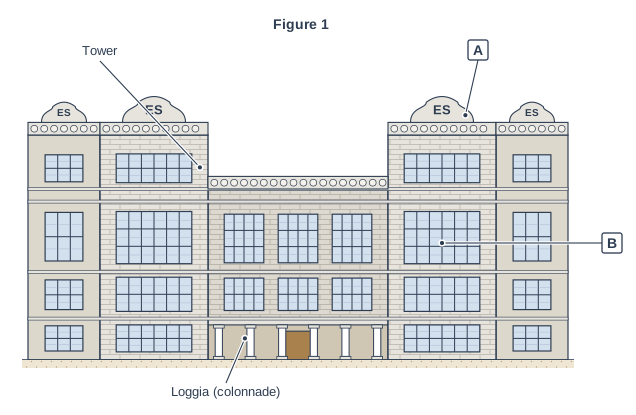
Figure 1 shows the entrance front of Hardwick Hall in Derbyshire, built in 1590-97. Who do the initials labelled A stand for, and why did the feature labelled B show off the owner's wealth?

Elevation of the front of a large stone house. The heading reads "Figure 1". A stone front, about 60 m wide and 28 m high. Two tall blocks stand forward at the ends of the front and two more, set back, are seen beyond them at the far left and right; each rises a storey above the rest and is crowned by a carved stone crest with two large letters, ES. Between the two front blocks the middle part has three storeys; across its ground floor runs a row of six columns with a doorway behind, in the middle. Almost the whole front is glass: very large windows divided by stone bars into many panes, getting taller floor by floor, so the top main floor has the tallest. A pierced stone band runs along the top; no roof or chimneys can be seen. Label A points to the large letters in the stone cresting on top of the tall blocks; label B points to the very large windows divided by stone bars into many panes; the label "Tower" points to the tall block at the left of the middle part, rising above the rest; the label "Loggia (colonnade)" points to the row of columns across the ground floor of the middle part.

Model answer

The initials ES stand for Elizabeth Shrewsbury, better known as Bess of Hardwick, Countess of Shrewsbury. Feature B is the huge windows: glass was very expensive, so a house that was 'more glass than wall' showed off her enormous wealth.

Explanation

Bess of Hardwick rose from a minor Derbyshire gentry family through four marriages to become, after the Queen, probably the richest woman in England. Her initials on every tower and the vast windows, tallest on the top floor where the state rooms were, advertised her wealth and status, as prodigy houses were meant to do.

Mark scheme
  1. 1 mark

    A: ES stands for Elizabeth Shrewsbury - Bess of Hardwick, Countess of Shrewsbury, who built the house.

    Accept Bess of Hardwick / Elizabeth, Countess of Shrewsbury / Elizabeth Talbot / Elizabeth Shrewsbury. Do not accept Elizabeth I or 'the Queen'.

  2. 1 mark

    B: the huge glass windows - glass was very expensive, so so much glass ('more glass than wall') showed great wealth.

    The mark needs the link between the windows/glass and its cost. Do not accept 'big windows' with no reason, or 'to let in light' alone.

Question 2

8 marks

Write an account of the ways in which the City of London authorities and Puritan preachers tried to stop or restrict the theatre in Elizabeth's reign.

Model answer

From the 1570s Puritan preachers attacked the theatre in sermons and pamphlets. A sermon at Paul's Cross in 1577 argued that sin caused plague and plays caused sin, so plays caused plague. John Northbrooke wrote against plays in about 1577, Stephen Gosson, a former playwright, published The School of Abuse in 1579, and Philip Stubbes attacked plays in The Anatomie of Abuses in 1583. They said that plays taught immorality, that boys dressing as women broke the law of the Bible, and that plays drew people away from church. When the stands at the Paris Garden bear-baiting arena collapsed on a Sunday in January 1583, killing about eight people, they presented it as God's judgement. Their aim was to persuade the authorities and the public that the stage was sinful.

The City authorities used their powers more directly. In 1574 the Common Council tried to license and restrict performances in City inns, banning them during church services and in times of plague. This was one reason why James Burbage built The Theatre in 1576 in Shoreditch, outside the City's jurisdiction. The Lord Mayor and aldermen then repeatedly petitioned the Privy Council to suppress the playhouses, arguing that crowds spread plague, attracted thieves and prostitutes, caused riots and drew apprentices away from work.

Their arguments sometimes succeeded. After a riot in Southwark in 1592 the Privy Council closed the playhouses, and plague kept them shut for most of the time until 1594. In July 1597 the Lord Mayor again asked for plays to be suppressed, and after The Isle of Dogs was judged seditious the Privy Council ordered the playhouses closed. In 1596 wealthy residents stopped adult players using the Blackfriars playhouse.

However, these successes were temporary. The playhouses reopened within months because the Queen and her council protected the licensed companies, which performed at court. The opposition therefore pushed the theatre out to Shoreditch and Bankside and limited it in plague years, but could not stop it, because royal protection, profits and popular demand were stronger.

Explanation

Puritans used sermons and pamphlets (Northbrooke, Gosson, Stubbes) and presented disasters as God's judgement, while the City used regulations, petitions and plague closures. Level 4 explains why they acted and why the court's protection meant their success was limited, rather than listing complaints.

Mark scheme
  1. 8 marks

    Levels of response (8 marks).
    Level 4 (7-8 marks): A coherent, logically structured account showing complex analysis of the campaign against the theatre: the methods used by Puritan writers and preachers (sermons, pamphlets, presenting disasters as God's judgement) and by the City (regulations, petitions to the Privy Council, plague closures, blocking Blackfriars), explaining why they acted and why they had only limited success, supported by precise knowledge.
    Level 3 (5-6 marks): A developed, organised account showing developed analysis of two or more methods or reasons, supported by accurate knowledge.
    Level 2 (3-4 marks): A simple, structured account showing simple analysis, with some accurate knowledge.
    Level 1 (1-2 marks): A basic, general narrative of opposition to the theatre with little analysis.
    0 marks: nothing worthy of credit.

    Indicative content (not a checklist; credit other valid points): Puritan preachers and writers: sermons at Paul's Cross (1577: sin causes plague and plays cause sin); John Northbrooke's treatise (about 1577); Stephen Gosson's The School of Abuse (1579); Philip Stubbes's The Anatomie of Abuses (1583); arguments - plays immoral, boys dressed as women against Scripture, idleness, drew people from church on Sundays and holy days; the Paris Garden collapse (January 1583, a Sunday, about eight killed) presented as God's judgement. City of London: in 1574 the Common Council tried to license and restrict plays in City inns (not during service time or plague); the Lord Mayor and aldermen repeatedly petitioned the Privy Council to suppress plays, citing plague, crime, disorder and apprentices missing work; plague closures - playhouses shut for most of 1592-94; after a riot in Southwark in June 1592 the Privy Council closed them for the summer; in July 1597 the Lord Mayor asked for plays to be suppressed and the Privy Council ordered the playhouses closed after The Isle of Dogs; in 1596 wealthy residents petitioned against adult players at Blackfriars and succeeded. Results: playhouses moved outside the City's jurisdiction to Shoreditch and Bankside; the Privy Council and the Queen protected licensed companies, so closures were temporary; in 1600 the Privy Council tried to limit London to two playhouses (the Globe and the Fortune). Analysis: why they acted (religion, plague, order) and why they failed (court support, profits, location).

Question 3

8 marks

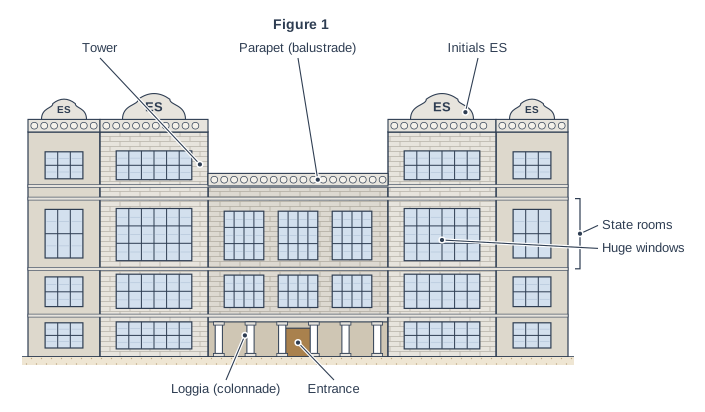
Figure 1 shows the entrance front of Hardwick Hall in Derbyshire, built in 1590-97 for Bess of Hardwick.

Explain what was important about prodigy houses such as Hardwick Hall, Burghley House and Longleat for the Elizabethan nobility and gentry.

Elevation of an Elizabethan prodigy house modelled on Hardwick Hall (1590-97), entrance front. The heading reads "Figure 1". A symmetrical stone front, about 60 m wide and 28 m high. Two tall towers stand forward at the ends of the front and two more, set back, are seen beyond them at the far left and right; every tower rises a storey above the rest of the house and is crowned by a strapwork crest carved with the initials ES (Elizabeth Shrewsbury, Bess of Hardwick). Between the front towers the centre has three storeys; across its ground floor runs a loggia (a colonnade of six columns) sheltering the entrance in the middle. Almost the whole front is glass: huge mullioned and transomed windows, getting taller floor by floor, so the top floor, with the state rooms, has the tallest (marked by a bracket at the right) ("Hardwick Hall, more glass than wall"). An openwork stone parapet runs along the top, hiding the flat roof; no chimneys show, because they are built inside the walls. The label "Initials ES" points to the large letters in the stone cresting on top of the tall blocks; the label "Tower" points to the tall block at the left of the middle part, rising above the rest; the label "Parapet (balustrade)" points to the pierced stone band along the top of the middle part; the label "Huge windows" points to the very large windows divided by stone bars into many panes; the label "State rooms" points to the bracket beside the top main floor, whose windows are the tallest; the label "Loggia (colonnade)" points to the row of columns across the ground floor of the middle part; the label "Entrance" points to the doorway behind the row of columns, in the middle.

Model answer

Prodigy houses were important first because they displayed their owners' wealth and status. They were enormous and symmetrical, and as Figure 1 shows, Hardwick Hall had huge windows at a time when glass was very expensive, so it was said to be 'more glass than wall'. Bess of Hardwick's initials, ES, stand on the top of every tower, announcing to everyone who had built it. The tallest windows lit the state rooms on the top floor, and long galleries were hung with portraits and tapestries that showed off the family's ancestry and connections. For a woman who had risen from a minor gentry family to become Countess of Shrewsbury, the house was a statement of her success.

Secondly, many prodigy houses were built to win royal favour. Elizabeth went on summer progresses, staying at the houses of her leading subjects, and hosting her was a great honour that could bring influence and rewards. William Cecil enlarged Theobalds to receive the Queen, who stayed there many times, and built Burghley House; Sir Christopher Hatton built Holdenby on a vast scale. These houses therefore linked the elite to the court and to the patronage system.

Thirdly, they showed the owners' learning and taste. Their symmetrical fronts and classical decoration followed Renaissance ideas from Italy and France, as at Longleat, begun by Sir John Thynne in 1568, and Wollaton Hall, built by Sir Francis Willoughby with profits from his coal mines. Inside, great chambers and withdrawing chambers gave the family more comfort and privacy, away from their servants.

However, they could also be a burden. The cost of building and entertaining was huge, and Hatton died heavily in debt to the Crown.

These consequences were linked: the houses displayed wealth and taste in order to win and show royal favour, which in turn brought more wealth and status. Their most important role was therefore as a public display of status in a society where rank and royal favour mattered above all.

Explanation

Prodigy houses displayed wealth (glass, size, ES initials), were built to receive the Queen on progress and win favour, showed Renaissance taste and gave privacy, but could bring debt. Level 4 links these consequences or makes a supported judgement about which was most important.

Mark scheme
  1. 8 marks

    Levels of response (8 marks).
    Level 4 (7-8 marks): Complex explanation of the importance of prodigy houses: explains two or more consequences with precise knowledge (e.g. displaying wealth, rank and lineage, gaining favour by receiving the Queen on progress, showing Renaissance learning and taste, giving comfort and privacy, the cost and debt involved) and shows how they are linked or reaches a judgement about the most important, using features such as those in Figure 1.
    Level 3 (5-6 marks): Developed explanation of two or more ways prodigy houses were important, supported by specific, accurate knowledge.
    Level 2 (3-4 marks): Simple explanation of one way prodigy houses were important, with some accurate knowledge.
    Level 1 (1-2 marks): Basic explanation: general statements about big houses with little specific knowledge.
    0 marks: nothing worthy of credit.

    Indicative content (not a checklist; credit other valid points): Display of wealth and status: size, symmetry and huge windows when glass was costly (Hardwick 'more glass than wall'); Bess of Hardwick's initials ES on the towers advertised the owner; the state rooms on the top floor with the tallest windows; long galleries with portraits and tapestries displayed lineage and connections; coats of arms. Royal favour: many were built to receive the Queen on her summer progresses - William Cecil said Theobalds was enlarged for her; Burghley House (Cecil), Holdenby (Sir Christopher Hatton); hosting the Queen brought honour and influence but cost a fortune. Renaissance taste and learning: symmetry and classical decoration copied from Italian and French books showed the owner was educated and fashionable; Longleat (Sir John Thynne, from 1568), Wollaton Hall (Sir Francis Willoughby, 1580-88). Comfort and privacy: chimneys, glass, great chambers and withdrawing chambers; the family lived apart from servants. Evidence of new wealth: built from rents, rising food prices, former monastic and Crown land, trade and industry (Willoughby's coal); the rise of the gentry and of new families such as the Cecils and Bess of Hardwick. Cost: building and entertaining could ruin families - Hatton died heavily in debt to the Crown. Judgement: e.g. most important as a display of status designed to win and show royal favour.

Question 4

16 marks

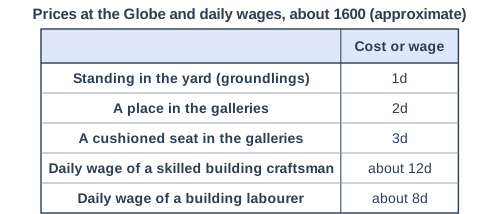
Figure 1 shows admission prices at the Globe and some typical daily wages in southern England in about 1600.

'The theatre was popular in Elizabethan England mainly because it was cheap.'

How far do you agree with this statement?

Explain your answer.

Prices at the Globe and daily wages, about 1600 (approximate). Table with columns (row headings), "Cost or wage". Standing in the yard (groundlings); Cost or wage: 1d | A place in the galleries; Cost or wage: 2d | A cushioned seat in the galleries; Cost or wage: 3d | Daily wage of a skilled building craftsman; Cost or wage: about 12d | Daily wage of a building labourer; Cost or wage: about 8d.

Model answer

Cheap prices were an important reason why the theatre was so popular, because they allowed ordinary Londoners to attend. However, I think the main reason was the quality and variety of the entertainment, because cheapness explains who could go but not why so many people chose to go again and again.

The case for cheapness is strong. It cost only a penny to stand in the yard of a playhouse such as the Globe, two pennies for the galleries and about three pennies for a cushioned seat. A craftsman earned about twelve pence a day by 1600, so a penny was affordable for apprentices, servants and craftsmen. Because the playhouses were large, with the Globe holding up to about 3,000 people, companies could keep prices low and still make money. Cheapness meant that the theatre was not only for the rich.

However, cheapness alone does not explain the theatre's popularity. Other entertainments, such as bear-baiting at Paris Garden, were also cheap, and the poorest still struggled to spare a penny, while workers had to miss work to see afternoon performances. Gentlemen, law students from the Inns of Court and nobles paid more for better places, so for them price was not the attraction.

The quality and variety of the plays mattered most. Audiences could see Marlowe's Tamburlaine, Kyd's The Spanish Tragedy and Shakespeare's comedies, tragedies and histories. Companies performed a changing programme, adding new plays often, as Philip Henslowe's diary shows, so there was always something new. Patriotic histories such as Henry V suited the national mood after the Armada. Star actors such as Richard Burbage, Edward Alleyn and the clowns Richard Tarlton and Will Kemp drew crowds of their own.

The spectacle and atmosphere also attracted people. Rich costumes, music, sword fights, ghosts rising through the trapdoor and the jig at the end made the theatre exciting, and people who could not read could still enjoy the stories. A visit was a social occasion, with food and drink sold in the crowd and the chance to be seen in fine clothes.

The theatre's popularity also depended on London itself. The city grew to perhaps 200,000 people by 1600, and many had money to spend on leisure. Shoreditch and Bankside were within easy reach, and protection from the Queen and her council allowed regular performances, despite opposition.

These factors were linked: cheap prices opened the playhouses to the many, but the plays and actors made them want to come back, and London's growing population supplied the crowds. Overall, I only partly agree. Cheapness made the theatre accessible, but the main reason it was so popular was the quality, variety and excitement of the entertainment itself.

Explanation

Prices of 1d, 2d and 3d made plays affordable, but other cheap entertainments existed and the rich paid more, so the quality of the plays, star actors, spectacle, the social occasion and London's growth also explain the theatre's popularity. Level 4 needs a sustained judgement about the main reason.

Mark scheme
  1. 16 marks

    Levels of response (16 marks).
    Level 4 (13-16 marks): Complex explanation of cheapness (1d for the yard, 2d and 3d for the galleries, affordable compared with wages) and of other reasons (the quality and variety of the plays, star actors, spectacle and staging, the social occasion, the growth of London and its audience, the location and size of the playhouses, royal and noble protection), leading to a sustained judgement about the main reason, supported by a wide range of precise knowledge and showing how the reasons were linked.
    Level 3 (9-12 marks): Developed explanation of cheapness and at least one other reason, supported by accurate knowledge, with a judgement that may not be fully sustained.
    Level 2 (5-8 marks): Simple explanation of cheapness or of another reason, with some accurate knowledge.
    Level 1 (1-4 marks): Basic explanation of one or more reasons why the theatre was popular: general statements with limited knowledge.
    0 marks: nothing worthy of credit.

    Indicative content (not a checklist; credit other valid points): Cheapness (for): 1d to stand in the yard as a groundling, 2d for the galleries, about 3d for a cushioned seat; a craftsman earned about 12d a day by 1600, so a penny was within reach of apprentices, servants and craftsmen; large playhouses (up to about 3,000 at the Globe) kept prices low. Against: the poorest still struggled to afford it, and workers had to miss work in the afternoon; bear-baiting and other entertainments were also cheap, so price alone does not explain why plays drew perhaps 15,000 or more a week. Other reasons: the plays - variety of comedies, tragedies and histories; Marlowe's Tamburlaine, Kyd's The Spanish Tragedy, Shakespeare's plays; companies performed a changing programme with frequent new plays (Henslowe's diary); patriotic histories after the Armada; star actors - Richard Burbage, Edward Alleyn, Richard Tarlton, Will Kemp; spectacle - rich costumes, music, fights, special effects (trapdoor, heavens), jigs; the social occasion - food and drink, being seen, lively crowds; plays were enjoyed by people who could not read; London's growth to perhaps 200,000 by 1600 and its prosperity gave a large audience with spare money; location - Shoreditch and Bankside within easy reach; protection by the court allowed regular performances; the gentry, nobles and law students paid more for better places, showing it was not only about price. Linking: low prices made it possible for the many to go, but the quality of the plays made them want to go repeatedly. Judgement: e.g. cheapness explains who could go, but the plays and actors explain why so many went.

Ready to try the rest? Every answer you write is marked against the mark scheme, so you can see exactly where the marks are.

AI Tutor Hints first, answers after you try

Hi! Stuck? Ask me for a hint and I’ll help you work it out. Once you’ve checked your answer I can explain exactly where the marks are.