'The main reason for Elizabethan voyages of exploration was the desire for wealth.'
How far do you agree with this statement?
Explain your answer.
Model answer
The desire for wealth was the most important reason for Elizabethan voyages, because it explains why investors, including the queen, were willing to pay for them. However, it was closely bound up with other reasons, especially rivalry with Catholic Spain, and some voyages were also driven by the search for glory, land and knowledge.
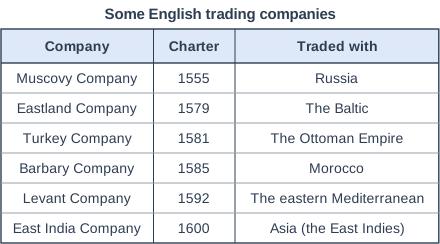
Wealth was clearly a powerful motive. Many voyages aimed to seize Spanish silver and gold from the Americas. Drake raided Nombre de Dios in Panama in 1572-73 and captured the treasure ship known as the Cacafuego in 1579, and the investors in his voyage around the world gained about £47 for every £1 they had put in. After war began in 1585, hundreds of privateering voyages set out to capture Spanish ships, such as the Madre de Deus in 1592. Other voyages sought wealth through trade. Hawkins's voyages of the 1560s traded enslaved Africans to Spanish colonies. When the Antwerp cloth market collapsed, culminating in the sack of Antwerp in 1576, merchants looked for new markets and for routes to the spices and silks of Asia. Frobisher's search for a North-West Passage in 1576-78 was paid for by investors hoping for trade and gold, and chartered companies such as the Levant Company (1592) and the East India Company (1600) existed to make profits. Even Raleigh, in 1595, went to Guiana in search of the gold of El Dorado.
However, rivalry with Spain and religion were also important. After the Spanish attack on Hawkins's fleet at San Juan de Ulúa in 1568, sailors such as Drake wanted revenge. Many Englishmen were Protestants who saw Catholic Spain as an enemy, and they resented Spain's claim to the Americas under the Treaty of Tordesillas. Richard Hakluyt's Discourse of Western Planting (1584), written to win support for Raleigh's plans, argued that colonies in America would provide bases against Spain and spread Protestantism. This rivalry made plunder seem patriotic rather than greedy.
The search for glory and royal favour also mattered. Drake was knighted in 1581 and Raleigh in 1585, and Raleigh named Virginia after the Virgin Queen. Some voyages aimed at colonisation: Gilbert claimed Newfoundland in 1583, and Raleigh sponsored the Roanoke colonies of 1585 and 1587, partly to find land for settlers. Curiosity and knowledge played a part as well: Thomas Harriot and John White studied and recorded the land and people of Virginia, and Hakluyt collected accounts of voyages in his Principal Navigations (1589). New ships and instruments, such as race-built galleons, the compass and the astrolabe, made such voyages possible, but they explain how rather than why people sailed.
These reasons were linked. Hostility to Spain and the hope of glory encouraged sailors, but voyages were expensive and risky, and they only happened when investors expected a profit. The queen herself invested secretly in Drake's voyage and took a large share of the treasure. Even the colonies were promoted as a source of wealth from new crops and goods.
Overall, I largely agree with the statement. The desire for wealth was the main reason, because almost every voyage depended on investors who wanted a return, but it was strengthened by rivalry with Spain and Protestant feeling, which made attacks on Spanish wealth seem a patriotic duty.
Explanation
Plunder, trade and new markets were the main motives, but rivalry with Spain, religion, glory, colonisation and curiosity also played a part, and new technology made voyages possible. Level 4 needs a sustained judgement that shows how the reasons were linked, for example that investors' hopes of profit decided which voyages happened.