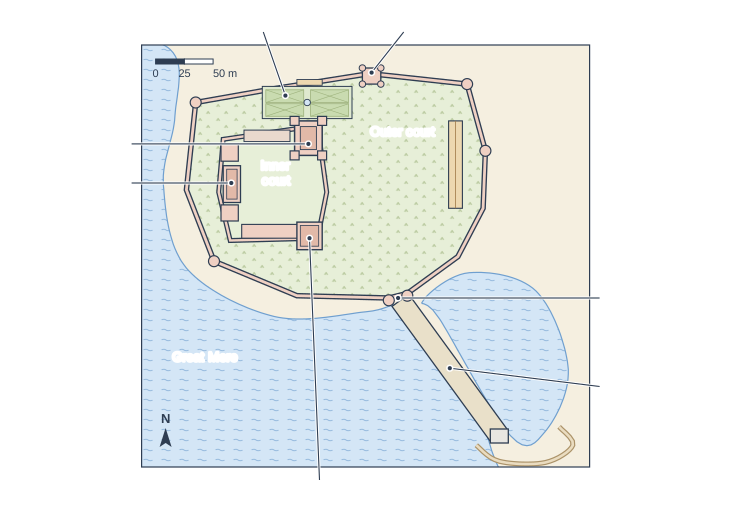
Figure 1 is a plan of Kenilworth Castle as it was in 1575.
'The main purpose of Robert Dudley's changes to Kenilworth Castle was to impress Elizabeth I.'
How far does a study of Kenilworth Castle support this statement? Explain your answer.
You should refer to Kenilworth Castle and your contextual knowledge.
Model answer
Robert Dudley spent huge sums transforming Kenilworth after Elizabeth granted it to him in 1563. A study of the castle shows that impressing the Queen was the most obvious purpose of his changes, but it was closely linked to another purpose: displaying his own wealth, status and power as the greatest nobleman at court.
There is strong evidence that the changes were meant to impress Elizabeth. As Figure 1 shows, the most striking new building was Leicester's Building, at the south-east corner of the inner court, built in 1571-72 specifically as lodgings for the Queen. Its huge windows gave her views over the Great Mere and the park. North of the great tower Dudley laid out a privy garden with knots, a fountain and an aviary, designed for her pleasure and overlooked by the royal rooms. The timing is revealing, because the work was done in time for her visits of 1572 and 1575. In 1575 she stayed for 19 days, longer than at any other courtier's house on her progresses, and the whole castle became a stage for entertainments in her honour: the Lady of the Lake on a floating island on the mere, fireworks, hunting, music and plays. Dudley owed his position entirely to Elizabeth's favour, and many historians think he also hoped the visit would persuade her to marry him.
However, the changes also served Dudley's own purposes. As Earl of Leicester he needed a seat worthy of his rank. Glass was very expensive, so the huge windows in Leicester's Building and the large windows put into older buildings such as the great tower displayed his wealth to everyone who saw them. Leicester's Gatehouse, a grand new entrance in the north wall, impressed every visitor, not just the Queen, and Dudley emblems such as the bear and ragged staff advertised his family. His brother Ambrose was Earl of Warwick, and Kenilworth showed the Dudleys' power in the Midlands. Dudley was also following fashion: other courtiers, such as William Cecil at Burghley House and Theobalds, were building great houses with large windows and gardens, partly to receive the Queen. Comfort mattered too, as modern, well-lit lodgings replaced dark medieval rooms. Finally, Dudley kept the great tower, the walls, the mere and John of Gaunt's great hall, linking himself to the castle's royal and chivalric past, which added to his prestige.
These purposes cannot really be separated. In Elizabethan England power came from the Queen's favour, and showing off that favour increased a courtier's power. By making Kenilworth fit to receive Elizabeth, Dudley showed the whole court that he was her closest favourite.
Overall, a study of Kenilworth largely supports the statement. The key new buildings, the garden and the timing of the work show that impressing Elizabeth was the main purpose. But Dudley impressed her in a way that also displayed his own wealth and power, so the Queen was the most important audience for a display that was also about Dudley himself.
Explanation
Leicester's Building, the privy garden and the timing for the 1572 and 1575 visits show the aim of impressing Elizabeth, but the windows, gatehouse, emblems and kept medieval features also displayed Dudley's own wealth, status and lineage in the latest fashion. Level 4 explains several purposes, shows how they were linked and sustains a judgement.