
Level:
Correct: 0
Incorrect: 0
Marks: 0/0
Exam Practice
Course:
Topics:
Edexcel A-Level Maths (Paper 1) Smart practice A mixed round aimed at your weak spots
Unit 1
Proof
Unit 2
Algebra and functions
Unit 3
Coordinate geometry in the (x, y) plane
Unit 4
Sequences and series
Unit 5
Trigonometry
Unit 6
Exponentials and logarithms
Unit 7
Differentiation
Unit 8
Integration
Unit 9
Numerical methods
Unit 10
Vectors
Avg
score:
–
Topics
done:
0/36

Vectors

Practise 18 exam-style questions on Vectors for Edexcel A-Level Maths (Paper 1). Write your answer as you would in the exam and get it marked in seconds against the mark scheme, point by point, with the Study Helper on hand if you get stuck.

  • 18 questions
  • 3–9 marks each
  • Instant marking
  • No sign-up needed
18 questions, marked as you go

Sample questions with model answers

Here are 4 of the questions in this topic, each with a model answer, an explanation of why it earns the marks and the mark scheme an examiner would use.

Question 1

3 marks

The vectors \(\mathbf{a}\) and \(\mathbf{b}\) are given by
\[\mathbf{a} = 3\mathbf{i} - 2\mathbf{j} + \mathbf{k}, \quad \mathbf{b} = p\mathbf{i} + 6\mathbf{j} + q\mathbf{k}\]
where \(p\) and \(q\) are constants.

Given that \(\mathbf{b}\) is parallel to \(\mathbf{a}\), find \(p\) and \(q\).

Model answer

\(\mathbf{b} = \lambda\mathbf{a}\): \(p\mathbf{i} + 6\mathbf{j} + q\mathbf{k} = 3\lambda\mathbf{i} - 2\lambda\mathbf{j} + \lambda\mathbf{k}\)
\(\mathbf{j}\): \(6 = -2\lambda\), so \(\lambda = -3\)
\(p = 3(-3) = -9\), \(q = -3\)

Explanation

Parallel vectors are scalar multiples of each other, so \(\mathbf{b} = \lambda\mathbf{a}\) for some scalar \(\lambda\). The \(\mathbf{j}\) components, which are both known, give \(\lambda = -3\), and then \(p\) and \(q\) follow. A common error is to drop the negative sign of \(\lambda\).

Mark scheme
  1. 1 mark

    M1 Writes \(\mathbf{b} = \lambda\mathbf{a}\) and uses the \(\mathbf{j}\) components to find \(\lambda = -3\); or correct answers \(p = -9\) and \(q = -3\) with no working

    Correct answers of \(p = -9\) and \(q = -3\) with no working score 3 marks. Equating ratios of components, \(\dfrac{p}{3} = \dfrac{6}{-2} = \dfrac{q}{1}\), is equivalent.

  2. 1 mark

    A1 \(p = -9\)

  3. 1 mark

    A1 \(q = -3\)

    Depends on the M mark. A common error is \(\lambda = 3\) (sign slip), giving \(p = 9\), \(q = 3\): M1A0A0.
Question 2

4 marks

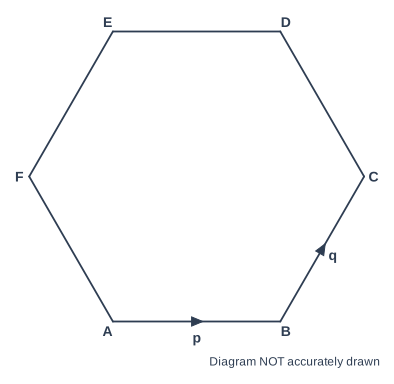
Figure 1 shows a regular hexagon \(ABCDEF\), with \(\overrightarrow{AB} = \mathbf{p}\) and \(\overrightarrow{BC} = \mathbf{q}\).

Find, in terms of \(\mathbf{p}\) and \(\mathbf{q}\), simplifying each answer,
\(\overrightarrow{CD}\), \(\overrightarrow{AD}\) and \(\overrightarrow{EC}\).

Geometry diagram, marked "Diagram NOT accurately drawn". Regular hexagon ABCDEF. AB has an arrow pointing from A to B and is labelled with the vector p (printed in bold). BC has an arrow pointing from B to C and is labelled with the vector q (printed in bold).

Model answer

In a regular hexagon, \(\overrightarrow{AD}\) is parallel to \(\overrightarrow{BC}\) and twice as long: \(\overrightarrow{AD} = 2\mathbf{q}\)
\(\overrightarrow{CD} = \overrightarrow{CB} + \overrightarrow{BA} + \overrightarrow{AD} = -\mathbf{q} - \mathbf{p} + 2\mathbf{q} = \mathbf{q} - \mathbf{p}\)
\(\overrightarrow{ED} = \overrightarrow{AB} = \mathbf{p}\) (opposite sides are equal and parallel)
\(\overrightarrow{EC} = \overrightarrow{ED} + \overrightarrow{DC} = \mathbf{p} - (\mathbf{q} - \mathbf{p}) = 2\mathbf{p} - \mathbf{q}\)

Explanation

Use the geometry of the regular hexagon: opposite sides are equal and parallel, so \(\overrightarrow{ED} = \mathbf{p}\), and the long diagonal \(\overrightarrow{AD}\) is parallel to \(\overrightarrow{BC}\) and twice its length. Each vector then comes from adding vectors along a route between its end points (the triangle law). A common error is a sign slip when a route goes against the direction of a given vector.

Mark scheme
  1. 1 mark

    B1 \(\overrightarrow{CD} = \mathbf{q} - \mathbf{p}\); or correct answers \(\mathbf{q} - \mathbf{p}\), \(2\mathbf{q}\) and \(2\mathbf{p} - \mathbf{q}\) with no working

    Correct answers of \(\mathbf{q} - \mathbf{p}\), \(2\mathbf{q}\) and \(2\mathbf{p} - \mathbf{q}\) with no working score 4 marks. (In a regular hexagon \(\overrightarrow{AD}\) is parallel to \(\overrightarrow{BC}\) and twice as long, and \(\overrightarrow{AB} + \overrightarrow{CD} = \overrightarrow{BC}\).)

  2. 1 mark

    B1 \(\overrightarrow{AD} = 2\mathbf{q}\)

    Accept \(\mathbf{p} + \mathbf{q} + (\mathbf{q} - \mathbf{p})\) simplified to \(2\mathbf{q}\); unsimplified is B0.

  3. 1 mark

    M1 Finds \(\overrightarrow{EC}\) by a valid route, e.g. \(\overrightarrow{ED} + \overrightarrow{DC}\) with \(\overrightarrow{ED} = \mathbf{p}\) and \(\overrightarrow{DC} = -(\text{their } \overrightarrow{CD})\), or \(\overrightarrow{EA} + \overrightarrow{AC}\)

    \(\overrightarrow{ED} = \mathbf{p}\) because \(ED\) is parallel and equal to \(AB\) in a regular hexagon.

  4. 1 mark

    A1 \(\overrightarrow{EC} = 2\mathbf{p} - \mathbf{q}\)

    cao, simplified.

Question 3

5 marks

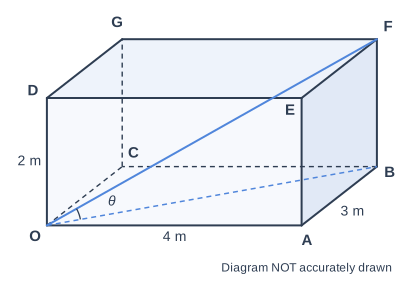
Figure 1 shows a frame in the shape of a cuboid \(OABCDEFG\). Relative to \(O\),
\[\overrightarrow{OA} = 4\mathbf{i}, \quad \overrightarrow{OC} = 3\mathbf{j}, \quad \overrightarrow{OD} = 2\mathbf{k}\]
where \(\mathbf{i}\) and \(\mathbf{j}\) are horizontal unit vectors, \(\mathbf{k}\) is a unit vector vertically upwards and distances are in metres. A straight rod joins \(O\) to \(F\).

Find \(\overrightarrow{OF}\) in the form \(a\mathbf{i} + b\mathbf{j} + c\mathbf{k}\), and find the length of the rod.

Find the angle \(\theta\) between the rod and the horizontal base \(OABC\), giving your answer in degrees to one decimal place.

A cuboid drawn in 3D with hidden edges shown as dashed lines. The length is labelled 4 m (along the front bottom edge). The width (the edge going back) is labelled 3 m (along the bottom edge going back on the right). The height is labelled 2 m (along the front left vertical edge). The vertices are labelled: base OABC (O front left, A front right, B back right, C back left) and top DEFG, with D above O, E above A, F above B and G above C. A straight line is drawn from O to F. A straight line is drawn from O to B. The angle BOF at O is marked θ. The diagram is labelled "Diagram NOT accurately drawn".

Model answer

\(\overrightarrow{OF} = \overrightarrow{OA} + \overrightarrow{AB} + \overrightarrow{BF} = 4\mathbf{i} + 3\mathbf{j} + 2\mathbf{k}\)
Length \(= \sqrt{16 + 9 + 4} = \sqrt{29}\) m (\(= 5.39\) m)
The projection of \(OF\) on the base is \(OB\), with \(OB = \sqrt{16 + 9} = 5\), and \(F\) is 2 m above \(B\).
\(\tan\theta = \dfrac{2}{5}\), \(\theta = 21.8^\circ\) (1 d.p.)

Explanation

\(\overrightarrow{OF}\) is the sum of the three edge vectors, and its length is its magnitude. The angle with the horizontal base is found in the right-angled triangle \(OBF\): the horizontal side \(OB = 5\) and the vertical side \(BF = 2\). A common error is to use the angle between \(OF\) and the edge \(OA\) instead of the base.

Mark scheme
  1. 1 mark

    B1 \(\overrightarrow{OF} = 4\mathbf{i} + 3\mathbf{j} + 2\mathbf{k}\); or correct answers \(4\mathbf{i} + 3\mathbf{j} + 2\mathbf{k}\), \(\sqrt{29}\) m and \(21.8^\circ\) with no working

    Correct answers of \(4\mathbf{i} + 3\mathbf{j} + 2\mathbf{k}\), \(\sqrt{29}\) m and \(21.8^\circ\) with no working score 5 marks. Accept a column vector; coordinates \((4, 3, 2)\) only are B0.

  2. 1 mark

    M1 Finds \(|\overrightarrow{OF}| = \sqrt{4^2 + 3^2 + 2^2}\)

  3. 1 mark

    A1 \(\sqrt{29}\) m (awrt 5.39 m, i.e. in [5.385, 5.395))

    Units not required.

  4. 1 mark

    M1 Uses the vertical component with a correct ratio: \(\sin\theta = \dfrac{2}{\sqrt{29}}\), or \(\tan\theta = \dfrac{2}{5}\) with \(OB = 5\), or \(\cos\theta = \dfrac{5}{\sqrt{29}}\)

    Using the angle with an edge (e.g. \(\cos\theta = \dfrac{4}{\sqrt{29}}\)) is M0.

  5. 1 mark

    A1 \(\theta = 21.8^\circ\) (awrt 21.8, i.e. in [21.75, 21.85))

Question 4

8 marks

In this question you must show all stages of your working.

In this question the unit vectors \(\mathbf{i}\) and \(\mathbf{j}\) point east and north respectively.

Megan walks from her starting point \(S\). She walks 3 km in a straight line on a bearing of \(060^\circ\), and then 5 km in a straight line on a bearing of \(150^\circ\), finishing at the point \(F\).

By writing each stage of the walk as a vector in terms of \(\mathbf{i}\) and \(\mathbf{j}\), find the exact distance \(SF\).

Find the bearing on which Megan must walk to return directly from \(F\) to \(S\), giving the bearing to the nearest 0.1°.

Model answer

Stage 1: \(3\sin 60^\circ\mathbf{i} + 3\cos 60^\circ\mathbf{j} = \dfrac{3\sqrt{3}}{2}\mathbf{i} + \dfrac{3}{2}\mathbf{j}\)
Stage 2: \(5\sin 150^\circ\mathbf{i} + 5\cos 150^\circ\mathbf{j} = \dfrac{5}{2}\mathbf{i} - \dfrac{5\sqrt{3}}{2}\mathbf{j}\)
\(\overrightarrow{SF} = \dfrac{5 + 3\sqrt{3}}{2}\mathbf{i} + \dfrac{3 - 5\sqrt{3}}{2}\mathbf{j}\)
\(SF^2 = \dfrac{(5 + 3\sqrt{3})^2 + (3 - 5\sqrt{3})^2}{4} = \dfrac{52 + 30\sqrt{3} + 84 - 30\sqrt{3}}{4} = \dfrac{136}{4} = 34\)
\(SF = \sqrt{34}\) km
\(\overrightarrow{FS} = -\overrightarrow{SF} = -5.098\mathbf{i} + 2.830\mathbf{j}\): west and north, at \(\arctan\dfrac{2.830}{5.098} = 29.0^\circ\) north of west
Bearing \(= 270^\circ + 29.0^\circ = 299.0^\circ\)

Explanation

Each stage of length \(r\) on bearing \(\theta\) is \(r\sin\theta\,\mathbf{i} + r\cos\theta\,\mathbf{j}\); adding the two vectors gives \(\overrightarrow{SF}\), whose magnitude simplifies exactly to \(\sqrt{34}\). The return journey is in the direction of \(\overrightarrow{FS} = -\overrightarrow{SF}\), which points north-west, so its bearing is \(270^\circ + 29.0^\circ\). Common errors are swapping sine and cosine for bearings and giving the bearing of \(F\) from \(S\) instead.

Mark scheme
  1. 1 mark

    M1 Writes one stage as a vector, e.g. \(3\sin 60^\circ\mathbf{i} + 3\cos 60^\circ\mathbf{j}\). An answer with no working scores 0 marks

    An answer with no working scores 0 marks: the question asks for vectors and all stages of working. A solution that uses Pythagoras directly (the two stages are perpendicular) without vectors scores M0A0M0A0 for the vector marks but can score the remaining M1A1 for \(\sqrt{34}\) and M1A1 for the bearing.

  2. 1 mark

    A1 Both stages correct: \(\dfrac{3\sqrt{3}}{2}\mathbf{i} + \dfrac{3}{2}\mathbf{j}\) and \(\dfrac{5}{2}\mathbf{i} - \dfrac{5\sqrt{3}}{2}\mathbf{j}\)

    Allow decimals (\(2.598\mathbf{i} + 1.5\mathbf{j}\), \(2.5\mathbf{i} - 4.330\mathbf{j}\)) for this mark.

  3. 1 mark

    M1 Adds their two vectors to find \(\overrightarrow{SF}\)

  4. 1 mark

    A1 \(\overrightarrow{SF} = \dfrac{5 + 3\sqrt{3}}{2}\mathbf{i} + \dfrac{3 - 5\sqrt{3}}{2}\mathbf{j}\) (in decimals, \(5.10\mathbf{i} - 2.83\mathbf{j}\) to 3 s.f.)

  5. 1 mark

    M1 Finds the magnitude of their \(\overrightarrow{SF}\)

  6. 1 mark

    A1 \(SF = \sqrt{34}\) km

    Exact value required (from \(\dfrac{136}{4} = 34\)); 5.83 only is A0.

  7. 1 mark

    M1 Finds a correct angle from the components of \(\overrightarrow{SF}\) or \(\overrightarrow{FS}\), e.g. \(\arctan\dfrac{2.830}{5.098} = 29.0^\circ\) below east, and uses it towards a bearing

    Accept an angle in [28.95, 29.05) (or its complement in [60.95, 61.05)). Alternative: the bearing of \(F\) from \(S\) is \(060^\circ + \arctan\dfrac{5}{3} = 119.0^\circ\) (right angle between the stages), then adds \(180^\circ\).

  8. 1 mark

    A1 \(299.0^\circ\) (awrt 299.0, i.e. in [298.95, 299.05))

    \(119.0^\circ\) (the bearing of \(F\) from \(S\)) is A0.

Ready to try the rest? Every answer you write is marked against the mark scheme, so you can see exactly where the marks are.

Study Helper Hints first, answers after you try

Stuck on this one? Ask for a hint and I’ll point you in the right direction, without giving the answer away. Once you’ve checked your answer, I’ll show you how the marks are awarded.