Level:
Correct: 0
Incorrect: 0
Marks: 0/0
Exam Practice
Course:
Topics:
Edexcel A-Level Maths (Paper 1) Smart practice A mixed round aimed at your weak spots
Unit 1
Proof
Unit 2
Algebra and functions
Unit 3
Coordinate geometry in the (x, y) plane
Unit 4
Sequences and series
Unit 5
Trigonometry
Unit 6
Exponentials and logarithms
Unit 7
Differentiation
Unit 8
Integration
Unit 9
Numerical methods
Unit 10
Vectors
Avg
score:
–
Topics
done:
0/36

Definite integrals and areas

Practise 19 exam-style questions on Definite integrals and areas for Edexcel A-Level Maths (Paper 1). Write your answer as you would in the exam and get it marked in seconds against the mark scheme, point by point, with the Study Helper on hand if you get stuck.

  • 19 questions
  • 2–10 marks each
  • Instant marking
  • No sign-up needed
19 questions, marked as you go

Sample questions with model answers

Here are 4 of the questions in this topic, each with a model answer, an explanation of why it earns the marks and the mark scheme an examiner would use.

Question 1

3 marks

The cross-section of the surface layer of a road is modelled as the region bounded by the \(x\)-axis, the lines \(x = -5\) and \(x = 5\), and the curve with equation
\[y = 0.25 - \dfrac{x^2}{400}, \quad -5 \leqslant x \leqslant 5\]
where \(x\) metres is the horizontal distance from the centre line of the road and \(y\) metres is the thickness of the layer.

Find the volume of material needed for the surface layer of a 1 km length of this road. Give your answer in m\(^3\) to 3 significant figures.

Model answer

Area \(= \displaystyle\int_{-5}^{5} \left(0.25 - \dfrac{x^2}{400}\right) dx = \left[0.25x - \dfrac{x^3}{1200}\right]_{-5}^{5}\)
\(= \left(1.25 - \dfrac{125}{1200}\right) - \left(-1.25 + \dfrac{125}{1200}\right) = 2.5 - \dfrac{250}{1200} = \dfrac{55}{24}\) m\(^2\)
Volume \(= \dfrac{55}{24} \times 1000 = 2291.6\ldots\)
Volume \(= 2290\) m\(^3\) (3 s.f.)

Explanation

The area of the cross-section is the integral of the thickness across the road from \(x = -5\) to \(x = 5\), and the volume is that area multiplied by the length, 1000 m. Because the curve is symmetrical you may double the integral from 0 to 5. A common error is forgetting to convert 1 km to 1000 m.

Mark scheme
  1. 1 mark

    M1 Integrates (\(x^2 \to kx^3\), with \(0.25 \to 0.25x\)) and uses the limits 5 and \(-5\) (or doubles the integral from 0 to 5); or a correct final answer of 2290 m\(^3\) with no working

    An answer of 2290 m\(^3\) with no working scores 3 marks.

  2. 1 mark

    A1 Area of cross-section \(= \dfrac{55}{24}\) m\(^2\) (awrt 2.29, i.e. [2.285, 2.295))

    May be implied by a correct volume.

  3. 1 mark

    A1 Volume awrt 2290 m\(^3\), i.e. [2285, 2295)

    Area \(\times\) 1000. Units not required. A common error is to multiply by 1 instead of 1000 (1 km = 1000 m): A0.
Question 2

5 marks

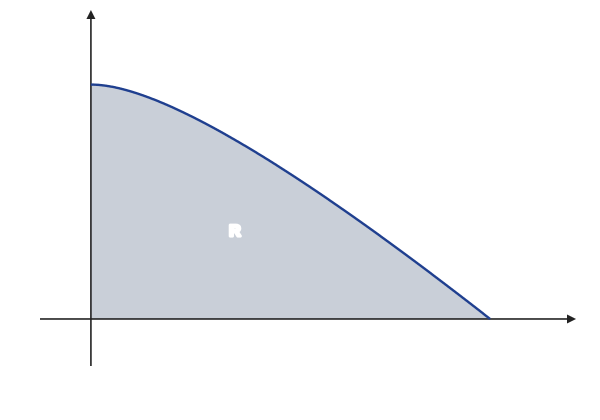
Figure 1 shows a sketch of the curve \(C\) with parametric equations
\[x = t^2 + 2t, \quad y = 4 - t^2, \quad 0 \leqslant t \leqslant 2\]
The curve starts at the point \(A(0, 4)\) on the \(y\)-axis and ends at the point \(B(8, 0)\) on the \(x\)-axis. The finite region \(R\), shown shaded in Figure 1, is bounded by \(C\) and the coordinate axes.

Show that the area of \(R\) is given by
\[\int_{0}^{2} \left(8 + 8t - 2t^2 - 2t^3\right) dt\]
Hence, or otherwise, using algebraic integration, find the exact area of \(R\).

Figure 1: a sketch of the curve C, which starts at the point A on the positive y-axis and falls, more and more steeply, to the point B on the positive x-axis. The region R between C and the coordinate axes is shaded.

Model answer

\(\dfrac{dx}{dt} = 2t + 2\), so area \(= \displaystyle\int y\,\dfrac{dx}{dt}\,dt = \int (4 - t^2)(2t + 2)\,dt = \int \left(8 + 8t - 2t^2 - 2t^3\right) dt\)
At \(A\), \(x = 0\) with \(t \geqslant 0\), so \(t = 0\); at \(B\), \(y = 0\) with \(t \geqslant 0\), so \(t = 2\).
Area \(= \displaystyle\int_{0}^{2} \left(8 + 8t - 2t^2 - 2t^3\right) dt\)
\(= \left[8t + 4t^2 - \dfrac{2t^3}{3} - \dfrac{t^4}{2}\right]_{0}^{2} = 16 + 16 - \dfrac{16}{3} - 8 = \dfrac{56}{3}\)

Explanation

For a curve given parametrically, the area under it is \(\int y\,\dfrac{dx}{dt}\,dt\), with the limits changed to the values of \(t\) at the ends of the region. Here \(t = 0\) at \(A\) and \(t = 2\) at \(B\), and the integrand expands to \(8 + 8t - 2t^2 - 2t^3\), giving \(\dfrac{56}{3}\). Common errors are using the \(x\)-limits 0 and 8 with the \(t\)-integral and leaving out the factor \(\dfrac{dx}{dt}\).

Mark scheme
  1. 1 mark

    M1 Uses area \(= \displaystyle\int y\,\dfrac{dx}{dt}\,dt\) with \(\dfrac{dx}{dt} = 2t + 2\): \(\displaystyle\int (4 - t^2)(2t + 2)\,dt\). An answer with no working scores 0 marks.

    An answer with no working scores 0 marks: the first step is a 'show that', and an area of \(\dfrac{56}{3}\) alone scores 0. Attempts using \(\int x\,\dfrac{dy}{dt}\,dt\) or \(\int y\,dt\) score M0.

  2. 1 mark

    B1 Justifies the limits: \(t = 0\) at \(A\) (where \(x = 0\) with \(t \geqslant 0\)) and \(t = 2\) at \(B\) (where \(y = 0\) with \(t \geqslant 0\))

    Values of \(t\) from either coordinate are acceptable, e.g. \(t^2 + 2t = 8\) gives \(t = 2\) (rejecting \(t = -4\)).

  3. 1 mark

    A1* \(\displaystyle\int_{0}^{2} \left(8 + 8t - 2t^2 - 2t^3\right) dt\) with the integral sign, the limits and \(dt\)

    cso. Requires the M1. The expansion \((4 - t^2)(2t + 2) = 8t + 8 - 2t^3 - 2t^2\) must be seen or clearly implied.

  4. 1 mark

    M1 Integrates: at least one power of \(t\) increased by 1

    Alternative ('or otherwise'): the Cartesian equation \(y = 2 - x + 2\sqrt{1 + x}\) integrated from 0 to 8 scores M1A1 for these two marks.

  5. 1 mark

    A1 \(\dfrac{56}{3}\)

    From \(\left[8t + 4t^2 - \dfrac{2t^3}{3} - \dfrac{t^4}{2}\right]_{0}^{2} = 16 + 16 - \dfrac{16}{3} - 8\). Accept \(18\tfrac{2}{3}\); a decimal only (18.7) is A0 for an exact area.

Question 3

6 marks

In this question you must show all stages of your working.
Solutions relying entirely on calculator technology are not acceptable.

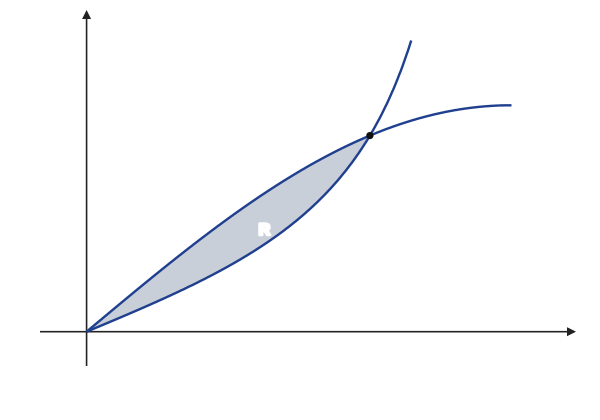
Figure 1 shows a sketch of the curves with equations \(y = 2\sin x\) and \(y = \tan x\), for \(0 \leqslant x < \dfrac{\pi}{2}\), where \(x\) is in radians.
The curves meet at the origin \(O\) and at the point \(P\). The finite region \(R\), shown shaded in Figure 1, is bounded by the two curves.

[You may use \(\displaystyle\int \tan x\,dx = \ln|\sec x| + c\)]

Show that the area of \(R\) is \(1 - \ln 2\).

Figure 1: a sketch of the curves y = 2 sin x and y = tan x for x from 0 to just under π/2. Both start at the origin O. Near O, y = 2 sin x is above y = tan x; they cross at P, after which y = tan x rises steeply above y = 2 sin x. The region R between the two curves from O to P is shaded.

Model answer

\(2\sin x = \dfrac{\sin x}{\cos x} \Rightarrow \sin x\,(2\cos x - 1) = 0\)
\(\sin x = 0\) gives \(O\); \(\cos x = \dfrac{1}{2}\) gives \(x = \dfrac{\pi}{3}\) at \(P\)
For \(0 < x < \dfrac{\pi}{3}\), \(2\sin x > \tan x\).
Area \(= \displaystyle\int_{0}^{\frac{\pi}{3}} \left(2\sin x - \tan x\right) dx = \left[-2\cos x - \ln|\sec x|\right]_{0}^{\frac{\pi}{3}}\)
\(= \left(-2 \times \dfrac{1}{2} - \ln 2\right) - \left(-2 - \ln 1\right)\)
\(= -1 - \ln 2 + 2 = 1 - \ln 2\)

Explanation

Solve \(2\sin x = \tan x\) by writing \(\tan x = \dfrac{\sin x}{\cos x}\) and factorising, which gives \(\cos x = \dfrac{1}{2}\) and the upper limit \(\dfrac{\pi}{3}\). Then integrate (upper curve minus lower curve), using \(\int \tan x\,dx = \ln|\sec x|\), and substitute exact values with \(\ln 1 = 0\). Common errors are a sign error on \(-2\cos x\) and working in degrees.

Mark scheme
  1. 1 mark

    M1 Sets \(2\sin x = \tan x\) and uses \(\tan x = \dfrac{\sin x}{\cos x}\) to reach \(\cos x = \dfrac{1}{2}\) (or \(\sin x(2\cos x - 1) = 0\)). An answer with no working scores 0 marks.

    An answer with no working scores 0 marks: this is a 'show that' question. Dividing by \(\sin x\) is condoned here, as the root \(x = 0\) is the point \(O\).

  2. 1 mark

    A1 \(x = \dfrac{\pi}{3}\) at \(P\)

    Must be in radians: \(60^\circ\) scores A0 unless converted.

  3. 1 mark

    M1 Integrates \(2\sin x - \tan x\) (or each curve separately): \(2\sin x \to \pm 2\cos x\) or \(\tan x \to \pm\ln|\sec x|\) (or \(\mp\ln|\cos x|\))

  4. 1 mark

    A1 \(-2\cos x - \ln|\sec x|\) oe

    Accept \(-2\cos x + \ln|\cos x|\).

  5. 1 mark

    M1 (dM1) Substitutes \(\dfrac{\pi}{3}\) and 0 and subtracts, using \(\cos\dfrac{\pi}{3} = \dfrac{1}{2}\) and \(\sec\dfrac{\pi}{3} = 2\)

    Depends on the M mark for integrating.

  6. 1 mark

    A1* \(1 - \ln 2\) with no errors, from a correct line such as \(\left(-1 - \ln 2\right) - \left(-2 - \ln 1\right)\)

    cso. Decimal working (0.307) scores A0*.

Question 4

8 marks

In this question you must show all stages of your working.
Solutions relying entirely on calculator technology are not acceptable.

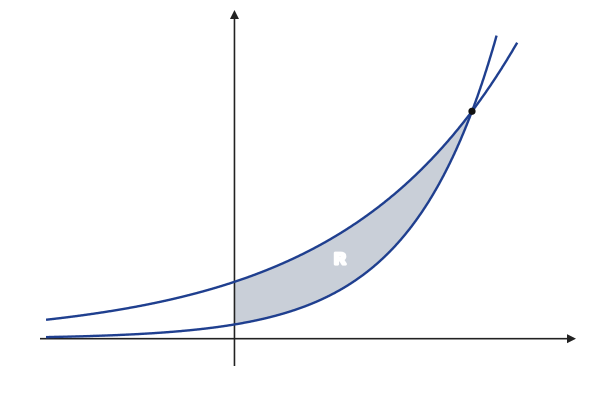
Figure 1 shows a sketch of parts of the curves \(C_1\) and \(C_2\) with equations
\[C_1: y = \mathrm{e}^{2x} \qquad C_2: y = 4\mathrm{e}^{x}\]
The curves meet at the point \(P\). The finite region \(R\), shown shaded in Figure 1, is bounded by \(C_1\), \(C_2\) and the \(y\)-axis.

Show that the area of \(R\) is \(\dfrac{9}{2}\).

The line with equation \(x = k\), where \(k\) is a constant, divides \(R\) into two regions of equal area.

Find the exact value of \(k\), giving your answer in the form \(\ln\left(p + q\sqrt{2}\right)\), where \(p\) and \(q\) are rational numbers.

Figure 1: a sketch of parts of two increasing exponential curves, C1 and C2, which both cross the positive y-axis, with C2 above C1 there. The curves meet at the point P in the first quadrant, and C1 is above C2 to the right of P. The region R, between the two curves from the y-axis to P, is shaded.

Model answer

\(\mathrm{e}^{2x} = 4\mathrm{e}^{x} \Rightarrow \mathrm{e}^{x}\left(\mathrm{e}^{x} - 4\right) = 0 \Rightarrow \mathrm{e}^{x} = 4\) (as \(\mathrm{e}^{x} > 0\)), so the curves meet where \(x = \ln 4\)
For \(0 < x < \ln 4\), \(C_2\) lies above \(C_1\) (at \(x = 0\): \(4 > 1\))
Area of \(R = \displaystyle\int_0^{\ln 4} \left(4\mathrm{e}^{x} - \mathrm{e}^{2x}\right) dx = \left[4\mathrm{e}^{x} - \dfrac{1}{2}\mathrm{e}^{2x}\right]_0^{\ln 4}\)
\(= \left(4 \times 4 - \dfrac{1}{2} \times 16\right) - \left(4 - \dfrac{1}{2}\right) = 8 - \dfrac{7}{2} = \dfrac{9}{2}\)
The line \(x = k\) cuts off half of \(R\): \(\left[4\mathrm{e}^{x} - \dfrac{1}{2}\mathrm{e}^{2x}\right]_0^{k} = \dfrac{9}{4}\)
\(4\mathrm{e}^{k} - \dfrac{1}{2}\mathrm{e}^{2k} - \dfrac{7}{2} = \dfrac{9}{4} \Rightarrow 2\mathrm{e}^{2k} - 16\mathrm{e}^{k} + 23 = 0\)
\(\mathrm{e}^{k} = \dfrac{16 \pm \sqrt{256 - 184}}{4} = \dfrac{16 \pm 6\sqrt{2}}{4} = 4 \pm \dfrac{3}{2}\sqrt{2}\)
The line must cross \(R\), so \(0 < k < \ln 4\) and \(1 < \mathrm{e}^{k} < 4\); \(4 + \dfrac{3}{2}\sqrt{2} > 4\) is rejected
\(k = \ln\left(4 - \dfrac{3}{2}\sqrt{2}\right)\)

Explanation

The curves meet where \(\mathrm{e}^{x} = 4\), so \(R\) runs from \(x = 0\) to \(x = \ln 4\) with \(C_2\) above \(C_1\); integrating the difference and using \(\mathrm{e}^{\ln 4} = 4\) gives \(\dfrac{9}{2}\). For the dividing line, the area from 0 to \(k\) must be \(\dfrac{9}{4}\), which gives a quadratic in \(\mathrm{e}^{k}\), and only the root between 1 and 4 gives a line that crosses \(R\). Common errors are integrating \(\mathrm{e}^{2x}\) as \(2\mathrm{e}^{2x}\) and keeping both roots.

Mark scheme
  1. 1 mark

    M1 Solves \(\mathrm{e}^{2x} = 4\mathrm{e}^{x}\) to reach \(\mathrm{e}^{x} = 4\) (e.g. by dividing by \(\mathrm{e}^{x}\), or factorising \(\mathrm{e}^{x}\left(\mathrm{e}^{x} - 4\right) = 0\), or taking logarithms: \(2x = \ln 4 + x\)) and finds \(x\). An answer with no working scores 0 marks.

    An answer of \(k = \ln\left(4 - \tfrac{3}{2}\sqrt{2}\right)\) with no working scores 0 marks, and so does an area of \(\dfrac{9}{2}\) with no working: the question demands all stages of working. Solving \(\mathrm{e}^{x} = 4\) by a decimal search scores M0.

  2. 1 mark

    A1 The curves meet where \(x = \ln 4\)

    Accept \(2\ln 2\). The \(y\)-coordinate of \(P\) (16) is not required. Rejecting \(\mathrm{e}^{x} = 0\) need not be mentioned.

  3. 1 mark

    M1 Integrates \(4\mathrm{e}^{x} - \mathrm{e}^{2x}\) (or \(\mathrm{e}^{2x} - 4\mathrm{e}^{x}\)) to the form \(\alpha\mathrm{e}^{x} + \beta\mathrm{e}^{2x}\), \(\alpha, \beta ≠ 0\)

    Accept integrating each curve separately (between the same limits) and subtracting.

  4. 1 mark

    A1 \(4\mathrm{e}^{x} - \dfrac{1}{2}\mathrm{e}^{2x}\) (or its negative)

    A common error is integrating \(\mathrm{e}^{2x}\) to \(2\mathrm{e}^{2x}\); this scores M1 A0.

  5. 1 mark

    A1* Uses the limits \(\ln 4\) and 0 and \(\mathrm{e}^{\ln 4} = 4\), \(\mathrm{e}^{2\ln 4} = 16\): \(\left(16 - 8\right) - \left(4 - \dfrac{1}{2}\right) = \dfrac{9}{2}\), cso

    Depends on the second M mark and needs a correct integral. The substitution of both limits must be seen; a decimal value 4.5 from a calculator alone is A0*. If the reverse subtraction gives \(-\dfrac{9}{2}\), the change of sign must be explained for A1*.

  6. 1 mark

    M1 Forms an equation for \(k\) using half of the area: \(\left[4\mathrm{e}^{x} - \dfrac{1}{2}\mathrm{e}^{2x}\right]_0^{k} = \dfrac{9}{4}\), i.e. \(4\mathrm{e}^{k} - \dfrac{1}{2}\mathrm{e}^{2k} - \dfrac{7}{2} = \dfrac{9}{4}\)

    Follow through their integral. Equivalent methods: \(\displaystyle\int_k^{\ln 4} \left(4\mathrm{e}^{x} - \mathrm{e}^{2x}\right) dx = \dfrac{9}{4}\), or equating the areas on either side of \(x = k\).

  7. 1 mark

    M1 (dM1) Rearranges to a three-term quadratic in \(\mathrm{e}^{k}\), e.g. \(2\mathrm{e}^{2k} - 16\mathrm{e}^{k} + 23 = 0\), and solves it by the formula or completing the square: \(\mathrm{e}^{k} = \dfrac{16 \pm \sqrt{72}}{4} = 4 \pm \dfrac{3}{2}\sqrt{2}\)

    Depends on the previous M mark. A substitution such as \(u = \mathrm{e}^{k}\) may be used. The quadratic may be in any equivalent form, e.g. \(\mathrm{e}^{2k} - 8\mathrm{e}^{k} + \dfrac{23}{2} = 0\).

  8. 1 mark

    A1 \(k = \ln\left(4 - \dfrac{3}{2}\sqrt{2}\right)\) only, rejecting \(\mathrm{e}^{k} = 4 + \dfrac{3}{2}\sqrt{2}\) because the line must cross \(R\), so \(0 < k < \ln 4\) and \(1 < \mathrm{e}^{k} < 4\), cso

    Accept \(\ln\left(\dfrac{8 - 3\sqrt{2}}{2}\right)\), i.e. \(p = 4\) and \(q = -\dfrac{3}{2}\). Giving both values, or rejecting the other value with no reason, scores A0. A decimal answer (0.631) alone scores A0, as an exact value is required.

Ready to try the rest? Every answer you write is marked against the mark scheme, so you can see exactly where the marks are.

Study Helper Hints first, answers after you try

Stuck on this one? Ask for a hint and I’ll point you in the right direction, without giving the answer away. Once you’ve checked your answer, I’ll show you how the marks are awarded.