
Level:
Correct: 0
Incorrect: 0
Marks: 0/0
Exam Practice
Course:
Topics:
Edexcel A-Level Maths (Paper 1) Smart practice A mixed round aimed at your weak spots
Unit 1
Proof
Unit 2
Algebra and functions
Unit 3
Coordinate geometry in the (x, y) plane
Unit 4
Sequences and series
Unit 5
Trigonometry
Unit 6
Exponentials and logarithms
Unit 7
Differentiation
Unit 8
Integration
Unit 9
Numerical methods
Unit 10
Vectors
Avg
score:
–
Topics
done:
0/36

Parametric equations

Practise 18 exam-style questions on Parametric equations for Edexcel A-Level Maths (Paper 1). Write your answer as you would in the exam and get it marked in seconds against the mark scheme, point by point, with the Study Helper on hand if you get stuck.

  • 18 questions
  • 2–9 marks each
  • Instant marking
  • No sign-up needed
18 questions, marked as you go

Sample questions with model answers

Here are 4 of the questions in this topic, each with a model answer, an explanation of why it earns the marks and the mark scheme an examiner would use.

Question 1

3 marks

The curve \(C\) has parametric equations
\[x = t + 2, \quad y = \dfrac{5}{t}, \quad t > 0\]
By eliminating \(t\), express \(y\) as a function of \(x\). Write down the set of possible values of \(x\) on \(C\).

Model answer

\(t = x - 2\)
\(y = \dfrac{5}{x - 2}\)
Since \(t > 0\), \(x = t + 2 > 2\), so the domain is \(x > 2\).

Explanation

Eliminate \(t\) by writing \(t = x - 2\) and substituting into \(y\). The restriction on the parameter carries over to \(x\): \(t > 0\) means \(x > 2\), so \(C\) is only one branch of the curve \(y = \dfrac{5}{x - 2}\). A common error is to omit the domain or to give \(x\) ≠ 2.

Mark scheme
  1. 1 mark

    M1 Uses \(t = x - 2\) and substitutes into \(y = \dfrac{5}{t}\); or correct final answers \(y = \dfrac{5}{x - 2}\) and \(x > 2\) with no working

    Correct answers of \(y = \dfrac{5}{x - 2}\) and \(x > 2\) with no working score 3 marks.

  2. 1 mark

    A1 \(y = \dfrac{5}{x - 2}\)

    Accept \(\mathrm{f}(x) = \dfrac{5}{x - 2}\).

  3. 1 mark

    B1 Domain \(x > 2\)

    From \(t > 0\). Accept \(\{x : x > 2\}\) or \((2, \infty)\). \(x \geqslant 2\) or \(x\) ≠ 2 is B0.
Question 2

4 marks

The curve \(C\) has parametric equations
\[x = \cos t - \sin t, \quad y = 3\sin 2t, \quad 0 \leqslant t < 2\pi\]
Find a Cartesian equation of \(C\) in the form \(y = \mathrm{f}(x)\), and state the domain of \(\mathrm{f}\).

Model answer

\(x^2 = (\cos t - \sin t)^2 = \cos^2 t - 2\sin t\cos t + \sin^2 t = 1 - \sin 2t\)
So \(\sin 2t = 1 - x^2\), and \(y = 3\sin 2t = 3(1 - x^2)\)
\(y = 3 - 3x^2\)
\(x = \cos t - \sin t = \sqrt{2}\cos\left(t + \dfrac{\pi}{4}\right)\), which takes every value from \(-\sqrt{2}\) (at \(t = \dfrac{3\pi}{4}\)) to \(\sqrt{2}\) (at \(t = \dfrac{7\pi}{4}\)) for \(0 \leqslant t < 2\pi\).
So the domain of \(\mathrm{f}\) is \(-\sqrt{2} \leqslant x \leqslant \sqrt{2}\).

Explanation

Squaring \(x\) produces \(2\sin t\cos t = \sin 2t\), and \(\cos^2 t + \sin^2 t = 1\) removes the other terms, so \(\sin 2t = 1 - x^2\) and \(y = 3 - 3x^2\). The parameter only gives values of \(x\) from \(-\sqrt{2}\) to \(\sqrt{2}\), so \(C\) is the arc of the parabola between \((-\sqrt{2}, -3)\) and \((\sqrt{2}, -3)\). Common errors are squaring \(\cos t - \sin t\) as \(\cos^2 t - \sin^2 t\) and omitting or misstating the domain.

Mark scheme
  1. 1 mark

    M1 Squares \(x\): \(x^2 = \cos^2 t - 2\sin t\cos t + \sin^2 t\); or correct final answers \(y = 3 - 3x^2\) and \(-\sqrt{2} \leqslant x \leqslant \sqrt{2}\) with no working

    Correct answers of \(y = 3 - 3x^2\) and \(-\sqrt{2} \leqslant x \leqslant \sqrt{2}\) with no working score 4 marks. A common error is \((\cos t - \sin t)^2 = \cos^2 t - \sin^2 t\): M0.

  2. 1 mark

    M1 Uses \(\cos^2 t + \sin^2 t = 1\) and \(\sin 2t = 2\sin t\cos t\) to obtain \(x^2 = 1 - \sin 2t\), or \(\sin 2t = 1 - x^2\)

    Both identities must be used correctly.

  3. 1 mark

    A1 \(y = 3 - 3x^2\)

    Depends on both M marks. Accept \(y = 3(1 - x^2)\) or any equivalent form with \(y\) as the subject.

  4. 1 mark

    B1 Domain \(-\sqrt{2} \leqslant x \leqslant \sqrt{2}\)

    For example because \(x = \sqrt{2}\cos\left(t + \dfrac{\pi}{4}\right)\), or because \(x^2 = 1 - \sin 2t\) takes every value from 0 to 2. Accept \(\lvert x \rvert \leqslant \sqrt{2}\) or \(\{x : -\sqrt{2} \leqslant x \leqslant \sqrt{2}\}\). Strict inequalities, \(x \in \mathbb{R}\) or \(-1 \leqslant x \leqslant 1\) score B0.

Question 3

6 marks

The curve \(C\) has parametric equations
\[x = 1 + \mathrm{e}^t, \quad y = \mathrm{e}^{2t} - 2\mathrm{e}^t, \quad t \in \mathbb{R}\]
Find a Cartesian equation of \(C\) in the form \(y = \mathrm{f}(x)\), where \(\mathrm{f}\) is a quadratic function, and state the domain of \(\mathrm{f}\).

Find the range of \(\mathrm{f}\).

Model answer

\(\mathrm{e}^t = x - 1\)
\(y = (\mathrm{e}^t)^2 - 2\mathrm{e}^t = (x - 1)^2 - 2(x - 1)\)
\(y = x^2 - 2x + 1 - 2x + 2 = x^2 - 4x + 3\)
\(\mathrm{e}^t > 0\) for all \(t\), so the domain is \(x > 1\).
\(\mathrm{f}(x) = (x - 2)^2 - 1\), and \(x = 2\) is in the domain (when \(t = 0\)), so the minimum value is \(-1\).
Range: \(\mathrm{f}(x) \geqslant -1\)

Explanation

Since \(\mathrm{e}^{2t} = (\mathrm{e}^t)^2\), replacing \(\mathrm{e}^t\) by \(x - 1\) eliminates the parameter, and \(\mathrm{e}^t > 0\) restricts the domain to \(x > 1\). Completing the square shows the vertex \((2, -1)\) lies in this domain, so the range is \(\mathrm{f}(x) \geqslant -1\). Common errors are writing \(\mathrm{e}^{2t}\) as \(2\mathrm{e}^t\) and stating the range in terms of \(x\).

Mark scheme
  1. 1 mark

    M1 Writes \(\mathrm{e}^t = x - 1\); or correct answers \(y = x^2 - 4x + 3\), \(x > 1\) and \(\mathrm{f}(x) \geqslant -1\) with no working

    Correct answers of \(y = x^2 - 4x + 3\), \(x > 1\) and \(\mathrm{f}(x) \geqslant -1\) with no working score 6 marks.

  2. 1 mark

    M1 (dM1) Uses \(\mathrm{e}^{2t} = (\mathrm{e}^t)^2 = (x - 1)^2\) to eliminate \(t\): \(y = (x - 1)^2 - 2(x - 1)\)

    Writing \(\mathrm{e}^{2t} = 2\mathrm{e}^t\) or \(\mathrm{e}^{t^2}\) is M0. Taking logs, \(t = \ln(x - 1)\), then \(\mathrm{e}^{2\ln(x - 1)} = (x - 1)^2\), is fine.

  3. 1 mark

    A1 \(y = x^2 - 4x + 3\)

    Accept \(y = (x - 1)(x - 3)\).

  4. 1 mark

    B1 Domain \(x > 1\)

    Because \(\mathrm{e}^t > 0\). \(x \geqslant 1\) is B0.

  5. 1 mark

    M1 Finds the minimum of their quadratic: \(y = (x - 2)^2 - 1\), noting \(x = 2\) is in the domain (\(t = 0\))

    Alternatively \(y = (\mathrm{e}^t - 1)^2 - 1\).

  6. 1 mark

    A1 \(\mathrm{f}(x) \geqslant -1\)

    Accept \(y \geqslant -1\) or \([-1, \infty)\). \(x \geqslant -1\) is A0; \(\mathrm{f}(x) > -1\) is A0. A common error is to give the range for \(x > 1\) as \(\mathrm{f}(x) > 0\) by using \(x = 1\) as the minimum: A0.

Question 4

8 marks

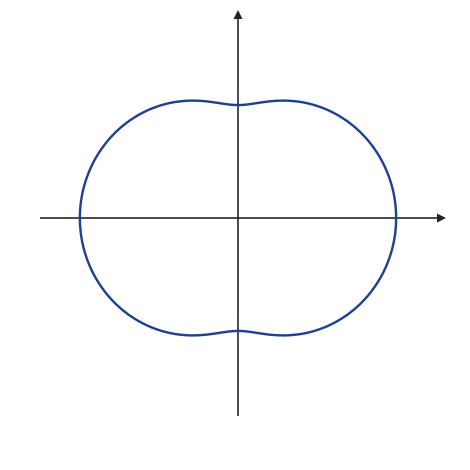
Figure 1 shows the path, seen from above, of a car on a fairground ride. Relative to the centre \(O\) of the ride, the position of the car is modelled by
\[x = 6\cos t + \cos 3t, \quad y = 6\sin t + \sin 3t, \quad 0 \leqslant t < 2\pi\]
where \(x\) and \(y\) are measured in metres.

[You may use \(\cos(A - B) \equiv \cos A\cos B + \sin A\sin B\)]

Show that the distance, \(d\) metres, of the car from \(O\) satisfies
\[d^2 = 37 + 12\cos 2t\]
Hence find the greatest and least distances of the car from \(O\), and the coordinates of the points on the path that are closest to \(O\).

Figure 1: a sketch on x and y axes with origin O. A closed curve goes once round O. It is wider across than it is high, symmetrical about both axes, with a slight inward dip where it crosses the positive y-axis and where it crosses the negative y-axis. No values are marked.

Model answer

\(d^2 = x^2 + y^2\)
\(= 36\cos^2 t + 12\cos t\cos 3t + \cos^2 3t + 36\sin^2 t + 12\sin t\sin 3t + \sin^2 3t\)
\(= 36(\cos^2 t + \sin^2 t) + (\cos^2 3t + \sin^2 3t) + 12(\cos 3t\cos t + \sin 3t\sin t)\)
\(= 36 + 1 + 12\cos(3t - t)\)
\(d^2 = 37 + 12\cos 2t\) as required.
\(-1 \leqslant \cos 2t \leqslant 1\), so \(25 \leqslant d^2 \leqslant 49\).
Greatest distance \(= 7\) m, least distance \(= 5\) m.
Least when \(\cos 2t = -1\): \(2t = \pi, 3\pi\), so \(t = \dfrac{\pi}{2}, \dfrac{3\pi}{2}\)
\(t = \dfrac{\pi}{2}\): \(x = 0 + 0 = 0\), \(y = 6 + \sin\dfrac{3\pi}{2} = 6 - 1 = 5\)
\(t = \dfrac{3\pi}{2}\): \(x = 0\), \(y = -6 + \sin\dfrac{9\pi}{2} = -6 + 1 = -5\)
The closest points are \((0, 5)\) and \((0, -5)\).

Explanation

Squaring and adding gives \(36 + 1\) from \(\cos^2 + \sin^2 = 1\), and the cross terms combine by the compound-angle formula into \(12\cos 2t\). Since \(\cos 2t\) lies between \(-1\) and 1, \(d^2\) lies between 25 and 49, and the least distance occurs when \(\cos 2t = -1\), i.e. \(t = \dfrac{\pi}{2}\) or \(\dfrac{3\pi}{2}\). Common errors are forgetting the square roots and evaluating \(\sin\dfrac{3\pi}{2}\) as \(+1\).

Mark scheme
  1. 1 mark

    M1 Forms \(d^2 = x^2 + y^2\) and expands both brackets, including the cross terms \(12\cos t\cos 3t\) and \(12\sin t\sin 3t\). An answer with no working scores 0 marks for the show-that

    An answer with no working scores 0 marks for the show-that (marks 1 to 4). Special case: with no working, correct distances 7 m and 5 m score B1B1, and the points \((0, 5)\) and \((0, -5)\) score M1A1.

  2. 1 mark

    M1 Uses \(\cos^2 + \sin^2 = 1\) twice: \(36(\cos^2 t + \sin^2 t) + (\cos^2 3t + \sin^2 3t) = 37\)

  3. 1 mark

    M1 Uses the compound-angle formula: \(\cos 3t\cos t + \sin 3t\sin t = \cos(3t - t) = \cos 2t\)

  4. 1 mark

    A1* \(d^2 = 37 + 12\cos 2t\)

    cso. Needs all three M marks and no errors.

  5. 1 mark

    B1 Greatest distance \(\sqrt{49} = 7\) m (when \(\cos 2t = 1\))

    Units not required.

  6. 1 mark

    B1 Least distance \(\sqrt{25} = 5\) m (when \(\cos 2t = -1\))

    Giving \(d^2\) values (49 and 25) without square roots scores B0 B0.

  7. 1 mark

    M1 Solves \(\cos 2t = -1\) for \(0 \leqslant t < 2\pi\), giving \(t = \dfrac{\pi}{2}\) and \(\dfrac{3\pi}{2}\), and substitutes into \(x\) and \(y\)

    At least one correct value of \(t\) substituted. Allow \(t = 90^\circ\), \(270^\circ\).

  8. 1 mark

    A1 \((0, 5)\) and \((0, -5)\)

    Both points needed. A common error is \(y = 6 + 1 = 7\) at \(t = \dfrac{\pi}{2}\), from \(\sin\dfrac{3\pi}{2} = 1\): A0.

Ready to try the rest? Every answer you write is marked against the mark scheme, so you can see exactly where the marks are.

Study Helper Hints first, answers after you try

Stuck on this one? Ask for a hint and I’ll point you in the right direction, without giving the answer away. Once you’ve checked your answer, I’ll show you how the marks are awarded.