
Level:
Correct: 0
Incorrect: 0
Marks: 0/0
Exam Practice
Course:
Topics:
Edexcel A-Level Maths (Paper 1) Smart practice A mixed round aimed at your weak spots
Unit 1
Proof
Unit 2
Algebra and functions
Unit 3
Coordinate geometry in the (x, y) plane
Unit 4
Sequences and series
Unit 5
Trigonometry
Unit 6
Exponentials and logarithms
Unit 7
Differentiation
Unit 8
Integration
Unit 9
Numerical methods
Unit 10
Vectors
Avg
score:
–
Topics
done:
0/36

Sine and cosine rules, radians, arcs and sectors

Practise 18 exam-style questions on Sine and cosine rules, radians, arcs and sectors for Edexcel A-Level Maths (Paper 1). Write your answer as you would in the exam and get it marked in seconds against the mark scheme, point by point, with the Study Helper on hand if you get stuck.

  • 18 questions
  • 3–10 marks each
  • Instant marking
  • No sign-up needed
18 questions, marked as you go

Sample questions with model answers

Here are 4 of the questions in this topic, each with a model answer, an explanation of why it earns the marks and the mark scheme an examiner would use.

Question 1

4 marks

The point \(P(-0.28, 0.96)\) lies on the circle with equation \(x^2 + y^2 = 1\). The line \(OP\), where \(O\) is the origin, makes an angle of \(\alpha\) radians with the positive \(x\)-axis, measured anticlockwise from the positive \(x\)-axis, where \(0 < \alpha < 2\pi\).

Find the value of \(\alpha\) to 3 significant figures.

Write down the exact value of \(\tan\alpha\), and state the coordinates of the point \(Q\) on the circle for which the line \(OQ\) makes an angle of \((\alpha + \pi)\) radians with the positive \(x\)-axis.

Model answer

\(P\) is on the unit circle, so \(\cos\alpha = -0.28\) and \(\sin\alpha = 0.96\): \(\alpha\) is in the second quadrant.
\(\alpha = \arccos(-0.28) = 1.8545...\)
\(\alpha = 1.85\) (3 s.f.)
\(\tan\alpha = \dfrac{\sin\alpha}{\cos\alpha} = \dfrac{0.96}{-0.28} = -\dfrac{24}{7}\)
\(\cos(\alpha + \pi) = -\cos\alpha = 0.28\) and \(\sin(\alpha + \pi) = -\sin\alpha = -0.96\)
\(Q(0.28, -0.96)\)

Explanation

For a point on the unit circle at angle \(\alpha\), the \(x\)-coordinate is \(\cos\alpha\) and the \(y\)-coordinate is \(\sin\alpha\), so \(\alpha\) is in the second quadrant and \(\arccos(-0.28)\) gives it directly. A common error is to use \(\arcsin 0.96\) or \(\arctan\left(-\dfrac{24}{7}\right)\) without adjusting for the quadrant, giving 1.29 or \(-1.29\). Adding \(\pi\) to the angle gives the point diametrically opposite \(P\), so both coordinates change sign.

Mark scheme
  1. 1 mark

    M1 Uses \(\cos\alpha = -0.28\) (or \(\sin\alpha = 0.96\) with \(\alpha\) in the second quadrant) to find \(\alpha\), e.g. \(\alpha = \arccos(-0.28)\), \(\alpha = \pi - \arcsin 0.96\) or \(\alpha = \pi - \arctan\dfrac{0.96}{0.28}\); or a correct final answer of \(\alpha =\) awrt 1.85 with no working

    An answer of \(\alpha =\) awrt 1.85 with no working scores 2 marks (the first two marks); the other two marks are for the separate answers below. On the unit circle the \(x\)-coordinate is \(\cos\alpha\) and the \(y\)-coordinate is \(\sin\alpha\). Common errors: \(\arcsin 0.96 = 1.29\) or \(\arctan\left(-\dfrac{24}{7}\right) = -1.29\) with no adjustment to the second quadrant (M0 A0).

  2. 1 mark

    A1 \(\alpha =\) awrt 1.85, i.e. in [1.845, 1.855)

    Do not accept \(106.3^\circ\) (degrees), 1.29 or \(-1.29\). An answer in degrees with a correct method scores M1 A0.

  3. 1 mark

    B1 \(\tan\alpha = -\dfrac{24}{7}\)

    Accept exact equivalents such as \(-\dfrac{0.96}{0.28}\), \(-\dfrac{96}{28}\) or \(-3\dfrac{3}{7}\). The rounded decimal \(-3.43\) on its own is B0 because the exact value is asked for. \(+\dfrac{24}{7}\) is B0.

  4. 1 mark

    B1 \(Q(0.28, -0.96)\)

    Both coordinates needed, in the correct order; they are exact. Condone missing brackets, or \(x = 0.28\), \(y = -0.96\). Turning \(OP\) through a further \(\pi\) radians (half a turn) changes the sign of both coordinates.
Question 2

4 marks

A student is given the following information about triangle \(ABC\):

\(AB = 10\) cm, \(BC = 7\) cm and angle \(BAC = 35^\circ\).

The student's working to find angle \(ABC\) is
\(\sin ACB = \dfrac{10\sin 35^\circ}{7} = 0.8194\), so angle \(ACB = 55.0^\circ\)
angle \(ABC = 180^\circ - 35^\circ - 55.0^\circ = 90.0^\circ\)

Explain why the student's answer is not complete, and find the other possible size of angle \(ABC\), giving your answer in degrees to one decimal place.

Model answer

\(\sin ACB = \dfrac{10\sin 35^\circ}{7} = 0.81939...\)
Angle \(ACB = 55.02...^\circ\) or angle \(ACB = 180^\circ - 55.02...^\circ = 124.98...^\circ\)
\(35^\circ + 124.98^\circ < 180^\circ\), so the obtuse angle is also possible: two triangles fit the information.
The student has used only the acute value of angle \(ACB\), so the answer is not complete.
With angle \(ACB = 124.98...^\circ\): angle \(ABC = 180^\circ - 35^\circ - 124.98...^\circ = 20.0^\circ\) (1 d.p.)
Angle \(ABC = 90.0^\circ\) or \(20.0^\circ\)

Explanation

This is the ambiguous case of the sine rule: the given angle is not between the two given sides, and the side opposite it (7 cm) is the shorter one, so \(\sin ACB = 0.8194\) gives an acute angle and its supplement \(125.0^\circ\), and both fit. The obtuse value leaves \(180^\circ - 35^\circ - 125.0^\circ = 20.0^\circ\) for angle \(ABC\). The common error, made by the student here, is to take only the acute angle from the calculator.

Mark scheme
  1. 1 mark

    M1 Finds the obtuse value of angle \(ACB\): \(180^\circ - 55.0^\circ = 125.0^\circ\); or a correct final answer of angle \(ABC = 20.0^\circ\) with no working

    An answer of \(20.0^\circ\) with no working scores 3 marks (this M1 and the final M1 A1); the B1 needs the explanation. Accept angle \(ACB =\) awrt \(125.0^\circ\), i.e. in [124.95, 125.05), or an exact form such as \(180^\circ - \arcsin(0.8194)\).

  2. 1 mark

    B1 Explains that \(\sin ACB = 0.8194\) is also satisfied by the obtuse angle \(ACB = 125.0^\circ\), and that this angle is possible because \(35^\circ + 125.0^\circ < 180^\circ\), so there is a second triangle; the student has found only the acute value

    The explanation must refer to the obtuse angle (or to \(\sin(180^\circ - x) = \sin x\)) and to why it is possible: the angle sum \(35^\circ + 125.0^\circ\) is less than \(180^\circ\), or the side \(BC = 7\) opposite the given angle is shorter than \(AB = 10\). "There are two answers" with no reason is B0. Accept the obtuse angle as awrt \(125^\circ\), i.e. in [124.5, 125.5), within the explanation.

  3. 1 mark

    M1 Finds angle \(ABC = 180^\circ - 35^\circ -\) their obtuse angle \(ACB\)

    Depends on the first M mark. Using the acute angle again (giving \(90.0^\circ\)) is M0.

  4. 1 mark

    A1 Angle \(ABC =\) awrt \(20.0^\circ\), i.e. in [19.95, 20.05)

    From \(180^\circ - 35^\circ - 124.976^\circ = 20.024^\circ\). Accept 20 with 125 used.

Question 3

6 marks

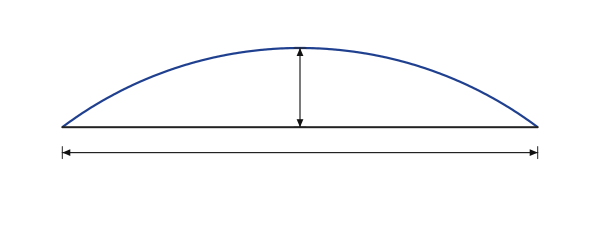
A footbridge in a park has an arch whose lower edge is an arc of a circle, as shown in Figure 1. The ends \(A\) and \(B\) of the arc are at the same horizontal level, with \(AB = 30\) m, and the highest point of the arc is 5 m above \(AB\).

Find the radius of the circle and the length of the arc, giving the length of the arc to 3 significant figures.

Figure 1: the lower edge of the arch, drawn as an arc of a circle from A to B, with the straight horizontal line AB joining its ends. A double-headed arrow below AB is labelled 30 m. A vertical double-headed arrow from the middle of AB up to the highest point of the arc is labelled 5 m.

Model answer

Let the radius be \(r\) m. The centre \(O\) is below the midpoint \(M\) of \(AB\), with \(OM = r - 5\) and \(AM = 15\).
\(r^2 = 15^2 + (r - 5)^2\)
\(r^2 = 225 + r^2 - 10r + 25\)
\(10r = 250 \Rightarrow r = 25\) m
Angle \(AOB = \theta\): \(\sin\dfrac{\theta}{2} = \dfrac{15}{25} = 0.6\)
\(\theta = 2\arcsin 0.6 = 1.2870...\) radians
Arc length \(= r\theta = 25 \times 1.2870... = 32.175...\)
Radius \(= 25\) m, arc length \(= 32.2\) m (3 s.f.)

Explanation

The centre of the circle lies on the perpendicular bisector of \(AB\), so Pythagoras in the triangle with sides 15, \(r - 5\) and \(r\) gives the radius. The angle at the centre then comes from right-angled trigonometry (or the cosine rule), and the arc length is \(r\theta\) with \(\theta\) in radians. Common errors are taking the centre distance as \(r + 5\) and forgetting to double the half-angle.

Mark scheme
  1. 1 mark

    M1 Forms an equation for the radius \(r\) using Pythagoras in the triangle formed by the centre, the midpoint of \(AB\) and \(A\): \(r^2 = 15^2 + (r - 5)^2\); correct final answers of 25 m and awrt 32.2 m with no working score SC 2 marks

    Answers of 25 m and awrt 32.2 m with no working score 2 marks (SC, 1 for each answer). The centre is directly below the midpoint of \(AB\), at a distance \(r - 5\) from it. The intersecting chords theorem, \(5(2r - 5) = 15 \times 15\), also scores M1.

  2. 1 mark

    A1 \(r = 25\) m

  3. 1 mark

    M1 Finds the angle \(\theta\) subtended at the centre by the arc, using their \(r\): e.g. \(\sin\dfrac{\theta}{2} = \dfrac{15}{25}\), \(\cos\dfrac{\theta}{2} = \dfrac{20}{25}\), or the cosine rule \(\cos\theta = \dfrac{25^2 + 25^2 - 30^2}{2 \times 25 \times 25}\)

    Depends on a value of \(r\) from the first M mark. Halving or doubling errors (e.g. using \(\sin\theta = \dfrac{15}{25}\) for the whole angle) are M0.

  4. 1 mark

    A1 \(\theta =\) awrt 1.29 radians, i.e. in [1.285, 1.295) (or \(\theta =\) awrt \(73.7^\circ\), i.e. in [73.65, 73.75))

    May be implied by a correct arc length.

  5. 1 mark

    M1 Uses \(s = r\theta\) with their \(r\) and their \(\theta\) in radians (or \(\dfrac{\theta}{360} \times 2\pi r\) with \(\theta\) in degrees)

    Using \(\theta\) in degrees in \(s = r\theta\) is M0.

  6. 1 mark

    A1 Arc length \(=\) awrt 32.2 m, i.e. in [32.15, 32.25)

    Units not required, but penalise wrong units.

Question 4

8 marks

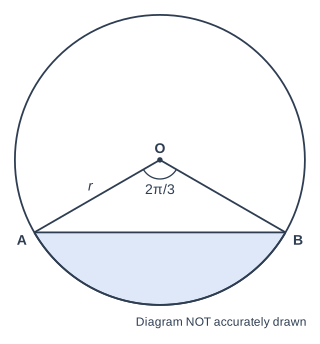
A circular tabletop has centre \(O\) and radius \(r\) metres. So that the table can stand against a straight wall, the minor segment cut off by the chord \(AB\) is removed, as shown shaded in Figure 1. The straight edge \(AB\) then fits against the wall.

Angle \(AOB = \dfrac{2\pi}{3}\) radians and the area of the segment that is removed is 0.5 m\(^2\).

Find the value of \(r\), the length of the straight edge \(AB\) and the greatest distance of any point of the tabletop from the wall. Give each answer to 3 significant figures.

Geometry diagram, marked "Diagram NOT accurately drawn". A circle with centre O; A and B lie on it. A minor arc from A to B with centre O (the region between the arc and AB is shaded). Line segments OA, OB and AB are drawn. Angle AOB is marked 2π/3. OA is labelled r.

Model answer

Segment area \(= \dfrac{1}{2}r^2\theta - \dfrac{1}{2}r^2\sin\theta\) with \(\theta = \dfrac{2\pi}{3}\)
\(\dfrac{1}{2}r^2\left(\dfrac{2\pi}{3} - \dfrac{\sqrt{3}}{2}\right) = 0.5\)
\(0.61418...r^2 = 0.5 \Rightarrow r^2 = 0.81408...\)
\(r = 0.90226... = 0.902\) (3 s.f.)
\(AB = 2r\sin\dfrac{\pi}{3} = r\sqrt{3} = 1.5627... = 1.56\) m (3 s.f.)
The distance from \(O\) to \(AB\) is \(r\cos\dfrac{\pi}{3} = \dfrac{r}{2}\), and the point of the edge furthest from the wall is a further \(r\) beyond \(O\).
Greatest distance \(= r + \dfrac{r}{2} = 1.5 \times 0.90226... = 1.3534... = 1.35\) m (3 s.f.)

Explanation

The segment is the sector minus triangle \(AOB\), so its area is \(\dfrac{1}{2}r^2(\theta - \sin\theta)\) with \(\theta\) in radians, which gives an equation for \(r\). The chord and the greatest distance both come from the right-angled triangle formed by \(O\), the midpoint of \(AB\) and \(A\): the chord is \(2r\sin\dfrac{\pi}{3}\) and the centre is \(\dfrac{r}{2}\) from the wall. Common errors are using only the sector or only the triangle, and giving the diameter as the greatest distance.

Mark scheme
  1. 1 mark

    M1 Area of segment \(=\) area of sector \(-\) area of triangle: \(\dfrac{1}{2}r^2\left(\dfrac{2\pi}{3}\right) - \dfrac{1}{2}r^2\sin\dfrac{2\pi}{3}\), set equal to 0.5; correct final answers of 0.902 m, 1.56 m and 1.35 m with no working score SC 3 marks

    Answers of 0.902 m, 1.56 m and 1.35 m with no working score 3 marks (SC, 1 for each answer). Work in degrees (\(120^\circ\)) is acceptable if formulae for degrees are used. The sector area alone, or the triangle area alone, is M0.

  2. 1 mark

    A1 A correct equation in \(r\), e.g. \(r^2\left(\dfrac{\pi}{3} - \dfrac{\sqrt{3}}{4}\right) = 0.5\) or \(0.6141...r^2 = 0.5\)

    Accept any equivalent exact form, or the coefficient as a decimal to at least 3 s.f. (0.614).

  3. 1 mark

    M1 (dM1) Solves their equation for \(r\), e.g. \(r = \sqrt{\dfrac{0.5}{0.6141...}}\)

    Depends on the first M mark (not on the point just before). Accept a correct method from any equivalent equation.

  4. 1 mark

    A1 \(r =\) awrt 0.902, i.e. in [0.9015, 0.9025)

    Units not required, but penalise wrong units. Accept 90.2 cm.

  5. 1 mark

    M1 A correct method for \(AB\) with their \(r\): \(AB = 2r\sin\dfrac{\pi}{3}\ (= r\sqrt{3})\), or \(AB^2 = r^2 + r^2 - 2r^2\cos\dfrac{2\pi}{3}\)

  6. 1 mark

    A1 \(AB =\) awrt 1.56 m, i.e. in [1.555, 1.565)

  7. 1 mark

    M1 Greatest distance \(= r + r\cos\dfrac{\pi}{3}\ \left(= \dfrac{3r}{2}\right)\) with their \(r\): the distance from \(O\) to \(AB\) plus a radius

    The point furthest from the wall is at the end of the diameter perpendicular to \(AB\). Common errors: the diameter \(2r\) (1.80) or \(r - \dfrac{r}{2}\): M0.

  8. 1 mark

    A1 Greatest distance \(=\) awrt 1.35 m, i.e. in [1.345, 1.355)

    From 1.353 m.

Ready to try the rest? Every answer you write is marked against the mark scheme, so you can see exactly where the marks are.

Study Helper Hints first, answers after you try

Stuck on this one? Ask for a hint and I’ll point you in the right direction, without giving the answer away. Once you’ve checked your answer, I’ll show you how the marks are awarded.