
Level:
Correct: 0
Incorrect: 0
Marks: 0/0
Exam Practice
Course:
Topics:
Edexcel A-Level Maths (Paper 1) Smart practice A mixed round aimed at your weak spots
Unit 1
Proof
Unit 2
Algebra and functions
Unit 3
Coordinate geometry in the (x, y) plane
Unit 4
Sequences and series
Unit 5
Trigonometry
Unit 6
Exponentials and logarithms
Unit 7
Differentiation
Unit 8
Integration
Unit 9
Numerical methods
Unit 10
Vectors
Avg
score:
–
Topics
done:
0/36

Simultaneous equations and inequalities

Practise 18 exam-style questions on Simultaneous equations and inequalities for Edexcel A-Level Maths (Paper 1). Write your answer as you would in the exam and get it marked in seconds against the mark scheme, point by point, with the Study Helper on hand if you get stuck.

  • 18 questions
  • 3–9 marks each
  • Instant marking
  • No sign-up needed
18 questions, marked as you go

Sample questions with model answers

Here are 4 of the questions in this topic, each with a model answer, an explanation of why it earns the marks and the mark scheme an examiner would use.

Question 1

3 marks

Find the set of values of \(x\) for which
\[(2x - 1)^2 > 25\]
Write your answer using inequalities in \(x\), or in set notation.

Model answer

Critical values: \(2x - 1 = 5 \Rightarrow x = 3\) and \(2x - 1 = -5 \Rightarrow x = -2\)
\((2x - 1)^2 > 25\) when \(2x - 1 > 5\) or \(2x - 1 < -5\)
So \(x < -2\) or \(x > 3\)

Explanation

The square of a quantity is greater than 25 when that quantity is greater than 5 or less than \(-5\), so there are two separate regions. Expanding instead gives \(x^2 - x - 6 > 0\), with the same critical values \(-2\) and 3 and the outside region. The common error is writing \(2x - 1 > \pm 5\), which fails to reverse the inequality for the negative value and gives the wrong second region.

Mark scheme
  1. 1 mark

    M1 Finds the critical values: solves \(2x - 1 = 5\) and \(2x - 1 = -5\), or expands to a three-term quadratic such as \(4x^2 - 4x - 24 > 0\) and solves it; or a correct final answer of \(x < -2\) or \(x > 3\) with no working

    An answer of \(x < -2\) or \(x > 3\) with no working scores 3 marks. Writing \(2x - 1 > \pm 5\) scores this mark only if both critical values, \(-2\) and 3, are then found.

  2. 1 mark

    A1 Critical values \(x = -2\) and \(x = 3\)

    Both values needed.

  3. 1 mark

    A1 \(x < -2\) or \(x > 3\)

    Accept \(\{x : x < -2\} \cup \{x : x > 3\}\) (typed with U for \(\cup\)), 'x < -2, x > 3', 'x < -2 U x > 3' and the two inequalities on separate lines. Do not accept 'and', \(\cap\), \(-2 > x > 3\) or non-strict inequalities. A common error is writing \(2x - 1 > \pm 5\) and concluding \(x > 3\) and \(x > -2\): this scores M1 A1 A0.
Question 2

4 marks

Given that \(x ≠ 2\), use algebra to find all the values of \(x\) that satisfy
\[\dfrac{x}{x - 2} > 3\]
Give your answer as one or more inequalities in \(x\).

Model answer

Multiply both sides by \((x - 2)^2\), which is positive for \(x ≠ 2\):
\(x(x - 2) > 3(x - 2)^2\)
\(0 > 3(x - 2)^2 - x(x - 2)\)
\(0 > (x - 2)(3x - 6 - x)\)
\((x - 2)(2x - 6) < 0\)
Critical values \(x = 2\) and \(x = 3\); the expression is negative between them:
\(2 < x < 3\)

Explanation

Multiplying an inequality by \(x - 2\) is not safe, because \(x - 2\) may be negative, which would reverse the inequality; multiplying by \((x - 2)^2\), which is positive, avoids this. This gives a quadratic inequality with critical values 2 and 3, and the region between them. The most common error is multiplying by \(x - 2\) and getting \(x < 3\), which wrongly includes values such as \(x = 0\).

Mark scheme
  1. 1 mark

    M1 Uses a valid method that does not multiply by an expression of unknown sign: multiplies both sides by \((x - 2)^2\), or writes \(\dfrac{x}{x - 2} - 3 > 0\) as a single fraction, or considers the cases \(x > 2\) and \(x < 2\) separately. An answer with no working scores 0 marks

    An answer of \(2 < x < 3\) with no working scores 0 marks: the question says 'using algebra'. A common error is to multiply both sides by \(x - 2\) without considering its sign, giving \(x > 3x - 6\) and so \(x < 3\): this scores 0 marks.

  2. 1 mark

    A1 Critical values 2 and 3 from a correct inequality, e.g. \((x - 2)(2x - 6) < 0\) or \(\dfrac{6 - 2x}{x - 2} > 0\) oe

    For the cases method: \(x > 2\) gives \(x < 3\), and \(x < 2\) gives \(x > 3\), which is impossible.

  3. 1 mark

    M1 (dM1) Chooses the region between their critical values (or the correct region for their cases)

    Depends on the first M mark.

  4. 1 mark

    A1 \(2 < x < 3\)

    Accept \(\{x : 2 < x < 3\}\) or \(x > 2\) and \(x < 3\). Do not accept 'or' or a comma between the two inequalities, \(2 \leqslant x\) (the expression is undefined at \(x = 2\)) or \(x \leqslant 3\) (at \(x = 3\) the expression equals 3).

Question 3

6 marks

In this question you must show all stages of your working.
Solutions relying entirely on calculator technology are not acceptable.

Find the set of values of \(x\) for which
\[x(x + 6) > 2(x + 3)\]
Give your answer in set notation, using exact values.

Model answer

\(x^2 + 6x > 2x + 6\)
\(x^2 + 4x - 6 > 0\)
Critical values: \((x + 2)^2 - 4 - 6 = 0\)
\((x + 2)^2 = 10\)
\(x = -2 \pm \sqrt{10}\)
The parabola \(y = x^2 + 4x - 6\) is above the \(x\)-axis outside its roots:
\(\{x : x < -2 - \sqrt{10}\} \cup \{x : x > -2 + \sqrt{10}\}\)

Explanation

Expand the brackets and collect all the terms on one side to get \(x^2 + 4x - 6 > 0\). The quadratic does not factorise, so the exact critical values come from completing the square or the formula, and 'greater than' for a U-shaped parabola needs the two outside regions, joined by a union. Common errors are giving decimal values, using \(\cap\) or 'and', and not using set notation.

Mark scheme
  1. 1 mark

    M1 Expands and rearranges to a three-term quadratic inequality (or equation), e.g. \(x^2 + 6x - 2x - 6 > 0\). An answer with no working scores 0 marks

    An answer of \(\{x : x < -2 - \sqrt{10}\} \cup \{x : x > -2 + \sqrt{10}\}\) with no working scores 0 marks: the question demands all stages of working.

  2. 1 mark

    A1 \(x^2 + 4x - 6 > 0\) oe

  3. 1 mark

    M1 Solves their \(x^2 + 4x - 6 = 0\) using the quadratic formula or completing the square, with working seen, e.g. \((x + 2)^2 = 10\) or \(x = \dfrac{-4 \pm \sqrt{16 + 24}}{2}\)

    Not dependent on the A mark. Values stated from a calculator score M0.

  4. 1 mark

    A1 Exact critical values \(x = -2 \pm \sqrt{10}\)

    Accept \(\dfrac{-4 \pm \sqrt{40}}{2}\). Decimals alone (\(-5.16\), 1.16) score A0.

  5. 1 mark

    M1 Chooses the outside region for their two critical values

    Depends on the first M mark.

  6. 1 mark

    A1 \(\{x : x < -2 - \sqrt{10}\} \cup \{x : x > -2 + \sqrt{10}\}\)

    Requires set brackets, \(\cup\) (typed U is fine) and exact values; accept \(\dfrac{-4 \pm \sqrt{40}}{2}\) or \(-2 \pm \sqrt{10}\) written as e.g. \(-(2 + \sqrt{10})\). Do not accept \(\cap\), 'and', decimals, or an answer not in set notation such as \(x < -2 - \sqrt{10}\) or \(x > -2 + \sqrt{10}\). Interval notation, e.g. \((-\infty, -2 - \sqrt{10}) \cup (-2 + \sqrt{10}, \infty)\), is not the set notation asked for: A0.

Question 4

8 marks

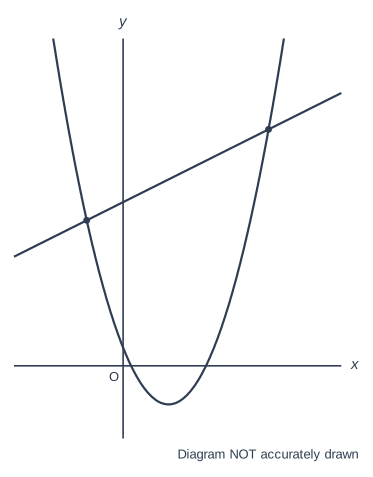
Figure 1 shows a sketch of the curve \(C\) with equation \(y = 2x^2 - 5x + 1\) and the line \(l\) with equation \(y = x + 9\). The line \(l\) meets \(C\) at the points \(A\) and \(B\), where \(A\) is to the left of \(B\).

Using algebra, find the coordinates of \(A\) and the coordinates of \(B\).

Find the length of \(AB\), giving your answer in the form \(k\sqrt{2}\), where \(k\) is an integer.

Hence write down the set of values of \(x\) for which
\[2x^2 - 5x + 1 < x + 9\]

A sketch on a pair of axes (x across, y up) with no scale marked, the axes crossing at the origin O. It is marked "Diagram NOT accurately drawn". Curve C is a U-shaped parabola: it meets the x-axis twice; these points cannot be read off, as the sketch has no scale; it crosses the y-axis at a point that cannot be read off, as the sketch has no scale; it has a minimum point, which cannot be read off, as the sketch has no scale. Line l is a straight line sloping upwards from left to right; its position cannot be read off, as the sketch has no scale. Curve C and line l cross at 2 points, which cannot be read off, as the sketch has no scale. Point A is marked with a dot; its coordinates cannot be read off, as the sketch has no scale. Point B is marked with a dot; its coordinates cannot be read off, as the sketch has no scale.

Model answer

\(2x^2 - 5x + 1 = x + 9\)
\(2x^2 - 6x - 8 = 0\)
\(x^2 - 3x - 4 = 0\)
\((x - 4)(x + 1) = 0\), so \(x = -1\) or \(x = 4\)
\(x = -1\): \(y = -1 + 9 = 8\); \(x = 4\): \(y = 4 + 9 = 13\)
\(A(-1, 8)\) and \(B(4, 13)\)
\(AB = \sqrt{(4 - (-1))^2 + (13 - 8)^2} = \sqrt{25 + 25} = \sqrt{50} = 5\sqrt{2}\)
The curve is below the line between \(A\) and \(B\):
\(-1 < x < 4\)

Explanation

Equating the two expressions for \(y\) gives a quadratic whose roots are the \(x\)-coordinates of \(A\) and \(B\), and the equation of the line gives their \(y\)-coordinates. The inequality \(2x^2 - 5x + 1 < x + 9\) asks where the curve is below the line, which the figure shows is between the intersection points. Common errors are leaving the length as \(\sqrt{50}\) rather than \(5\sqrt{2}\) and giving the outside region.

Mark scheme
  1. 1 mark

    M1 Sets \(2x^2 - 5x + 1 = x + 9\) and rearranges to a three-term quadratic \(= 0\); an answer with no working scores at most 4 marks (see comments)

    An answer of \(A(-1, 8)\), \(B(4, 13)\), \(AB = 5\sqrt{2}\) and \(-1 < x < 4\) with no working scores 4 marks as a special case (M0 A0 M0 A0 M1 A1 M1 A1): the coordinates must be found using algebra, but the length and the set can follow from correct coordinates.

  2. 1 mark

    A1 \(x^2 - 3x - 4 = 0\) oe, e.g. \(2x^2 - 6x - 8 = 0\)

  3. 1 mark

    M1 (dM1) Solves their three-term quadratic by factorising, the formula or completing the square, with working seen

    Depends on the first M mark. Roots written down from a calculator score M0, as the question says 'using algebra'.

  4. 1 mark

    A1 \(A(-1, 8)\) and \(B(4, 13)\)

    Both points, with both coordinates.

  5. 1 mark

    M1 Uses Pythagoras with their \(A\) and \(B\): \(AB = \sqrt{(4 - (-1))^2 + (13 - 8)^2}\)

    Not dependent on the earlier marks.

  6. 1 mark

    A1 \(AB = 5\sqrt{2}\) (\(k = 5\))

    \(\sqrt{50}\) followed by \(5\sqrt{2}\) is fine. \(\sqrt{50}\) alone, or 7.07 alone, scores A0 (not in the form asked for).

  7. 1 mark

    M1 Chooses the region between the \(x\)-coordinates of their \(A\) and \(B\) (where \(C\) is below \(l\))

    Not dependent on the earlier marks.

  8. 1 mark

    A1 \(-1 < x < 4\)

    Accept \(\{x : -1 < x < 4\}\) or \(x > -1\) and \(x < 4\). Do not accept \(\leqslant\), 'or' or a comma between the two inequalities, or the outside region.

Ready to try the rest? Every answer you write is marked against the mark scheme, so you can see exactly where the marks are.

Study Helper Hints first, answers after you try

Stuck on this one? Ask for a hint and I’ll point you in the right direction, without giving the answer away. Once you’ve checked your answer, I’ll show you how the marks are awarded.