Level:
Correct: 0
Incorrect: 0
Marks: 0/0
Exam Practice
Subject:
Topics:
Avg
score:
–
Topics
done:
0/14

Tombs, graves and burial

Practise 35 exam-style questions on Tombs, graves and burial for OCR GCSE Classical Civilisation (The Homeric World). Write your answer as you would in the exam and get it marked in seconds against the mark scheme, point by point, with an AI tutor on hand if you get stuck.

  • 35 questions
  • 1–15 marks each
  • Instant marking
  • No sign-up needed
20 questions, marked as you go

Sample questions with model answers

Here are 4 of the questions in this topic, each with a model answer, an explanation of why it earns the marks and the mark scheme an examiner would use.

Question 1

1 mark

Source A: 'I have gazed on the face of Agamemnon.'

These words are said to have been spoken by the archaeologist who excavated Grave Circle A at Mycenae in 1876, when he lifted a gold death mask. Name this archaeologist.

Model answer

Heinrich Schliemann.

Explanation

Schliemann, who had already dug at Troy from 1870, excavated the shaft graves in 1876 hoping to find Agamemnon. The famous words may not be exactly what he said, but they sum up his belief that Homer's heroes were real people.

Mark scheme
  1. 1 mark

    Heinrich Schliemann

    Accept 'Schliemann' with minor misspellings (e.g. 'Schleimann'). Do not accept Blegen, Wace, Evans or Mylonas.

Question 2

2 marks

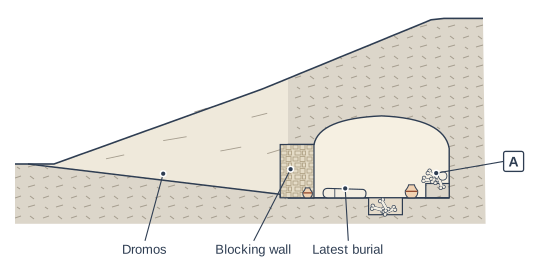
Figure 1 is a section through a Mycenaean chamber tomb.

Describe what is shown at A and explain why it happened.

Section through a Mycenaean tomb. Section (cut-away side view) through a tomb cut into a hillside. From the left, an open passage cut into the slope, with no stone lining, slopes down to an opening sealed by a wall of rough stones. Beyond it is a room cut out of the rock, with a curved roof, a low ledge of rock along the back wall and a hole cut into the floor. A wrapped body lies stretched out on the floor with pots beside it; a heap of other bones lies at the back of the room, on the ledge and in the hole. Label A points to the heap of bones at the back of the room, on the ledge and in the hole; the label "Dromos" points to the open passage cut into the slope, its floor sloping down towards the doorway; the label "Blocking wall" points to the wall of rough stones filling the opening at the end of the passage; the label "Latest burial" points to the wrapped body lying stretched out on the floor of the room.

Model answer

A shows the bones of earlier burials swept aside onto the bench and into the pit. This happened because chamber tombs were family tombs used over many generations: each time the tomb was reopened for a new burial, the older remains were pushed aside to make room.

Explanation

Sweeping aside earlier bones is one of the most distinctive Mycenaean burial customs and suggests that, once the body had decayed, the dead were no longer treated as needing their place and possessions. It also explains why many chamber tombs contain dozens of jumbled skeletons.

Mark scheme
  1. 1 mark

    The bones of earlier burials, swept aside onto the bench / into the pit

    Accept 'old bones pushed to the side', 'earlier skeletons moved'. Do not accept 'grave goods'.

  2. 1 mark

    Because the tomb was a family tomb reused over generations: when a new body was buried, the earlier remains were moved to make room for it

    Accept 'to make space for a new burial'. Credit also the idea that once the flesh had decayed the remains no longer needed the same care.

Question 3

4 marks

Source A: Shaft Grave III in Grave Circle A at Mycenae (about 1550 BC) held the burials of three women and two children. The women wore gold diadems and other jewellery, and hundreds of thin gold discs decorated their clothes. The bodies of the two children were covered with sheets of gold foil.

Select two features of these burials and suggest what each tells us about the family buried in Grave Circle A.

Model answer

The children's bodies were covered with gold foil, which suggests that status in this family was inherited at birth: even children who had achieved nothing were buried as members of a ruling dynasty. The women wore gold diadems and clothes covered with gold discs, which suggests that women of the family also had very high status and that the family made a great show of its wealth at funerals.

Explanation

The burials of women and children are important evidence that Grave Circle A belonged to a ruling family, not just to warrior chiefs who won their position. The children's gold is the strongest sign of inherited status; each pair needs a feature and a clear conclusion about the family.

Mark scheme
  1. 2 marks

    First feature with suggestion: 1 mark for a relevant feature of the burials in Source A, 1 mark for a valid suggestion about the family buried in Grave Circle A.

    Two pairs from, e.g.: women buried with rich goods (1) - women of the family had high status, not only the men (1); gold diadems (1) - a sign of rank, perhaps royal status (1); hundreds of gold discs on their clothes (1) - the family was extremely wealthy / made a great display at the funeral (1); children covered in gold foil (1) - status was inherited by birth, not earned, so this was a hereditary ruling family (1); several people buried in the same grave (1) - the grave was a family grave, reopened over time (1); the grave was part of a grave circle (1) - the family set itself apart from ordinary people in its own burial ground (1). The second pair must use a different feature.

  2. 2 marks

    Second, different feature with suggestion: 1 mark for a relevant feature, 1 mark for a valid suggestion.

    As above; must be a different feature from the first.

Question 4

8 marks

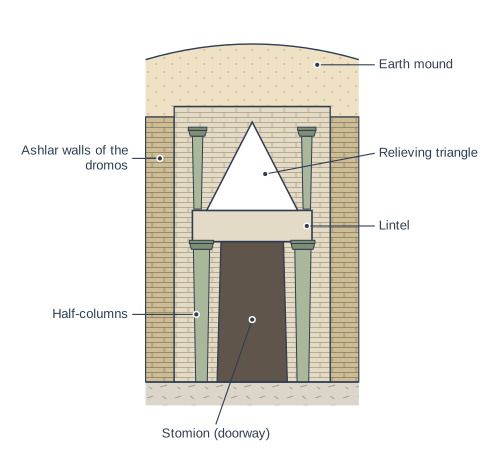
Source A: the Treasury of Atreus at Mycenae (about 1250 BC, though some date it earlier), whose facade is shown in Figure 1. A dromos about 36 m long, lined with walls of cut stone, leads to a doorway over 5 m high, roofed by two huge lintel blocks, the inner one weighing about 120 tonnes. The facade was decorated with half-columns and carved stone panels. Inside, the corbelled chamber is about 14.5 m across and 13 m high; for over a thousand years it was the largest dome in the world.

To what extent were tholos tombs built to impress the living rather than to honour the dead? Use Source A as a starting point and your own knowledge.

Front view (elevation) of the facade of a tholos tomb (the Treasury of Atreus). Front view (elevation) of the facade of a tholos tomb, as seen from the end of the dromos (modelled on the Treasury of Atreus). The facade is built of ashlar (cut stone) blocks and stands between the ends of the ashlar walls lining the dromos, with the earth mound above. In the middle is the stomion (doorway), tall and narrowing slightly towards the top; over it lies the huge lintel, and above the lintel is the relieving triangle, a triangular gap that takes the weight of the masonry off the lintel (it was once covered by a decorated slab). Half-columns, narrower at the base than at the top, stand on each side of the doorway, with a smaller pair above the lintel on either side of the triangle. The label "Stomion (doorway)" points to the tall dark doorway in the middle of the front wall; the label "Lintel" points to the great horizontal block over the doorway; the label "Relieving triangle" points to the triangular opening above the great block over the doorway; the label "Half-columns" points to the green columns, narrower at the base, on each side of the doorway; the label "Ashlar walls of the dromos" points to the walls of neat rectangular blocks on either side, at the ends of the approach passage; the label "Earth mound" points to the earth heaped above the front wall.

Model answer

Source A suggests that tholos tombs were built on a scale meant to impress. The Treasury of Atreus has a dromos about 36 m long lined with cut stone, a doorway over 5 m high under a lintel weighing about 120 tonnes, and a decorated facade with half-columns and carved panels. Its corbelled chamber, 14.5 m across and 13 m high, was the largest dome in the world for over a thousand years. Moving such stones needed huge numbers of workers and great engineering skill, so the tomb advertised the wealth and power of the ruling family. The other tholoi at Mycenae, the Tombs of Clytemnestra and Aegisthus, stand close to the approach to the citadel, and their earth mounds would have been visible landmarks.

However, there is evidence that honouring the dead was just as important. After a funeral the dromos was usually filled in with earth, so the decorated facade could only be seen during funerals - by mourners honouring the dead - rather than by every passer-by. Inside, the chamber was dark and sealed, and it was designed as a lasting home for the royal dead and their grave goods, such as the gold cups found in the tholos at Vapheio. Tholoi were reopened for later burials of the same family, which shows care for ancestors over generations, and toasts drunk and cups broken in the dromos were rituals for the dead.

In reality the two purposes overlapped. A magnificent funeral and tomb honoured the dead king, but by honouring royal ancestors the living ruler also showed his own power and legitimacy.

Overall, tholos tombs were to a large extent built to impress the living, but they did so through honouring the dead, so the statement creates a false choice: they were monuments to a dynasty, both past and present.

Explanation

Strong answers use the scale and decoration of the Treasury of Atreus as evidence of display, but also use the filled-in dromos, sealed chamber, grave goods and reuse as evidence of honouring the dead, and recognise that the purposes overlap. A purely descriptive account of the tomb cannot go above Level 2.

Mark scheme
  1. 8 marks

    Levels of response (8 marks). AO1 (4) and AO2 (4) are equally weighted.
    Level 4 (7-8 marks): consistently accurate and detailed knowledge of tholos tombs, using both Source A and own wider knowledge; very good understanding of the context of royal burial and of possible interpretations; a well-argued response with a clear, substantiated judgement on whether tholos tombs were built more to impress the living or to honour the dead, supported by a range of well-selected evidence, including critical analysis.
    Level 3 (5-6 marks): accurate knowledge, using both the source and own knowledge; a focused response with relevant analysis of both purposes, and a judgement.
    Level 2 (3-4 marks): sound, mostly accurate knowledge; engages with the general topic of tholos tombs; limited range of evidence; some analysis.
    Level 1 (1-2 marks): limited knowledge, may only use the source given; isolated analysis.
    0 marks: no response or no response worthy of credit.
    A mainly descriptive answer with little analysis or judgement cannot go above Level 2.

    Indicative content (not a checklist; credit other valid points): AO1: Source A - 36 m dromos lined with cut stone; doorway over 5 m high; lintel of about 120 tonnes; decorated facade with half-columns and carved panels; chamber 14.5 m across and 13 m high, the largest dome for over a thousand years. Own knowledge - other tholoi at Mycenae (Tomb of Clytemnestra, Tomb of Aegisthus) beside the approach to the citadel; tholoi elsewhere (Pylos, Vapheio, Orchomenos); earth mounds visible in the landscape; relieving triangle once covered by a carved panel; side chamber for burials; dromos usually filled with earth after a burial and dug out again for the next; tombs reused by the royal family for generations; grave goods (e.g. the Vapheio cups) placed with the dead; toasts drunk and cups broken; tholoi largely robbed. AO2: impress the living - enormous labour and engineering, the vast lintel and dome, the decorated facade and long processional dromos, and positions near the citadel and roads all advertised the power of the ruling family and the resources it could command; funerals were public displays. Honour the dead - the chamber was dark and sealed and the dromos filled in after the funeral, so the facade was seen only during funerals; the tomb gave the royal dead a lasting home with their grave goods; reuse shows care for the family's ancestors; possible beliefs about the afterlife or ancestor cult. The two purposes overlap: honouring royal ancestors also strengthened the living dynasty. Judgement, e.g.: tholos tombs were largely built to display the power of the ruling family, but this display took place through honouring the dead, so the two cannot be separated.

Ready to try the rest? Every answer you write is marked against the mark scheme, so you can see exactly where the marks are.

AI Tutor Hints first, answers after you try

Hi! Stuck? Ask me for a hint and I’ll help you work it out. Once you’ve checked your answer I can explain exactly where the marks are.