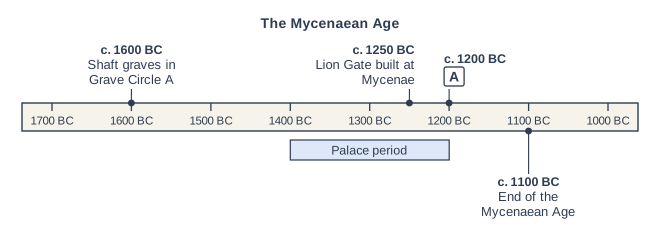
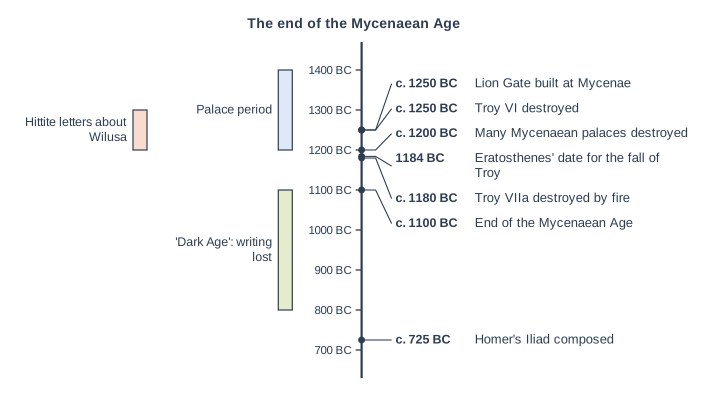
Source A is a timeline of the end of the Mycenaean Age.
To what extent does the dating evidence support the idea that Mycenaean Greeks attacked and destroyed Troy? Use Source A as a starting point and your own knowledge.
Model answer
Source A shows that the Mycenaean palace period lasted from about 1400 to 1200 BC, and that the Lion Gate was built at Mycenae about 1250 BC, when the walls of the citadel were extended. Mycenae was therefore at the height of its wealth and power in the mid-13th century, the same period in which the Hittite letters about Wilusa and Ahhiyawa were written. If Ahhiyawa is the land of the Achaeans and Wilusa is Ilios, these letters suggest that Greeks were involved in trouble over Troy at this time, which supports the idea of a Mycenaean attack.
The problem is matching this with the destruction of Troy. Troy VI, the great walled city, ended about 1250 BC, at the right time, but Carl Blegen believed it was destroyed by an earthquake, not by an army. Troy VIIa, by contrast, was destroyed by fire about 1180 BC, with arrowheads and unburied bodies, and this date is remarkably close to Eratosthenes' traditional date of 1184 BC. Yet Source A also shows that many Mycenaean palaces were destroyed about 1200 BC, so by the time VIIa fell the Mycenaean world was collapsing. It is hard to imagine a weakened Mycenae organising a great overseas expedition, and VIIa could have been destroyed by other raiders such as the Sea Peoples.
We must also remember that these dates are approximate, based largely on pottery styles, and could be decades out, while Eratosthenes was calculating many centuries later. The timeline also shows a gap of about 500 years, including a 'Dark Age' without writing, before Homer composed the Iliad, so his story may combine memories of several conflicts.
Overall, the dating evidence supports the idea only partly. It shows that the Mycenaeans were powerful and involved in Anatolia at the time Troy suffered destructions, but no single destruction fits both a Mycenaean attack and the height of Mycenaean power. The dates make a Mycenaean attack possible, not proven.
Explanation
The crucial analysis is the mismatch: Troy VI fell when Mycenae was strong but apparently by earthquake, while Troy VIIa was sacked when the palaces were collapsing. Top answers also question the reliability of the dates themselves and the 500-year gap before Homer.