
Level:
Correct: 0
Incorrect: 0
Marks: 0/0
Exam Practice
Subject:
Topics:
Avg
score:
–
Topics
done:
0/14

Mycenae: the citadel, its structures and tombs

Practise 35 exam-style questions on Mycenae: the citadel, its structures and tombs for OCR GCSE Classical Civilisation (The Homeric World). Write your answer as you would in the exam and get it marked in seconds against the mark scheme, point by point, with an AI tutor on hand if you get stuck.

  • 35 questions
  • 1–15 marks each
  • Instant marking
  • No sign-up needed
20 questions, marked as you go

Sample questions with model answers

Here are 4 of the questions in this topic, each with a model answer, an explanation of why it earns the marks and the mark scheme an examiner would use.

Question 1

1 mark

The corbelled chamber of the Treasury of Atreus at Mycenae is about 14.5 m across and 13 m high. It is often said to have been the largest dome in the world for over a thousand years.

Which Roman building, completed in the 2nd century AD, is usually said to have been the first to have a larger dome?

Model answer

The Pantheon in Rome.

Explanation

The comparison shows how ambitious the Mycenaean builders were: the Treasury of Atreus, built about 1250 BC, was not surpassed until the Roman Pantheon, with its concrete dome about 43 m across. The Mycenaeans achieved their span without a true arch or dome, by corbelling courses of stone inwards.

Mark scheme
  1. 1 mark

    The Pantheon (in Rome)

    Accept 'the Pantheon'. Do not accept 'the Colosseum' or 'the Parthenon' (a Greek temple with no dome).
Question 2

2 marks

The Treasury of Atreus is a tholos tomb outside the walls of Mycenae.

Explain why it has this name. Make two points.

Model answer

Later Greeks, such as Pausanias, believed that the great underground buildings at Mycenae were treasuries where Atreus and his sons kept their wealth, so the tomb was called a 'treasury'. It was linked with Atreus because he was the legendary king of Mycenae and father of Agamemnon, although there is no evidence of who was really buried there.

Explanation

The name is misleading on both counts: the building is a tomb, not a treasury, and it was built about 1250 BC by an unknown ruler. Like the Tombs of Clytemnestra and Aegisthus, it shows how the myths of the house of Atreus shaped the way later Greeks interpreted the ruins.

Mark scheme
  1. 1 mark

    Any one valid point explaining the name.

    E.g.: later Greeks (e.g. Pausanias) believed that the underground buildings at Mycenae were treasuries where Atreus and his sons kept their wealth, so it was called a 'treasury'; Atreus was a legendary king of Mycenae, the father of Agamemnon and Menelaus, so the greatest tomb was linked with him; the name comes from tradition and legend, not from evidence: it is really a tomb, robbed in ancient times, and no one knows who was buried there.

  2. 1 mark

    A second, different valid point.

    As above; must be different.

Question 3

4 marks

Source A: a description of the north-east extension at Mycenae (about 1200 BC)

About 1200 BC the walls at the east end of the citadel were extended to enclose a new area. Inside it, a passage of steps, roofed with corbelled stone slabs, runs under the north wall and then down deep into the rock to an underground cistern beyond the wall. The cistern was lined with waterproof plaster and fed with water from a spring on the hillside outside the walls, carried in clay pipes. Two narrow sally ports pass through the walls of the extension.

Select two features of the north-east extension described in Source A and suggest why each was important in a siege.

Model answer

First, the underground cistern meant that the defenders had their own supply of water, so they could hold out for a long time without having to leave the citadel; running out of water was often what forced a besieged city to surrender. Second, the sally ports allowed defenders to slip out and make surprise attacks on the besiegers, or to send messengers to allies for help, without opening the main gates.

Explanation

The north-east extension is the clearest evidence that the rulers of Mycenae prepared for a long siege. Its date, about 1200 BC, matches the time when many palaces were being destroyed, so it may reflect real fear of attack.

Mark scheme
  1. 2 marks

    First feature with suggestion: 1 mark for selecting a relevant feature from Source A, 1 mark for a valid suggestion of why it was important in a siege. The suggestion mark may be awarded if it clearly refers to a feature from Source A.

    Two pairs from, e.g.: the underground cistern (1) - a supply of water so the defenders could hold out for a long time without going outside (1); the passage under the wall, deep underground (1) - defenders could reach the water secretly and safely, without the enemy seeing or cutting them off (1); fed from a spring outside by clay pipes (1) - the water supply kept flowing even when the citadel was surrounded / the pipes were hidden underground (1); waterproof plaster lining (1) - the water was stored without leaking away, so there was a reserve (1); corbelled roof over the passage (1) - strong, so the passage would not collapse; it was protected from attack (1); the walls extended to enclose the area (1) - the entrance to the passage was protected inside the walls (1); sally ports (1) - defenders could make surprise attacks on besiegers or escape / send messengers (1). The second pair must use a different feature.

  2. 2 marks

    Second, different feature with suggestion: 1 mark for selecting a relevant feature from Source A, 1 mark for a valid suggestion of why it was important in a siege.

    As above; must be a different feature from the first pair.

Question 4

8 marks

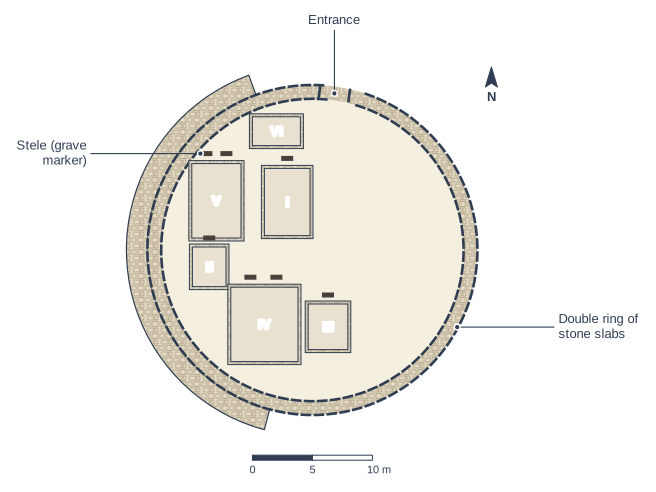
Source A is a plan of Grave Circle A at Mycenae as it was rebuilt about 1250 BC, about 300 years after the shaft graves were dug.

To what extent does the treatment of Grave Circle A show that the rulers of 13th-century Mycenae honoured their ancestors? Use Source A as a starting point and your own knowledge.

Plan of Grave Circle A at Mycenae. Plan, north at the top, with a scale bar (0-10 m). Grave Circle A, about 27.5 m across, is enclosed by a double ring of upright stone slabs filled with rubble; the entrance is a gap through the ring on the north side (towards the Lion Gate), and a curved retaining wall supports the west side on the slope. Inside are the six shaft graves, numbered I-VI as the excavators numbered them, all in the western half of the circle: Grave VI at the north near the entrance; Grave V (where the gold 'Mask of Agamemnon' was found) in the north-west and Grave I east of it; the small Grave II on the west; the largest, Grave IV, in the south-west; and Grave III, small, east of Grave IV. Each grave is a rectangle with a stone-lined edge. Small dark slabs at the north ends of the graves are the stelae (grave markers). The label "Double ring of stone slabs" points to the double ring of upright slabs, filled with rubble, running round the outside; the label "Entrance" points to the gap through the ring of slabs at the top (north); the label "Stele (grave marker)" points to one of the small dark slabs standing at the end of the graves, above the north-west rectangle; the label "I" is written on the rectangle just north of the middle of the circle; the label "II" is written on the smallest rectangle, on the west side of the circle; the label "III" is written on the small rectangle south of the middle of the circle, on the east of the southern pair; the label "IV" is written on the largest rectangle, in the south-west of the circle; the label "V" is written on the large rectangle in the north-west of the circle; the label "VI" is written on the rectangle nearest the entrance, at the north of the circle.

Model answer

Source A shows that the rulers of Mycenae went to great lengths to preserve Grave Circle A. About 1250 BC, some 300 years after the shaft graves were dug, the walls of the citadel were extended so that the circle lay inside them, protected for ever. The plan shows that it was enclosed by a double ring of upright stone slabs, about 27.5 m across, with a formal entrance on the north side facing the Lion Gate, and with the stelae marking the six graves. The ground was built up with a retaining wall on the west side, where the hill slopes away. This was a major building project for graves that were already ancient, and the graves were left undisturbed, still full of their gold masks, swords and cups when Schliemann found them in 1876. All this strongly suggests that the dead were honoured.

However, other motives are possible. The circle was placed so that everyone entering through the Lion Gate saw it immediately, next to the Great Ramp leading up to the palace. This suggests that the rulers wanted to display a link with the great rulers of the past, perhaps claiming them as ancestors to strengthen their own right to rule, whether or not they were really descended from them. The treatment of Grave Circle B makes the point: it was left outside the walls and was even cut into by the Tomb of Clytemnestra, so the rulers did not honour all the old graves, only those that suited their purposes. We also cannot know whether they knew who was buried in Grave Circle A.

Overall, the treatment of Grave Circle A shows clearly that its graves were honoured, but it is less certain that the rulers saw them as their own ancestors. The rebuilding was probably both an act of respect and a piece of political display, linking the 13th-century dynasty with the glorious past.

Explanation

The plan gives the evidence of care (double ring, entrance, stelae); own knowledge adds the date, the extension of the walls, the contents and the contrast with Grave Circle B. Top answers question whether 'honouring ancestors' is the whole story or whether political display was also involved.

Mark scheme
  1. 8 marks

    Levels of response (8 marks). AO1 (4) and AO2 (4) are equally weighted.
    Level 4 (7-8 marks): consistently accurate and detailed knowledge of Grave Circle A, its rebuilding and related evidence, using both Source A and own wider knowledge; very good understanding of the context and of possible interpretations of the rulers' motives; a well-argued response with a clear, substantiated judgement on how far the treatment of the circle shows that the rulers honoured their ancestors, supported by a range of well-selected evidence, including critical analysis.
    Level 3 (5-6 marks): accurate knowledge, using both the source and own knowledge; a focused response with relevant analysis and a judgement.
    Level 2 (3-4 marks): sound, mostly accurate knowledge; engages with the general topic of Grave Circle A; limited range of evidence; some analysis.
    Level 1 (1-2 marks): limited knowledge, may only use Source A; isolated analysis.
    0 marks: no response or no response worthy of credit.
    A mainly descriptive or narrative answer with little analysis or judgement cannot go above Level 2.

    Indicative content (not a checklist; credit other valid points): AO1: six shaft graves of about 1600-1500 BC, with stelae (some carved with chariot scenes); rich goods (gold masks, swords, cups, jewellery); about 1250 BC the walls were extended to bring the circle inside the citadel; enclosed with a double ring of upright stone slabs, about 27.5 m across; entrance on the north side facing the Lion Gate; ground built up with a retaining wall on the west; next to the Great Ramp, seen by everyone entering; the graves were not robbed; by contrast Grave Circle B was left outside the walls and partly cut by the Tomb of Clytemnestra; Schliemann found the graves in 1876. AO2: honour - great labour spent on old graves, protection inside the walls, a monument with a formal entrance, graves left undisturbed; other motives - political: the rulers may have claimed descent from these great figures to strengthen their right to rule; display to visitors entering by the Lion Gate; we cannot know whether the 13th-century rulers really were descended from those buried, or knew who they were; the neglect of Grave Circle B shows that not all ancestors were honoured; honour and propaganda can go together. Judgement: any supported conclusion.

Ready to try the rest? Every answer you write is marked against the mark scheme, so you can see exactly where the marks are.

AI Tutor Hints first, answers after you try

Hi! Stuck? Ask me for a hint and I’ll help you work it out. Once you’ve checked your answer I can explain exactly where the marks are.