
Level:
Correct: 0
Incorrect: 0
Marks: 0/0
Exam Practice
Subject:
Topics:
Avg
score:
–
Topics
done:
0/14

Palaces and Linear B tablets

Practise 32 exam-style questions on Palaces and Linear B tablets for OCR GCSE Classical Civilisation (The Homeric World). Write your answer as you would in the exam and get it marked in seconds against the mark scheme, point by point, with an AI tutor on hand if you get stuck.

  • 32 questions
  • 1–15 marks each
  • Instant marking
  • No sign-up needed
20 questions, marked as you go

Sample questions with model answers

Here are 4 of the questions in this topic, each with a model answer, an explanation of why it earns the marks and the mark scheme an examiner would use.

Question 1

1 mark

Figure 1 is a plan of a Mycenaean megaron, based on the Palace of Nestor at Pylos.

Name the feature labelled A.
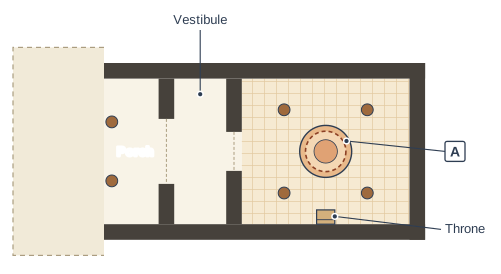
Plan of a Mycenaean building. Plan of a building entered from the left. In front is an open area. The building has three rooms in a row: a first room open at the front, with two dots (columns) across its open side; a narrow second room entered through a wide doorway; and a big room at the back entered through a second doorway. In the middle of the big room is a large circle with a painted rim, with four dots round it; a small rectangle stands against the middle of its lower wall (on your right as you go in). The floor of the big room is marked in squares. Label A points to the large circle in the middle of the big room; the label "Porch" is written on the first room, open at the front; the label "Vestibule" points to the narrow second room, between the open first room and the big room; the label "Throne" points to the small rectangle against the middle of the lower wall of the big room.

Model answer

The hearth.

Explanation

The great round hearth stood in the centre of the main hall, surrounded by four columns that held up a raised roof with an opening to let the smoke out. At Pylos the hearth was raised and painted with flame and spiral patterns, which suggests it was a ceremonial and perhaps religious centre as well as a source of heat and light.

Mark scheme
  1. 1 mark

    The hearth

    Accept 'hearth', 'round / ceremonial hearth', 'fireplace'. Do not accept 'altar', 'well', 'pool', 'column' or 'throne'.

Question 2

2 marks

Explain why the decipherment of Linear B in 1952 was so important. Make two points.

Model answer

First, it proved that the Mycenaeans wrote in an early form of Greek, so they were Greeks, the ancestors of the later Greeks. Second, it meant the tablets could be read, which revealed how the palaces controlled the economy, with records of goods, workers, land and offerings to gods such as Zeus and Poseidon.

Explanation

Before 1952 no one knew what language the Mycenaeans spoke; Evans thought Linear B was Minoan. Ventris's decipherment pushed the history of the Greek language back about 500 years before Homer. Answers that just say 'we could read the tablets' need to explain what that revealed.

Mark scheme
  1. 1 mark

    First valid point

    Two from: it proved that the Mycenaeans spoke and wrote (an early form of) Greek; so the Mycenaeans were Greeks / ancestors of the later Greeks (continuity); it disproved Evans' belief that Linear B was the Minoan language / showed that Greek speakers controlled Knossos; it meant the tablets could be read, revealing the palace economy, officials (wanax, lawagetas), workers and taxes; it showed that gods such as Zeus, Hera and Poseidon were worshipped centuries before Homer; it gave the earliest written Greek. Max 2.

  2. 1 mark

    Second, different valid point

    As above; must be a different point from the first.

Question 3

4 marks

Source A: Homer, Odyssey 6 (Princess Nausicaa tells Odysseus how to approach her parents in the palace of King Alcinous)

'When the house and the courtyard have hidden you, go quickly through the great hall until you reach my mother. She sits at the hearth in the firelight, spinning wool dyed sea-purple, a wonder to see, leaning against a pillar, and her maids sit behind her. Beside her, leaning against the same pillar, is my father's throne, where he sits drinking his wine like an immortal.'

What does Source A suggest about how the megaron (great hall) of a palace was used? Make two points.

Model answer

Source A suggests that the megaron was where the king sat in state and feasted, because Alcinous has a throne there 'where he sits drinking his wine like an immortal'. It also suggests that the hearth was the centre of the household's daily life, since the queen 'sits at the hearth in the firelight' spinning wool with her maids around her.

Explanation

Homer's description fits the archaeology closely: Mycenaean megarons had a central hearth surrounded by four columns, with a throne nearby, as at Pylos. Homer composed centuries after the palaces fell, so his picture mixes memories of the Bronze Age with later customs, but it helps us imagine how the halls were used.

Mark scheme
  1. 2 marks

    First point with supporting evidence from Source A: 1 mark for a valid suggestion about how the megaron was used, 1 mark for a relevant reference or quotation from the source that supports it. The two marks are independent: award 1 for a valid point even if no evidence is given, and 1 for a relevant quotation from, reference to or close paraphrase of the source even if the point is missing, weak or wrong.

    Two pairs from, e.g.: the king sat on his throne there to show his authority (1) - 'my father's throne' (1); feasting and drinking took place there (1) - 'where he sits drinking his wine' (1); the hearth was the centre of life in the hall (1) - 'She sits at the hearth in the firelight' (1); the women of the royal household worked there, making textiles (1) - 'spinning wool dyed sea-purple' / 'her maids sit behind her' (1); visitors and suppliants were received there (1) - Odysseus is to 'go quickly through the great hall until you reach my mother' (1); it displayed the wealth of the royal family (1) - 'sea-purple' wool / 'a wonder to see' (1). The second pair must make a different point from the first. Points must come from the source.

  2. 2 marks

    Second, different point with supporting evidence from Source A: 1 mark for a valid suggestion, 1 mark for a relevant reference or quotation. The two marks are independent: award 1 for a valid point even if no evidence is given, and 1 for a relevant quotation from, reference to or close paraphrase of the source even if the point is missing, weak or wrong.

    As above; must be a different point from the first.

Question 4

8 marks

Source A: the megaron (throne room) of the Palace of Nestor at Pylos

In the centre is a large circular hearth, raised and painted with flame and spiral patterns, surrounded by four wooden columns. The throne stood against the right-hand wall; beside it, a shallow channel in the floor led to a small hollow. The walls were painted with frescoes, including griffins and lions beside the throne and a man playing a lyre.

To what extent was the megaron a religious space as well as a royal one? Use Source A as a starting point and your own knowledge.

Model answer

Source A suggests that the megaron at Pylos had a strong religious side. The shallow channel beside the throne leading to a hollow is usually interpreted as a means of pouring libations, so the wanax may have made offerings from his throne. The griffins painted beside the throne were mythical creatures associated with the gods and with guarding sacred places, as in the throne room at Knossos. The great hearth, raised and painted with flames and spirals, may have served as an altar for burnt offerings as well as a fire. The lyre player with the bird flying before him may show a sacred song, since birds can signal the presence of a god. We also know from Linear B that the palace organised offerings to gods such as Zeus, Hera and Poseidon, so religion was part of the palace's work.

On the other hand, much of the evidence points to a royal and social function. The throne itself, approached through the porch and vestibule, was designed to display the wanax's authority to visitors. The pantries at Pylos held thousands of drinking cups, which suggests large feasts in and around the megaron, and the lyre player may simply have been entertaining guests, like the bards in Homer's palaces. In Homer the megaron is a place of daily life, feasting and receiving guests: in Odyssey 6 the queen sits spinning at the hearth while the king drinks wine on his throne. Mycenae also had a separate cult centre with shrines, which suggests that the main worship of the gods happened elsewhere. The interpretation of the channel and the frescoes is also uncertain.

Overall, the megaron was both royal and religious, because in the Mycenaean world the two could not be separated: the wanax seems to have had religious duties, and feasts and offerings may have been the same occasions. It was above all a royal space, but one where the king's power was presented as being supported by the gods.

Explanation

The question rewards careful interpretation of features whose meaning is debated. Top answers explain why features such as the channel and the griffins are thought to be religious, weigh them against the throne, feasting and Homer's evidence, and reach a judgement that recognises how kingship and religion overlapped.

Mark scheme
  1. 8 marks

    Levels of response (8 marks). AO1 (4) and AO2 (4) are equally weighted.
    Level 4 (7-8 marks): consistently accurate and detailed knowledge of the megaron at Pylos and other palaces, using both Source A and own wider knowledge; very good understanding of the cultural context and possible interpretations of its features; a well-argued response with a clear, substantiated judgement on how far the megaron was a religious space as well as a royal one, supported by a range of well-selected evidence, including critical analysis.
    Level 3 (5-6 marks): accurate knowledge, using both the source and own knowledge; a focused response with relevant analysis and a judgement.
    Level 2 (3-4 marks): sound, mostly accurate knowledge; engages with the general topic; limited range of evidence, some analysis.
    Level 1 (1-2 marks): limited knowledge, may only use the source given; isolated analysis.
    0 marks: no response or no response worthy of credit.
    A mainly descriptive or narrative answer with little analysis or judgement cannot go above Level 2.

    Indicative content (not a checklist; credit other valid points): AO1: Source A: painted circular hearth; four columns; throne against the right-hand wall; channel and hollow beside the throne (often interpreted as for libations); griffins and lions beside the throne; lyre player (with a bird). Wider: porch and vestibule; painted floor (with an octopus in one square near the throne at Pylos); megarons at Tiryns and Mycenae; the throne room at Knossos with griffins; Linear B offerings to Zeus, Hera, Poseidon and others recorded by the palace; pantries of drinking cups for feasts; the separate cult centre at Mycenae; Homer's megarons as places of feasting, entertaining guests and daily life (Odyssey 6: Arete spinning at the hearth). AO2: religious - the libation channel suggests the wanax poured offerings; griffins were mythical guardians linked with the gods; the hearth may have been an altar for offerings; feasts may have been religious; the bird with the lyre player may be a sign of divine presence; the palace organised religion. Royal - the throne and the controlled approach display royal power; the room was used for audiences, feasting and entertainment; separate shrines existed (Mycenae's cult centre), so the megaron was not the main place of worship; interpretations of the channel and frescoes are uncertain. Judgement: e.g. royal and religious roles overlapped because the wanax had religious duties, so it was both.

Ready to try the rest? Every answer you write is marked against the mark scheme, so you can see exactly where the marks are.

AI Tutor Hints first, answers after you try

Hi! Stuck? Ask me for a hint and I’ll help you work it out. Once you’ve checked your answer I can explain exactly where the marks are.