Level:
Correct: 0
Incorrect: 0
Marks: 0/0
Exam Practice
Course:
Topics:
Avg
score:
–
Topics
done:
0/24

Purity and melting points

Practise 13 exam-style questions on Purity and melting points for OCR GCSE Combined Science (Chemistry Paper 3). Write your answer as you would in the exam and get it marked in seconds against the mark scheme, point by point, with the Study Helper on hand if you get stuck.

  • 13 questions
  • 1–4 marks each
  • Instant marking
  • No sign-up needed
13 questions, marked as you go

Sample questions with model answers

Here are 4 of the questions in this topic, each with a model answer, an explanation of why it earns the marks and the mark scheme an examiner would use.

Question 1

1 mark

Vanillin is the substance that gives vanilla its flavour. Pure vanillin melts at 81 °C.

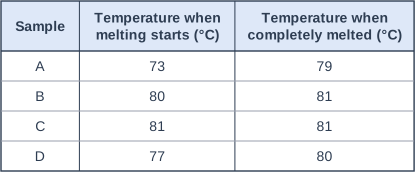
A food scientist tests four samples of vanillin, A, B, C and D. The table shows the temperature at which each sample starts to melt and the temperature at which it has completely melted.

Which sample contains the most impurity?

Choose your answer.

  • A sample A
  • B sample B
  • C sample C
  • D sample D
Table with columns "Sample", "Temperature when melting starts (°C)", "Temperature when completely melted (°C)". Sample: A; Temperature when melting starts (°C): 73; Temperature when completely melted (°C): 79 | Sample: B; Temperature when melting starts (°C): 80; Temperature when completely melted (°C): 81 | Sample: C; Temperature when melting starts (°C): 81; Temperature when completely melted (°C): 81 | Sample: D; Temperature when melting starts (°C): 77; Temperature when completely melted (°C): 80.

Model answer

A - sample A

Explanation

Impurities lower the temperature at which a solid starts to melt and make it melt over a range of temperatures instead of at one temperature. Sample A starts melting furthest below 81 °C and melts over the widest range, so it is the least pure. Sample C melts sharply at 81 °C, the melting point of pure vanillin, so it is the pure sample.

Mark scheme
  1. 1 mark

    A / sample A

    The only correct answer is A: an impurity makes a solid start to melt below the melting point of the pure substance and melt over a range of temperatures, and the more impurity there is, the lower the melting starts and the wider the range. Sample A starts to melt at the lowest temperature (73 °C, 8 °C below 81 °C) and melts over the widest range (73 °C to 79 °C, 6 °C). B is not correct because B melts between 80 °C and 81 °C, very close to 81 °C, so it contains only a little impurity. C is not correct because C melts sharply at 81 °C, so it is pure vanillin. D is not correct because D starts to melt at 77 °C and melts over a range of only 3 °C, so it contains less impurity than A. ALLOW the letter or the option. If more than one option is given, do not award the mark.

Question 2

2 marks

Lead is an element. It is a soft grey metal, and it is poisonous.

A chemical supplier sells small bars of lead labelled 'pure'. Nothing else is mixed with the lead.

A student says:

'The lead cannot be pure, because it is poisonous.'

Explain why the student is wrong.

Model answer

In science, a pure substance contains only one element or one compound, with nothing else mixed in. The bar contains only lead, a single element, so it is pure. Being poisonous has nothing to do with being pure: the student is using the everyday meaning of 'pure', which suggests something clean and safe.

Explanation

The scientific meaning of 'pure' is about how many substances are in a sample, not about whether the sample is safe, clean or natural. A single element such as lead, with nothing mixed in, is pure even though it is poisonous. In everyday speech 'pure' often suggests 'good for you', which is why the student is confused.

Mark scheme
  1. 1 mark

    the bar contains only one substance / only lead / a single element with nothing mixed with it (so it is pure)

    ALLOW in science a pure substance is a single element or compound not mixed with any other substance (and lead is a single element). ALLOW it contains only lead atoms. IGNORE lead is a metal.

  2. 1 mark

    whether a substance is poisonous / safe has nothing to do with whether it is pure / a pure substance can be poisonous / harmful

    ALLOW the student is using the everyday meaning of pure (clean / safe / good for you), not the scientific meaning. IGNORE repeats of the information that lead is poisonous.

Question 3

2 marks

An ice cube made from pure water melts at 0 °C.

Sorbet is a frozen dessert. It is made by freezing a mixture of water, fruit purée and sugar.

A sample of sorbet starts to soften and melt at about −6 °C, and it has completely melted at −2 °C.

Explain why the ice cube and the sorbet melt in different ways.

Model answer

The ice cube is pure water, a single substance, so it melts at one fixed temperature, 0 °C. The sorbet is a mixture of water with sugar and substances from the fruit. These act as impurities, so it starts to melt below 0 °C and melts over a range of temperatures.

Explanation

A pure substance melts at one fixed temperature, but a mixture melts over a range of temperatures, starting below the melting point of the pure substance. Sorbet contains sugar and fruit substances as well as water, so it is a mixture. This is why it softens below 0 °C while a pure ice cube stays solid.

Mark scheme
  1. 1 mark

    the ice cube is a pure substance / contains only water, so it melts at one fixed temperature

    ALLOW the ice cube contains only one substance / one compound. IGNORE the ice cube melts at 0 °C on its own (this repeats the question).

  2. 1 mark

    the sorbet is a mixture / is not pure / contains sugar (and other substances) as well as water

    ALLOW the sugar and fruit substances are impurities which lower the melting point / make it melt over a range of temperatures. ALLOW the dissolved substances lower the melting point. IGNORE the sorbet is sweet / tastes of fruit.

Question 4

3 marks

Pure acetanilide melts at 114 °C.

A student makes some crystals of acetanilide. She measures the temperature at which the last of the crystals melt. She does this three times.

Her results are 109 °C, 112 °C and 112 °C.

Calculate the mean of her results. Use your answer to explain whether her crystals are pure.

Model answer

Mean = (109 + 112 + 112) ÷ 3 = 333 ÷ 3 = 111 °C

The crystals are not pure. Their mean melting point, 111 °C, is lower than 114 °C, the melting point of pure acetanilide, so they must contain an impurity.

Explanation

To find a mean, add all the results and divide by the number of results: 333 ÷ 3 = 111 °C. The middle value and the most common value are both 112 °C, but neither is the mean. Impurities lower the melting point, so crystals that finish melting below 114 °C are not pure acetanilide.

Mark scheme
  1. 1 mark

    (109 + 112 + 112) ÷ 3 / 333 ÷ 3; or a correct final answer of 111 °C with no working

    An answer of 111 °C with no working scores marking points 1 and 2 only. DO NOT ALLOW 112 °C (the middle value or the most common value) or 110.5 °C (the mean of only the highest and lowest values) for points 1 and 2.

  2. 1 mark

    111 (°C)

    ALLOW 111.0 (°C). IGNORE units.

  3. 1 mark

    the crystals are not pure, because the mean (melting point) is lower than the melting point of pure acetanilide

    ALLOW 111 °C is lower than 114 °C, so the crystals are not pure. ALLOW ECF from a wrong mean below 114 °C. ALLOW the crystals contain impurities because they melt below 114 °C. ALLOW every result is below 114 °C, so the crystals are not pure. DO NOT ALLOW the crystals are pure. The decision with no reason scores 0.

Ready to try the rest? Every answer you write is marked against the mark scheme, so you can see exactly where the marks are.

Study Helper Hints first, answers after you try

Stuck on this one? Ask for a hint and I’ll point you in the right direction, without giving the answer away. Once you’ve checked your answer, I’ll show you how the marks are awarded.