
Level:
Correct: 0
Incorrect: 0
Marks: 0/0
Exam Practice
Course:
Topics:
Avg
score:
–
Topics
done:
0/24

Chromatography

Practise 16 exam-style questions on Chromatography for OCR GCSE Combined Science (Chemistry Paper 3). Write your answer as you would in the exam and get it marked in seconds against the mark scheme, point by point, with the Study Helper on hand if you get stuck.

  • 16 questions
  • 1–6 marks each
  • Instant marking
  • No sign-up needed
16 questions, marked as you go

Sample questions with model answers

Here are 4 of the questions in this topic, each with a model answer, an explanation of why it earns the marks and the mark scheme an examiner would use.

Question 1

1 mark

A student uses paper chromatography to find the Rf value of a dye in a hair colouring. She uses ethanol as the solvent.

Which change to her experiment would give a different Rf value for the dye?

Choose your answer.

  • A letting the solvent run for longer
  • B making the spot of hair colouring smaller
  • C using a longer piece of the same paper
  • D using water instead of ethanol as the solvent

Model answer

D (using water instead of ethanol as the solvent)

Explanation

An Rf value compares how far a substance moves with how far the solvent moves, so it stays the same however long the chromatogram runs or however long the paper is. It depends on how the substance is shared between the mobile phase and the stationary phase. Changing the solvent, for example from a non-aqueous solvent such as ethanol to an aqueous one, changes this, so the same dye has a different Rf value in each solvent.

Mark scheme
  1. 1 mark

    D / using water instead of ethanol as the solvent

    The only correct answer is D: the Rf value depends on how the dye is distributed between the solvent (the mobile phase) and the paper (the stationary phase), and a different solvent changes this distribution, so the dye moves a different fraction of the distance moved by the solvent. A is not correct because when the solvent runs for longer the dye also moves further in proportion, so distance moved by dye ÷ distance moved by solvent stays the same; B is not correct because a smaller spot is neater, but its centre still moves the same fraction of the distance moved by the solvent; C is not correct because on the same paper the dye and the solvent behave in the same way whatever the length of the paper, so the Rf value does not change. ALLOW the letter or the option. If more than one option is given, do not award the mark.
Question 2

2 marks

Brown icing colouring is a mixture of a red dye and a green dye. A student separates the two dyes using paper chromatography, with water as the solvent.

While the water moves up the paper:
• the red dye spends most of its time dissolved in the water
• the green dye spends most of its time stuck to the paper.

Predict which dye will move further up the paper.

Explain your prediction.

Model answer

The red dye will move further up the paper.

The water is the mobile phase: it moves up the paper and carries the dye that is dissolved in it. The paper is the stationary phase, which does not move. The red dye spends most of its time in the mobile phase, so it is carried a long way, but the green dye spends most of its time stuck to the stationary phase, so it stays nearer the start line.

Explanation

Separation in chromatography depends on how each substance is distributed between the two phases. A substance that spends more of its time in the moving solvent (the mobile phase) travels further than one that spends more time on the paper (the stationary phase), so the two dyes end up at different heights. Remember which phase moves: the solvent (mobile phase) moves, the paper (stationary phase) does not.

Mark scheme
  1. 1 mark

    (the) red dye (moves further up the paper)

    The prediction on its own scores this mark. DO NOT ALLOW 'both dyes move the same distance'.

  2. 1 mark

    the water (mobile phase) moves up the paper and carries the dissolved red dye with it, but the paper (stationary phase) does not move, so the green dye that is stuck to it is held back / the red dye spends more time in the moving water (mobile phase), so it is carried further than the green dye

    The explanation must say that the water (solvent) moves up the paper or carries the dye, and link this to the red dye moving further. ALLOW the terms mobile phase and stationary phase or the words water (solvent) and paper. DO NOT ALLOW the paper called the mobile phase or the water called the stationary phase (CON). DO NOT ALLOW only a repeat of the information in the question with no idea that the water moves. IGNORE references to the colour or the size of the dyes.

Question 3

2 marks

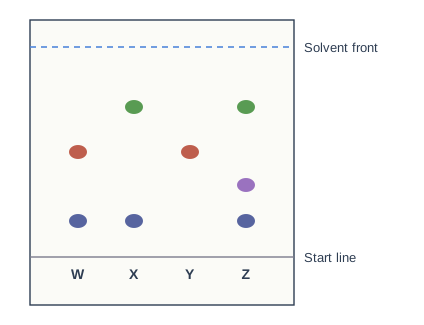
A student uses paper chromatography to compare the dyes in four felt-tip pens, W, X, Y and Z, from a set of art pens.

The diagram shows the chromatogram.

How many different dyes are there in the four pens altogether?

Which pen contains a dye that is not in any of the other pens?

Paper chromatogram. The solvent front is 7 cm above the start line. W: 2 spots at 1.2 cm, 3.5 cm; X: 2 spots at 1.2 cm, 5 cm; Y: one spot at 3.5 cm; Z: 3 spots at 1.2 cm, 2.4 cm, 5 cm.

Model answer

There are 4 different dyes altogether (spots at four different heights).

Pen Z contains a dye that is not in any other pen.

Explanation

Spots at the same height on one chromatogram are the same dye, so count the different heights, not the spots: there are spots at four heights, so four dyes. Pen Z has a spot at a height where no other pen has a spot. Counting every spot gives 8, which counts some dyes more than once.

Mark scheme
  1. 1 mark

    4 / four (different dyes)

    DO NOT ALLOW 8 (the total number of spots, which counts the same dye more than once).

  2. 1 mark

    Z

    ALLOW pen Z. If more than one pen is given, do not award the mark.

Question 4

4 marks

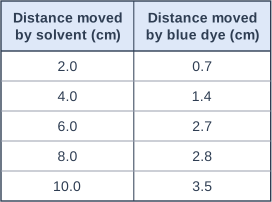
A student investigates how far a blue dye moves as the solvent moves further up the paper. She runs five chromatograms of the same blue ink in the same solvent, and stops each one after a different time.

The table shows her results.

Use one of the results that is NOT anomalous to calculate the Rf value of the blue dye.

Identify the anomalous result.

Describe the relationship between the distance moved by the solvent and the distance moved by the blue dye.

Table with columns "Distance moved by solvent (cm)", "Distance moved by blue dye (cm)". Distance moved by solvent (cm): 2.0; Distance moved by blue dye (cm): 0.7 | Distance moved by solvent (cm): 4.0; Distance moved by blue dye (cm): 1.4 | Distance moved by solvent (cm): 6.0; Distance moved by blue dye (cm): 2.7 | Distance moved by solvent (cm): 8.0; Distance moved by blue dye (cm): 2.8 | Distance moved by solvent (cm): 10.0; Distance moved by blue dye (cm): 3.5.

Model answer

Rf = distance moved by dye ÷ distance moved by solvent = 1.4 ÷ 4.0 = 0.35

The anomalous result is the third one: solvent 6.0 cm, dye 2.7 cm.

As the distance moved by the solvent increases, the distance moved by the dye increases in proportion: when the solvent distance doubles, the dye distance doubles.

Explanation

Every result except the third gives the same Rf value: 0.7 ÷ 2.0 = 1.4 ÷ 4.0 = 2.8 ÷ 8.0 = 3.5 ÷ 10.0 = 0.35. The third result gives 0.45, so it does not fit the pattern; the dye distance should have been about 2.1 cm. Because the dye always moves the same fraction of the solvent's distance, the Rf value of a dye stays the same however long the chromatogram runs, which is why Rf values are used to identify substances.

Mark scheme
  1. 1 mark

    Rf = distance moved by dye ÷ distance moved by solvent, using any result except the third one, for example 1.4 ÷ 4.0; or a correct final answer of 0.35 with no working

    An answer of 0.35 with no working scores marking points 1 and 2 only. ALLOW 0.7 ÷ 2.0, 2.8 ÷ 8.0 or 3.5 ÷ 10.0. DO NOT ALLOW 2.7 ÷ 6.0 = 0.45 (the anomalous result) for marking point 1 or 2. DO NOT ALLOW the division the wrong way round (for example 4.0 ÷ 1.4 = 2.9).

  2. 1 mark

    evaluation: 0.35

    IGNORE units.

  3. 1 mark

    the third result (when the solvent moved 6.0 cm and the dye moved 2.7 cm) is anomalous

    ALLOW the dye distance of 2.7 cm. DO NOT ALLOW more than one result named as anomalous.

  4. 1 mark

    as the distance moved by the solvent increases, the distance moved by the dye increases / the two distances are (directly) proportional / doubling the distance moved by the solvent doubles the distance moved by the dye

    ALLOW positive correlation. ALLOW the dye always moves about a third of the distance moved by the solvent. IGNORE 'the dye moves less than the solvent' on its own.

Ready to try the rest? Every answer you write is marked against the mark scheme, so you can see exactly where the marks are.

Study Helper Hints first, answers after you try

Stuck on this one? Ask for a hint and I’ll point you in the right direction, without giving the answer away. Once you’ve checked your answer, I’ll show you how the marks are awarded.