
Level:
Correct: 0
Incorrect: 0
Marks: 0/0
Exam Practice
Course:
Topics:
Avg
score:
–
Topics
done:
0/24

Ionic, covalent and metallic bonding

Practise 16 exam-style questions on Ionic, covalent and metallic bonding for OCR GCSE Combined Science (Chemistry Paper 3). Write your answer as you would in the exam and get it marked in seconds against the mark scheme, point by point, with the Study Helper on hand if you get stuck.

  • 16 questions
  • 1–6 marks each
  • Instant marking
  • No sign-up needed
16 questions, marked as you go

Sample questions with model answers

Here are 4 of the questions in this topic, each with a model answer, an explanation of why it earns the marks and the mark scheme an examiner would use.

Question 1

1 mark

Sulfur dioxide is a gas. It is used to preserve some dried fruits.

Sulfur dioxide is made of separate particles. Each particle contains one sulfur atom and two oxygen atoms, joined by shared pairs of electrons.

What type of substance is sulfur dioxide?

Choose your answer.

  • A a giant covalent structure
  • B a metal
  • C a simple molecular substance
  • D an ionic compound

Model answer

C (a simple molecular substance)

Explanation

Atoms that share pairs of electrons are joined by covalent bonds. When only a few atoms are joined together, as in SO₂, the substance is made of separate small molecules: it is a simple molecular substance. A giant covalent structure also has covalent bonds, but every atom is joined to its neighbours in a network with no separate molecules.

Mark scheme
  1. 1 mark

    C / a simple molecular substance

    The only correct answer is C: shared pairs of electrons are covalent bonds, and each particle is a small, separate molecule of only three atoms (SO₂). A is not correct because in a giant covalent structure all the atoms are joined in one huge network, not in separate small particles; B is not correct because sulfur and oxygen are non-metals and there are no positive ions or delocalised electrons; D is not correct because no electrons are transferred, so no ions are formed. ALLOW the letter or the option. If more than one option is given, do not award the mark.
Question 2

2 marks

PTFE is a polymer used to coat non-stick frying pans. A PTFE molecule is a chain of thousands of carbon atoms, with fluorine atoms joined to them.

A student says:
'PTFE has a giant covalent structure, because each of its molecules contains thousands of atoms joined by covalent bonds.'

Explain why the student is wrong.

Model answer

Each PTFE chain is a separate molecule: the covalent bonds only join the atoms within one chain. The chains are held to each other by weak intermolecular forces, not by covalent bonds. In a giant covalent structure every atom is joined to its neighbours by covalent bonds, so there are no separate molecules.

Explanation

Being large is not what makes a structure giant covalent. A polymer molecule is very large, but each chain is still a separate molecule, and only intermolecular forces hold the chains together. In a giant covalent structure, such as silicon dioxide, covalent bonds join every atom to its neighbours throughout the whole structure.

Mark scheme
  1. 1 mark

    each chain is a separate molecule / the covalent bonds join atoms only within each chain

    1 mark for each of points 1 to 3, max 2. ALLOW PTFE is made of (very large) separate molecules.

  2. 1 mark

    the chains are held to each other by (weak) intermolecular forces (not by covalent bonds)

    ALLOW there are no covalent bonds between the chains. DO NOT ALLOW the chains are held by ionic bonds.

  3. 1 mark

    in a giant covalent structure, all the atoms are joined to each other by covalent bonds (in one network) / a giant covalent structure has no separate molecules

    ALLOW the bonds in a giant covalent structure continue through the whole structure. IGNORE references to melting points or other properties.

Question 3

2 marks

Zinc is a metal. Steel is coated with zinc to stop it rusting.

In solid zinc, each zinc atom has lost two outer electrons to form a zinc ion, Zn²⁺. These electrons are delocalised.

A student says:
'A piece of solid zinc must have an overall positive charge, because it is made of positive ions.'

Explain why the student is wrong.

Model answer

The electrons that the zinc atoms lost have not left the metal: they are delocalised between the ions. There are two delocalised electrons for every Zn²⁺ ion, so the total negative charge of the electrons equals the total positive charge of the ions, and the zinc has no overall charge.

Explanation

A metal is a lattice of positive ions in a sea of delocalised electrons, and all the electrons that make up the sea came from the metal's own atoms. Each Zn²⁺ ion has given two electrons to the sea, so the charges balance exactly. The electrostatic attraction between the ions and the delocalised electrons is the metallic bond.

Mark scheme
  1. 1 mark

    the electrons lost by the atoms are still in the metal / are delocalised between the ions (they do not leave the zinc)

    ALLOW the zinc also contains (a sea of) negative delocalised electrons.

  2. 1 mark

    there are two delocalised electrons for every Zn²⁺ ion, so the total negative charge (of the electrons) equals the total positive charge (of the ions) / the charges cancel (so there is no overall charge)

    ALLOW the negative charge of the delocalised electrons balances the positive charge of the ions. DO NOT ALLOW the zinc contains negative ions.

Question 4

4 marks

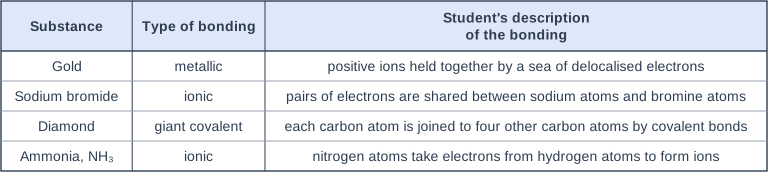
A student made a table about the bonding in four substances.

Two rows of the table contain a mistake.

Identify the two substances whose rows contain a mistake.

For each one, describe what really happens to the electrons when its bonds form.

Table with columns "Substance", "Type of bonding", "Student's description of the bonding". Substance: Gold; Type of bonding: metallic; Student's description of the bonding: positive ions held together by a sea of delocalised electrons | Substance: Sodium bromide; Type of bonding: ionic; Student's description of the bonding: pairs of electrons are shared between sodium atoms and bromine atoms | Substance: Diamond; Type of bonding: giant covalent; Student's description of the bonding: each carbon atom is joined to four other carbon atoms by covalent bonds | Substance: Ammonia, NH₃; Type of bonding: ionic; Student's description of the bonding: nitrogen atoms take electrons from hydrogen atoms to form ions.

Model answer

The sodium bromide row is wrong: the electrons are not shared. Each sodium atom transfers its outer electron to a bromine atom, forming Na⁺ and Br⁻ ions.
The ammonia row is wrong: no ions form. The nitrogen atom and the hydrogen atoms share pairs of electrons, forming covalent bonds in small NH₃ molecules.

Explanation

Sodium is a metal and bromine is a non-metal, so electrons are transferred and ions form: that is ionic bonding. Nitrogen and hydrogen are both non-metals, so their atoms share pairs of electrons in covalent bonds. The gold row (metallic bonding) and the diamond row (giant covalent) are both correct.

Mark scheme
  1. 1 mark

    sodium bromide (row) contains a mistake

    If more than two substances are identified, a wrong one cancels a right one.

  2. 1 mark

    (in sodium bromide) electrons are transferred from sodium atoms to bromine atoms / each sodium atom loses an electron and each bromine atom gains one, forming (Na⁺ and Br⁻) ions

    ALLOW the bonding is ionic and the electrons are not shared. IGNORE the ions are held together by electrostatic attraction. DO NOT ALLOW bromine atoms lose electrons.

  3. 1 mark

    ammonia (row) contains a mistake

    The gold and diamond rows are correct.

  4. 1 mark

    (in ammonia) nitrogen and hydrogen atoms share pairs of electrons / form covalent bonds (so no ions are formed)

    ALLOW ammonia is made of (small) molecules with covalent bonds. DO NOT ALLOW the bonding is covalent with no reference to sharing electrons, unless the answer says no electrons are transferred.

Ready to try the rest? Every answer you write is marked against the mark scheme, so you can see exactly where the marks are.

Study Helper Hints first, answers after you try

Stuck on this one? Ask for a hint and I’ll point you in the right direction, without giving the answer away. Once you’ve checked your answer, I’ll show you how the marks are awarded.