
Level:
Correct: 0
Incorrect: 0
Marks: 0/0
Exam Practice
Course:
Topics:
Avg
score:
–
Topics
done:
0/24

Conservation of mass

Practise 13 exam-style questions on Conservation of mass for OCR GCSE Combined Science (Chemistry Paper 3). Write your answer as you would in the exam and get it marked in seconds against the mark scheme, point by point, with the Study Helper on hand if you get stuck.

  • 13 questions
  • 1–4 marks each
  • Instant marking
  • No sign-up needed
13 questions, marked as you go

Sample questions with model answers

Here are 4 of the questions in this topic, each with a model answer, an explanation of why it earns the marks and the mark scheme an examiner would use.

Question 1

1 mark

When sodium nitrate is heated strongly, it breaks down into sodium nitrite and oxygen.

sodium nitrate → sodium nitrite + oxygen

A student heats some sodium nitrate until it has all broken down. 6.90 g of sodium nitrite and 1.60 g of oxygen are made.

What mass of sodium nitrate did the student heat?

Choose your answer.

  • A 8.50 g
  • B 6.90 g
  • C 5.30 g
  • D 1.60 g

Model answer

A - 8.50 g

Explanation

The law of conservation of mass says that the total mass of the products equals the total mass of the reactants. All the atoms in the sodium nitrate end up in either the sodium nitrite or the oxygen, so the mass of sodium nitrate = 6.90 + 1.60 = 8.50 g. Subtracting the oxygen instead of adding it gives the wrong answer of 5.30 g.

Mark scheme
  1. 1 mark

    A / 8.50 g

    The only correct answer is A: by the law of conservation of mass, the mass of the sodium nitrate equals the total mass of the products, so the mass of sodium nitrate = 6.90 + 1.60 = 8.50 g. B is not correct because 6.90 g is the mass of the sodium nitrite only: the oxygen also came from the sodium nitrate. C is not correct because it subtracts the mass of oxygen (6.90 − 1.60) instead of adding it. D is not correct because 1.60 g is the mass of the oxygen only. ALLOW the letter or the option. If more than one option is given, do not award the mark.
Question 2

2 marks

A student mixes silver nitrate solution with sodium chloride solution in an open beaker on a balance. A white solid forms. No gas is made.

silver nitrate + sodium chloride → silver chloride + sodium nitrate

The student predicts:
'The reading on the balance will increase, because a solid forms and a solid is heavier than a solution.'

Explain why the student's prediction is wrong.

Model answer

The reading stays the same. The solid silver chloride is made from silver ions and chloride ions that were already in the two solutions: the particles are only rearranged, so no extra mass is made. No gas is made, so no atoms leave the open beaker, and the total mass does not change.

Explanation

A solid forming does not add mass: the particles in the solid were in the solutions all along. In an open container the mass changes only if a gas leaves or a gas from the air reacts. The student's mistake is to think that the same particles are heavier in a solid than when they are dissolved.

Mark scheme
  1. 1 mark

    the reading stays the same / the total mass does not change

    1 mark for each of points 1 to 3, max 2. ALLOW the mass is conserved.

  2. 1 mark

    the solid (silver chloride) is made from particles (ions / atoms) that were already in the two solutions / the atoms are only rearranged (no new atoms are made)

    ALLOW the silver and chloride ions were in the solutions all along. DO NOT ALLOW the solid is made from the water.

  3. 1 mark

    no gas is made, so no atoms leave (or enter) the beaker

    ALLOW nothing escapes from the beaker. IGNORE 'the beaker is open' on its own.

Question 3

2 marks

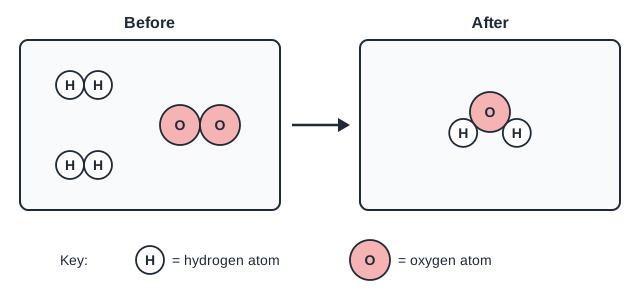
Hydrogen reacts with oxygen to make water. A student draws a model of the molecules in a sealed container before and after the reaction. The diagram shows her model.

Her teacher says that the 'After' box is wrong, because it does not show that mass is conserved.

Explain why the teacher is correct. Describe what the 'After' box should show.

Two boxes joined by an arrow. The box labelled Before contains two molecules that are each made of two hydrogen atoms joined together, and one molecule made of two oxygen atoms joined together. The box labelled After contains one molecule made of one oxygen atom joined to two hydrogen atoms. A key shows that a small white circle labelled H is a hydrogen atom and a larger pink circle labelled O is an oxygen atom.

Model answer

Before the reaction there are 4 hydrogen atoms and 2 oxygen atoms, but the 'After' box shows only 2 hydrogen atoms and 1 oxygen atom, so atoms (and their mass) have gone missing. In a reaction, atoms are not made or destroyed; they are only rearranged. The 'After' box should show two water molecules, which contain 4 hydrogen atoms and 2 oxygen atoms.

Explanation

Mass is conserved because the same atoms are there before and after a reaction: they just join up in new ways. So a model must show the same number of each type of atom on both sides. Two hydrogen molecules and one oxygen molecule rearrange to make two water molecules.

Mark scheme
  1. 1 mark

    before the reaction there are 4 hydrogen atoms and 2 oxygen atoms, but after the reaction there are only 2 hydrogen atoms and 1 oxygen atom / atoms are missing after the reaction

    ALLOW the numbers of atoms are not the same before and after. ALLOW half of the atoms have disappeared, so the mass would be smaller. DO NOT ALLOW the molecules are different (they should be different: new molecules form).

  2. 1 mark

    the 'After' box should show two water molecules (containing 4 hydrogen atoms and 2 oxygen atoms) (because atoms are not made or destroyed, only rearranged)

    ALLOW it should show the same number of each type of atom as the 'Before' box, joined as water molecules. DO NOT ALLOW it should show the same molecules as the 'Before' box.

Question 4

3 marks

Some hand warmers contain iron powder. When a hand warmer is taken out of its airtight wrapper, the iron reacts with oxygen from the air and the hand warmer gets warm. A used hand warmer has a greater mass than a new one.

A student takes a new hand warmer out of its wrapper and puts it inside a large glass jar. She closes the lid so that the jar is sealed. The jar stands on a balance.

Predict what happens to the reading on the balance as the hand warmer reacts. Explain your prediction.

Model answer

The reading on the balance stays the same. The iron still reacts with oxygen, but this oxygen comes from the air that is already inside the jar. The hand warmer gains mass, but the air in the jar loses the same mass of oxygen. The jar is sealed, so no atoms can get in or out, and the total mass of the jar and everything inside it does not change.

Explanation

In the open, a hand warmer gains mass because oxygen atoms from the surrounding air join the iron. In a sealed jar, the oxygen only moves from the air in the jar to the iron, inside the same closed system, so the total mass on the balance is conserved. Whether a reading changes depends on whether atoms can enter or leave the container.

Mark scheme
  1. 1 mark

    the reading stays the same / does not change

    DO NOT ALLOW the reading increases (as for a used hand warmer in the open) or decreases. Points 2 and 3 can be given even if the prediction is wrong, as long as they are correct statements.

  2. 1 mark

    the oxygen that reacts with the iron comes from the air already inside the jar

    ALLOW the oxygen moves from the air in the jar into the hand warmer. ALLOW no new oxygen can get into the jar from outside. DO NOT ALLOW the iron does not react in the jar.

  3. 1 mark

    no atoms / particles can enter or leave the sealed jar, so the total mass (of the jar and its contents) stays the same

    ALLOW mass is conserved because the jar is a closed system. ALLOW the mass gained by the hand warmer is the same as the mass of oxygen lost from the air in the jar.

Ready to try the rest? Every answer you write is marked against the mark scheme, so you can see exactly where the marks are.

Study Helper Hints first, answers after you try

Stuck on this one? Ask for a hint and I’ll point you in the right direction, without giving the answer away. Once you’ve checked your answer, I’ll show you how the marks are awarded.