
Level:
Correct: 0
Incorrect: 0
Marks: 0/0
Exam Practice
Course:
Topics:
Avg
score:
–
Topics
done:
0/24

Bonding, states and bulk properties of materials

Practise 16 exam-style questions on Bonding, states and bulk properties of materials for OCR GCSE Combined Science (Chemistry Paper 3). Write your answer as you would in the exam and get it marked in seconds against the mark scheme, point by point, with the Study Helper on hand if you get stuck.

  • 16 questions
  • 1–6 marks each
  • Instant marking
  • No sign-up needed
16 questions, marked as you go

Sample questions with model answers

Here are 4 of the questions in this topic, each with a model answer, an explanation of why it earns the marks and the mark scheme an examiner would use.

Question 1

1 mark

A student has samples of four solids:
• ice, made of small simple molecules
• paraffin wax, made of much larger simple molecules
• sodium chloride, an ionic compound
• silicon dioxide, which has a giant covalent structure.

Without looking up any data, she predicts the order of their melting points, from lowest to highest.

Which order is correct?

Choose your answer.

  • A silicon dioxide, sodium chloride, paraffin wax, ice
  • B ice, paraffin wax, sodium chloride, silicon dioxide
  • C ice, sodium chloride, paraffin wax, silicon dioxide
  • D paraffin wax, ice, silicon dioxide, sodium chloride

Model answer

B - ice, paraffin wax, sodium chloride, silicon dioxide

Explanation

The weaker the forces or bonds that must be overcome, the lower the melting point. Ice and paraffin wax are made of simple molecules, so only weak forces between molecules are overcome when they melt; these forces are weaker between small water molecules than between large wax molecules. Sodium chloride has strong ionic bonds throughout its giant lattice, and silicon dioxide has very many strong covalent bonds, so both melt only at high temperatures (801 °C and 1710 °C).

Mark scheme
  1. 1 mark

    B / ice, paraffin wax, sodium chloride, silicon dioxide

    The only correct answer is B: ice (0 °C) and paraffin wax (about 60 °C) melt when the weak forces between their molecules are overcome, and these forces are stronger between the large wax molecules than between small water molecules; sodium chloride (801 °C) melts only when its strong ionic bonds are overcome; silicon dioxide (1710 °C) melts only when very many strong covalent bonds are broken. A is not correct because it is the order from highest to lowest. C is not correct because sodium chloride, with strong ionic bonds, melts at a much higher temperature than paraffin wax, whose molecules are held together only by weak forces. D is not correct because the forces between the large wax molecules are stronger than those between small water molecules, so wax melts at a higher temperature than ice, and silicon dioxide melts at a higher temperature than sodium chloride. ALLOW the letter or the option. If more than one option is given, do not award the mark.
Question 2

2 marks

Councils spread salt on roads when water on the road surface could freeze. Water freezes at 0 °C.

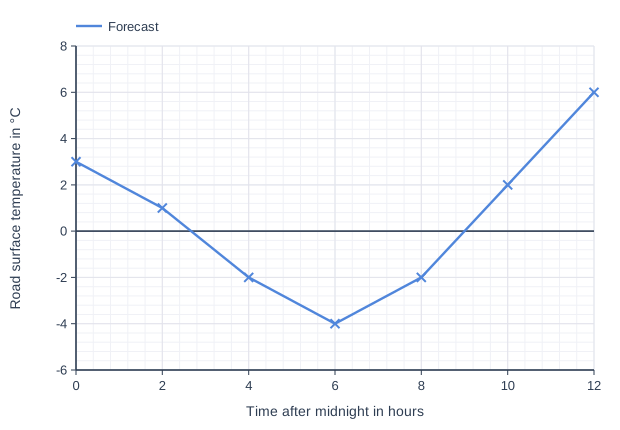
The graph shows a forecast of the temperature of a road surface during one night.

Use the graph to find the time when the road surface temperature first falls below the freezing point of water, and the time when it rises above it again.

Line graph of road surface temperature in °C (y-axis, -6 to 8) against time after midnight in hours (x-axis, 0 to 12). "Forecast" joins the points (0, 3), (2, 1), (4, -2), (6, -4), (8, -2), (10, 2), (12, 6).

Model answer

The temperature falls below 0 °C at about 2.7 hours after midnight (about 02:40).
It rises above 0 °C again at about 9 hours after midnight (09:00).

Explanation

Water on the road can freeze whenever the road surface is below the melting (freezing) point of water, 0 °C. Find where the line crosses 0 °C: going down between the readings at 2 hours (1 °C) and 4 hours (−2 °C), and going up between 8 hours (−2 °C) and 10 hours (2 °C). Read each crossing carefully from the time axis rather than using the nearest plotted point.

Mark scheme
  1. 1 mark

    falls below 0 °C at about 2.7 hours after midnight (about 02:40)

    ALLOW any time from 2.5 to 2.9 hours after midnight (02:30 to 02:55). ALLOW the answer written as a clock time or as hours after midnight.

  2. 1 mark

    rises above 0 °C at about 9 hours after midnight (about 09:00)

    ALLOW any time from 8.8 to 9.2 hours after midnight (08:50 to 09:10). ALLOW the answer written as a clock time or as hours after midnight. If the two times are given the wrong way round, award 1 mark only.

Question 3

2 marks

Candles are made of paraffin wax. Paraffin wax is made of simple molecules, which are long chains of carbon atoms with hydrogen atoms attached. Wax melts at about 60 °C.

A student says: 'Wax melts at a low temperature, so the covalent bonds between the carbon and hydrogen atoms in wax must be weak.'

Explain why the student is wrong.

Model answer

The covalent bonds between the carbon and hydrogen atoms inside the wax molecules are strong, and they are not broken when wax melts. Melting only overcomes the weak intermolecular forces between the wax molecules. These need little energy to overcome, so wax melts at a low temperature.

Explanation

In a simple molecular substance there are two kinds of attraction: strong covalent bonds inside each molecule and weak intermolecular forces between molecules. Changes of state only overcome the weak forces between molecules, so the melting point tells you about these forces, not about the covalent bonds.

Mark scheme
  1. 1 mark

    the covalent bonds inside the wax molecules are strong / are not broken when wax melts

    ALLOW the molecules stay whole when wax melts.

  2. 1 mark

    melting only overcomes the weak (intermolecular) forces between the wax molecules, which needs little energy

    ALLOW the forces between the molecules are weak, so the molecules can move past each other at a low temperature. DO NOT ALLOW weak bonds between the atoms (CON).

Question 4

4 marks

Titanium and silicon dioxide both have high melting points:
• titanium melts at 1668 °C
• silicon dioxide melts at 1710 °C.

Titanium conducts electricity, but silicon dioxide does not.

Titanium is a metal. Silicon dioxide has a giant covalent structure.

Explain these properties of titanium and silicon dioxide. Use ideas about structure and bonding.

Model answer

Titanium is made of positive titanium ions in a sea of delocalised electrons. There is a strong attraction between the ions and the delocalised electrons, so a lot of energy is needed to overcome it and titanium has a high melting point. The delocalised electrons can move through the metal and carry charge, so titanium conducts electricity.
Silicon dioxide is a giant covalent structure: every atom is joined to others by strong covalent bonds. To melt it, many strong covalent bonds must be broken, which needs a lot of energy, so it also has a high melting point. But all its electrons are held in place, in the covalent bonds or on their own atoms, so it has no delocalised electrons or ions that can move, and it does not conduct.

Explanation

A high melting point means strong bonds or attractions must be overcome: metallic bonding in titanium and covalent bonds in silicon dioxide. Conducting needs charged particles that can move: titanium has delocalised electrons, but silicon dioxide does not. This shows that two substances can share one property but differ in another because their bonding is different.

Mark scheme
  1. 1 mark

    titanium: there is a strong attraction between the positive (titanium) ions and the delocalised electrons (strong metallic bonding), so a lot of energy is needed to overcome it

    DO NOT ALLOW titanium has strong covalent bonds or intermolecular forces (CON). ALLOW strong metallic bonds need a lot of energy to break.

  2. 1 mark

    silicon dioxide: every atom is joined to other atoms by strong covalent bonds in a giant structure, so a lot of energy is needed to break the many bonds

    DO NOT ALLOW silicon dioxide has strong intermolecular forces (CON). ALLOW lots of strong covalent bonds must be broken to melt it.

  3. 1 mark

    titanium has delocalised electrons that are free to move through the metal (and carry the charge), so it conducts

    ALLOW free electrons / sea of electrons that can move. DO NOT ALLOW ions move (CON).

  4. 1 mark

    in silicon dioxide every electron is held in place in a covalent bond or on its own atom, so there are no delocalised electrons (and no ions) that can move, so it does not conduct

    ALLOW silicon dioxide has no free electrons or charged particles that can move.

Ready to try the rest? Every answer you write is marked against the mark scheme, so you can see exactly where the marks are.

Study Helper Hints first, answers after you try

Stuck on this one? Ask for a hint and I’ll point you in the right direction, without giving the answer away. Once you’ve checked your answer, I’ll show you how the marks are awarded.