
Level:
Correct: 0
Incorrect: 0
Marks: 0/0
Exam Practice
Course:
Topics:
Avg
score:
–
Topics
done:
0/24

Carbon compounds and giant carbon structures

Practise 16 exam-style questions on Carbon compounds and giant carbon structures for OCR GCSE Combined Science (Chemistry Paper 3). Write your answer as you would in the exam and get it marked in seconds against the mark scheme, point by point, with the Study Helper on hand if you get stuck.

  • 16 questions
  • 1–6 marks each
  • Instant marking
  • No sign-up needed
16 questions, marked as you go

Sample questions with model answers

Here are 4 of the questions in this topic, each with a model answer, an explanation of why it earns the marks and the mark scheme an examiner would use.

Question 1

1 mark

Cyclobutane is a compound of carbon and hydrogen. In a molecule of cyclobutane, four carbon atoms are joined in a ring by single covalent bonds.

Each carbon atom forms four covalent bonds. Each hydrogen atom forms one covalent bond.

Deduce the formula of cyclobutane.

Model answer

C₄H₈

Explanation

In the ring, every carbon atom is bonded to two other carbon atoms, so it has two bonds left for hydrogen atoms. Four carbon atoms × 2 hydrogen atoms = 8 hydrogen atoms, so the formula is C₄H₈. A chain of four carbon atoms (butane) has two more hydrogen atoms, C₄H₁₀, because its two end carbon atoms are bonded to only one carbon atom each.

Mark scheme
  1. 1 mark

    C₄H₈

    ALLOW C4H8 or H₈C₄. DO NOT ALLOW C₄H₁₀ (the formula of butane, where the carbon atoms are in a chain, not a ring). DO NOT ALLOW C₄H₁₆ (four hydrogen atoms on every carbon atom).
Question 2

2 marks

A carbon atom forms four covalent bonds. A nitrogen atom forms three covalent bonds.

Carbon has atomic number 6. Nitrogen has atomic number 7.

Use the electron arrangements of a carbon atom and a nitrogen atom to explain this difference.

Model answer

Carbon's electron arrangement is 2,4, so a carbon atom has four electrons in its outer shell. It needs four more electrons to fill the shell, so it shares four pairs of electrons and forms four covalent bonds.
Nitrogen's electron arrangement is 2,5, so a nitrogen atom has five outer electrons. It needs only three more electrons to fill its outer shell, so it shares three pairs and forms three covalent bonds.

Explanation

In a covalent bond two atoms share a pair of electrons, and each shared pair adds one electron to an atom's outer shell. A second-shell atom needs eight outer electrons, so the number of bonds is the number of electrons it is short of eight: carbon (4 outer electrons) needs 4, nitrogen (5 outer electrons) needs 3. This is why carbon, with four bonds, can join to so many other atoms.

Mark scheme
  1. 1 mark

    carbon is 2,4: it has four electrons in its outer shell, so it needs four more electrons to fill the outer shell and shares four pairs of electrons (four covalent bonds)

    ALLOW 2.4. ALLOW carbon has four outer electrons, so it needs four more to have eight in its outer shell. The point needs the electron arrangement (or the number of outer electrons) linked to the four bonds. DO NOT ALLOW carbon gains or loses four electrons (that would form ions, not covalent bonds).

  2. 1 mark

    nitrogen is 2,5: it has five electrons in its outer shell, so it needs only three more electrons to fill the outer shell and shares three pairs of electrons (three covalent bonds)

    ALLOW 2.5. ALLOW nitrogen needs three more electrons to have eight in its outer shell. DO NOT ALLOW nitrogen forms three bonds because it has three outer electrons. Mark each point on its own: a correct point 2 scores even if point 1 is wrong.

Question 3

2 marks

Here are five statements about forms of carbon.

A Carbon nanotubes are hollow tubes of carbon atoms.
B Diamond conducts electricity because it has delocalised electrons.
C Graphite is hard because its layers are joined by strong covalent bonds.
D Buckminsterfullerene has a giant covalent structure.
E Graphite and diamond are both made of only one element.

Which two statements are correct?

Give the two letters.

Model answer

A and E

Explanation

Nanotubes are hollow fullerene tubes, and diamond and graphite are both pure carbon. The other statements contain common mix-ups: it is graphite, not diamond, that has delocalised electrons; graphite is soft because its layers are held by weak forces; and buckminsterfullerene is made of separate C₆₀ molecules, not a giant structure.

Mark scheme
  1. 1 mark

    A

    Max 1 if more than two answers are given. ALLOW the statement written out instead of the letter. A is correct: nanotubes are fullerenes shaped like hollow cylinders. B is wrong because diamond has no delocalised electrons (all four outer electrons of each atom are in bonds), so it does not conduct; C is wrong because graphite is soft, and its layers are held together only by weak forces; D is wrong because buckminsterfullerene is made of separate molecules of 60 atoms, not a giant structure.

  2. 1 mark

    E

    E is correct: both are made only of carbon atoms. The two letters can be given in either order.

Question 4

4 marks

A student investigates whether pencil lines conduct electricity. The 'lead' in a pencil is a mixture of graphite and clay. Clay does not conduct electricity.

The student draws a thick line 10 cm long on paper with each of four pencils. They connect each line in turn to the same battery and an ammeter, and measure the current.

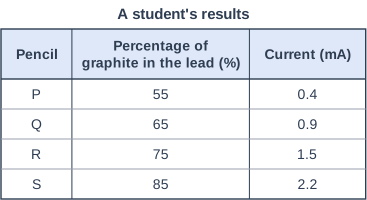
The table shows the student's results.

Describe the pattern in the results.

Explain the pattern. Use ideas about the structure and bonding of graphite.

A student's results. Table with columns "Pencil", "Percentage of graphite in the lead (%)", "Current (mA)". Pencil: P; Percentage of graphite in the lead (%): 55; Current (mA): 0.4 | Pencil: Q; Percentage of graphite in the lead (%): 65; Current (mA): 0.9 | Pencil: R; Percentage of graphite in the lead (%): 75; Current (mA): 1.5 | Pencil: S; Percentage of graphite in the lead (%): 85; Current (mA): 2.2.

Model answer

The higher the percentage of graphite in the pencil lead, the larger the current: 55 % graphite gives 0.4 mA, but 85 % graphite gives 2.2 mA.
In graphite, each carbon atom is bonded to only three other carbon atoms, so one outer electron from each atom is delocalised. These delocalised electrons can move along the layers and carry the charge, so graphite conducts. Clay has no delocalised electrons and does not conduct. So the more graphite there is in the line, the more delocalised electrons and paths there are for the charge, and the larger the current.

Explanation

First describe the trend in words, as a comparison of the two variables. Then explain it: graphite conducts because of the delocalised electron from each carbon atom, and the clay mixed with it does not conduct. So the more graphite in the line, the better it conducts. Saying 'graphite conducts' is not enough: the explanation needs the delocalised electrons.

Mark scheme
  1. 1 mark

    the higher the percentage of graphite (in the lead), the larger the current / ORA (allow the reverse argument)

    The answer must be a comparison: IGNORE the current changes on its own. ALLOW a description using data, for example 55 % graphite gives 0.4 mA but 85 % graphite gives 2.2 mA.

  2. 1 mark

    in graphite, each carbon atom is bonded to (only) three other carbon atoms / each carbon atom has one outer electron that is not used in bonding

    ALLOW each carbon atom forms three covalent bonds.

  3. 1 mark

    these electrons are delocalised / free to move (along the layers), so they can carry the charge (the current)

    ALLOW graphite has delocalised electrons that move through it. DO NOT ALLOW ions move (CON). IGNORE graphite is a conductor on its own.

  4. 1 mark

    clay has no delocalised electrons / clay does not conduct, so more graphite in the lead gives more delocalised electrons or more paths for the charge to flow (so a larger current)

    ALLOW less clay means less of the line is non-conducting. ALLOW more graphite means more electrons that can move.

Ready to try the rest? Every answer you write is marked against the mark scheme, so you can see exactly where the marks are.

Study Helper Hints first, answers after you try

Stuck on this one? Ask for a hint and I’ll point you in the right direction, without giving the answer away. Once you’ve checked your answer, I’ll show you how the marks are awarded.