Question 1
2 marksDescribe one feature of the refugees who fled from the Harrying of the North.
Model answer
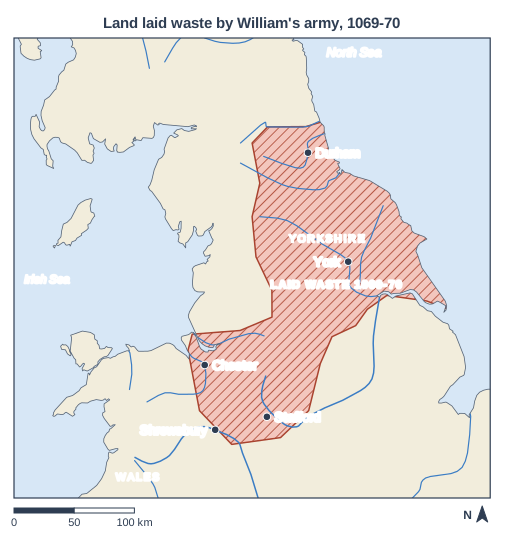
Some refugees travelled a long way south to escape the famine. The chronicle of Evesham Abbey in Worcestershire records large numbers of starving old people, women and children arriving there, where Abbot Aethelwig gave them food, although many still died.
Explanation
Two marks need one clear feature of the refugees, such as where they went, who they were or how many died, followed by a precise detail such as the help given at Evesham Abbey. Avoid writing only about the Harrying itself: the question is about the people who fled from it.
Mark scheme
-
1 mark
A valid feature of the refugees identified, e.g. they were fleeing famine / they included old people, women and children / some travelled a long way south, as far as Worcestershire / they came from the Midlands as well as Yorkshire / many were starving and died, even after reaching help / churchmen gave them food and shelter / some went into exile, and English leaders fled north to Scotland / some died on the journey / some people sold themselves into slavery instead
Award one mark for a valid feature identified. The second mark should be awarded for supporting information. e.g. Some refugees travelled a long way south (1); the chronicle of Evesham Abbey in Worcestershire records large numbers of starving people arriving there (1). / The refugees included old people, women and children (1); the abbot of Evesham placed many of the children in the care of the abbey's servants and monks (1). / Many refugees were starving (1), and the Evesham chronicle says that five or six of them died there almost every day for a long time (1). / Churchmen helped them (1); Abbot Aethelwig of Evesham gave food to as many refugees as he could (1). / Refugees came from the Midlands as well as Yorkshire (1); the Evesham chronicle names Cheshire, Shropshire, Staffordshire and Derbyshire, which William's army also laid waste (1). / Some people went into exile (1); Edgar the Aethling and other English leaders who feared William's anger took refuge in Scotland in 1070 (1). Accept other appropriate features and supporting information.
-
1 mark
Supporting information that develops the feature identified, e.g. for the cause: homes, food stores, animals and tools had been destroyed in the winter of 1069-70, so people had no means of surviving where they were; for the people: whole families came, and some of the children taken in at Evesham later grew up to serve the abbey; for distance: Evesham is in Worcestershire, far to the south of Yorkshire; for deaths: many were so weak from hunger that they died soon after eating, and the prior of Evesham buried them; for help: Aethelwig was one of the few English abbots trusted by William and he organised food for the poor and travellers; for the Midlands: the march to Chester in early 1070 wasted parts of these counties; for Scotland: Symeon of Durham says Malcolm III promised Edgar and his companions a home in his kingdom; for the journey: Symeon says some people collapsed and died while trying to leave the country
The supporting information must develop the feature already identified. Do not credit a second statement of the same feature in other words, or a general comment such as 'they had a hard time'. Accept 'about five or six a day' as the Evesham chronicle's figure, and accept Worcestershire, the West Midlands or 'the south' for Evesham. Accept the bishop and church community of Durham, who fled with the body of St Cuthbert to Lindisfarne (Holy Island) in December 1069 for fear of William's army. Do not credit refugees fleeing to Normandy, refugees from the Battle of Hastings, or the claim that William provided food for them.