
Level:
Correct: 0
Incorrect: 0
Marks: 0/0
Exam Practice
Course:
Topics:
Edexcel GCSE History (Anglo-Saxon and Norman England c1060-88) Smart practice A mixed round aimed at your weak spots
Unit 1
Key topic 1: Anglo-Saxon England and the Norman Conquest, 1060-66
Unit 2
Key topic 2: William I in power: securing the kingdom, 1066-87
Unit 3
Key topic 3: Norman England, 1066-88
Avg
score:
–
Topics
done:
0/12

Establishing control

Practise 22 exam-style questions on Establishing control for Edexcel GCSE History (Anglo-Saxon and Norman England c1060-88). Write your answer as you would in the exam and get it marked in seconds against the mark scheme, point by point, with the Study Helper on hand if you get stuck.

  • 22 questions
  • 2–16 marks each
  • Instant marking
  • No sign-up needed
20 questions, marked as you go

Sample questions with model answers

Here are 4 of the questions in this topic, each with a model answer, an explanation of why it earns the marks and the mark scheme an examiner would use.

Question 1

2 marks

Describe one feature of William's campaign to make the English leaders submit after the Battle of Hastings (October-December 1066).

Model answer

William did not attack London directly. His men drove back a force from the city and burned Southwark, and then he marched west and crossed the Thames at Wallingford, where Archbishop Stigand submitted, before circling round London to Berkhamsted.

Explanation

Full marks need one clear feature of the campaign, such as the burning of Southwark, the crossing at Wallingford or the ravaging of the land around London, with a precise supporting detail. Avoid describing the Battle of Hastings itself: the question is about William's actions in the weeks after the battle.

Mark scheme
  1. 1 mark

    A valid feature of William's campaign identified, e.g. he waited at Hastings for the English leaders to submit, but they did not come / he punished Romney / he took Dover and strengthened its defences / disease broke out in his army / Canterbury and Kent submitted / he did not attack London directly but burned Southwark / he crossed the Thames at Wallingford, where Stigand submitted / his army ravaged the countryside around London / reinforcements came from Normandy / it ended with the submission of the English leaders at Berkhamsted

    Award one mark for a valid feature identified. The second mark should be awarded for supporting information. e.g. William waited at Hastings for the English leaders to submit (1), but none came, because the Witan had chosen Edgar the Aethling as king (1). / William punished the people of Romney (1), who had killed some of his men who landed there by mistake (1). / William took Dover (1) and spent about eight days strengthening its fortifications before moving on (1). / William did not attack London directly (1); his men drove back a force from the city and burned Southwark, on the south bank of the Thames (1). / William crossed the Thames at Wallingford (1), where Archbishop Stigand came to submit to him (1). / William's army ravaged the land in a wide circle around London (1), so that the city was cut off and its leaders were frightened into submitting (1). Accept other appropriate features and supporting information.

  2. 1 mark

    Supporting information that develops the feature identified, e.g. for waiting: he stayed at Hastings for several days (about five, according to Guy of Amiens) but no English leaders came; for Romney: he took it by assault in revenge; for Dover: the garrison was ready to surrender, some houses were burned by his men, he paid for the damage and left a garrison there; for disease: many soldiers suffered from dysentery at Dover; for Kent: the men of Kent and Canterbury swore loyalty and gave hostages; for Winchester: a force was sent to take Winchester, where the royal treasury was kept; for London: he had too few men to storm a large walled city, so his men fought off troops from London and burned Southwark; for Wallingford: he marched west up the Thames valley and crossed there, where Stigand submitted; for ravaging: the Anglo-Saxon Chronicle says he ravaged all the country he passed through, and his route ran west through Surrey and Berkshire and then north-east through Buckinghamshire and Hertfordshire; for reinforcements: more men arrived from Normandy; for Berkhamsted: Ealdred, Edgar and the leaders of London submitted there in early December

    The supporting information must develop the feature already identified. Do not credit a second statement of the same feature in other words, or a general comment such as 'he was very successful'. Accept 'about a week' for Dover and any route given in outline (east to Dover, then towards London, west along the Thames to Wallingford, north-east to Berkhamsted). Do not credit events of the Battle of Hastings itself, Harold's march south from Stamford Bridge, a claim that William stormed London or besieged it for months, or the Harrying of the North (1069-70).
Question 2

12 marks

Explain why the Marcher earls were able to extend Norman control into Wales in the years 1067-87.

You may use the following in your answer:
- castles
- Welsh rulers

You must also use information of your own.

Model answer

The Marcher earls of Hereford, Shrewsbury and Chester were able to push Norman control into Wales because they built castles as bases, because the Welsh were divided, and because their special powers and compact lands gave them both the means and the motive to attack.

Castles were the key to holding any land the earls won. William FitzOsbern began a castle at Chepstow, on the cliffs above the River Wye, in 1067 and built another at Monmouth, which allowed him to begin the conquest of Gwent in south-east Wales. Roger de Montgomery built a castle at Montgomery, named after his home in Normandy, on the edge of Powys, and Robert of Rhuddlan, Hugh d'Avranches' cousin, built a castle at Rhuddlan in north Wales in about 1073. Each castle held a garrison of mounted knights who could ride out to raid the surrounding land, and once built it was very hard for the Welsh to remove.

The Welsh rulers were also divided. After Gruffydd ap Llywelyn was killed in 1063, Wales broke up into rival kingdoms whose princes often fought one another instead of uniting against the Normans. This allowed the earls to attack one area at a time. FitzOsbern defeated several Welsh princes soon after he became earl, and Hugh d'Avranches, Earl of Chester, pushed along the coast into Gwynedd in north Wales.

The earls' special powers gave them a strong motive. They could build castles without asking the king and keep the land they conquered, so every Welsh district they took added to their own wealth. Aggressive leaders such as Hugh d'Avranches, nicknamed 'the Wolf', were eager to use these powers.

Their compact earldoms gave them the means. Hugh held almost all of Cheshire and Roger most of Shropshire, so the knights, money and supplies of a whole shire could be used on the frontier. The earls granted land to their own followers in return for knight service, building up forces of experienced Norman knights.

Finally, the earls had the king's support. William marched to Chester in 1070 and built a castle there, and in 1081 he led an expedition to St Davids himself. Backed by the king, the Marcher earls could keep pushing forward, even though most of Wales was still ruled by Welsh princes in 1087.

Explanation

Strong answers explain how each factor allowed the earls to advance, for example linking their right to keep conquered land to their eagerness to attack, rather than listing castles or naming the earls. To reach Level 4, add aspects beyond castles and Welsh rulers, such as the earls' special powers, their compact earldoms or the king's support.

Mark scheme
  1. 12 marks

    Levels of response (12 marks). AO2: 6 marks. AO1: 6 marks.
    Level 4 (10-12 marks): An analytical explanation is given which is directed consistently at the conceptual focus of the question, showing a line of reasoning that is coherent, sustained and logically structured. [AO2] Accurate and relevant information is precisely selected to address the question directly, showing wide-ranging knowledge and understanding of the required features or characteristics of the period studied. [AO1] No access to Level 4 for answers that do not address three or more aspects of content.
    Level 3 (7-9 marks): An explanation is given, showing some analysis, which is mainly directed at the conceptual focus of the question. It shows a line of reasoning that is generally sustained, although some passages may lack coherence and organisation. [AO2] Accurate and relevant information is included, showing good knowledge and understanding of the required features or characteristics of the period studied. [AO1] Maximum 8 marks for answers that do not address three or more aspects of content.
    Level 2 (4-6 marks): An explanation is given, showing limited analysis and with implicit or unsustained links to the conceptual focus of the question. It shows some development and organisation of material, but a line of reasoning is not sustained. [AO2] Accurate and relevant information is included, showing some knowledge and understanding of the period. [AO1]
    Level 1 (1-3 marks): A simple or generalised answer is given, lacking development and organisation. [AO2] Limited knowledge and understanding of the topic is shown. [AO1]
    0 marks: No rewardable material.
    Performance in AO1 and AO2 is interdependent. An answer displaying no qualities of AO2 cannot be awarded more than the top of Level 1, no matter how strong performance is in AO1; markers should note that the expectation for AO1 is that candidates demonstrate both knowledge and understanding.

    Indicative content (not a checklist; credit other valid points): Castles: the earls built castles as bases on the frontier and then pushed them forward into Welsh land, such as Chepstow (begun 1067) and Monmouth in Gwent (William FitzOsbern), Montgomery (Roger de Montgomery, about 1070-74) and Rhuddlan (Robert of Rhuddlan, about 1073), as well as the royal castles at Shrewsbury (in use by 1069) and Chester (built by William in 1070), which the earls took over; each castle held the land around it with a garrison of knights who could ride out to raid, and was hard for the Welsh to remove. Welsh rulers: after the death of Gruffydd ap Llywelyn in 1063 Wales was divided between rival kingdoms and princes, who often fought each other rather than uniting against the Normans; FitzOsbern defeated several Welsh princes (Orderic names Rhys, Cadwgan and Maredudd); Gruffudd ap Cynan, king of Gwynedd, was captured in 1081 and imprisoned at Chester. Special powers: Marcher earls could build castles without asking the king, keep their own forces and officials, set up boroughs and keep the land they conquered, which gave them a strong reason to attack (accept the usual textbook list of powers; historians note that some privileges, such as Chester's later 'palatine' status, developed after 1087). Compact earldoms: each earl held most of the land in his shire (Hugh d'Avranches almost all of Cheshire, Roger de Montgomery most of Shropshire), so the knights, money and supplies of the whole area could be used on the frontier. Military strength: mounted knights, archers and experienced, aggressive leaders such as Hugh 'the Wolf' and Robert of Rhuddlan; earls granted land to followers in return for knight service (e.g. Walter de Lacy under FitzOsbern, Warin the Bald under Roger). Royal support: William trusted these men, campaigned in the area himself (he marched to Chester in 1070 and built a castle there), and in 1081 led an expedition to St Davids, after which the ruler of Deheubarth paid him tribute. Settlement: new boroughs (towns) attracted settlers and trade, strengthening the Norman hold. Answers need not judge how far Norman control extended, but should not claim that the whole of Wales was conquered by 1087 (most of it was still ruled by Welsh princes). Do not credit Edward I's conquest and castles (1270s-1290s), or confusion between the three earldoms and their earls.

    Pearson's marking instructions: The middle mark in each level may be achieved by stronger performance in either AO1 or AO2.

Question 3

12 marks

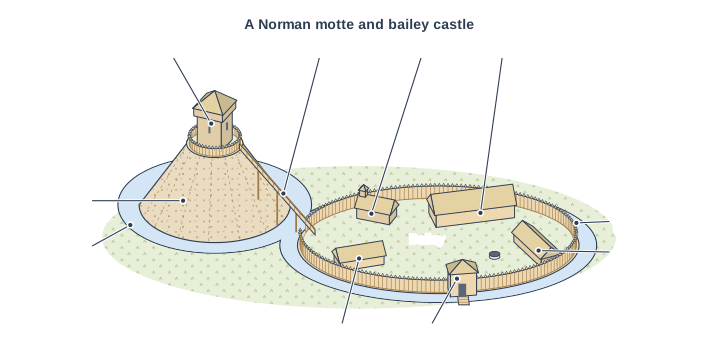
Explain why motte and bailey castles, like the one shown in the diagram, could be built so quickly in the years 1066-71.

You may use the following in your answer:
- earth and timber
- English labour

You must also use information of your own.

Bird's-eye drawing of a motte and bailey castle. Its heading is "A Norman motte and bailey castle". Bird's-eye drawing of a Norman motte and bailey castle. On the left is the motte, a tall steep mound of earth with a flat top, ringed by its own water-filled ditch; on top stands the keep, a square wooden tower with a pyramid roof and an overhanging top storey, inside a palisade (fence of pointed wooden stakes). A steep wooden flying bridge climbs from the bailey across the ditch to the top of the motte. To the right is the bailey, a large oval courtyard surrounded by a palisade on a low bank and by a water-filled ditch (moat) that joins the motte's ditch. In the bailey are a long hall at the back, a small chapel with a bell turret at the back left, stables along the right-hand side, a storehouse at the front left and a well in the middle. The way in is through a wooden gatehouse in the front of the palisade, reached by a short bridge over the ditch. The label "Keep (wooden tower)" points to the tower on top of the mound; the label "Bridge up to the motte" points to the steep wooden walkway climbing from the large enclosure to the top of the mound; the label "Chapel" points to the small building with a little bell turret at the back left of the large enclosure; the label "Hall" points to the long building at the back of the large enclosure; the label "Motte (earth mound)" points to the tall steep mound of earth on the left; the label "Ditch (moat)" points to the water-filled channel running round the outside; the label "Palisade (wooden fence)" points to the row of pointed wooden stakes round the large enclosure; the label "Stables" points to the long low building on the right-hand side of the large enclosure; the label "Bailey" is written in the large enclosed area on the right; the label "Stores" points to the building at the front left of the large enclosure; the label "Gatehouse" points to the wooden tower at the front, where a short crossing leads over the water.

Model answer

Motte and bailey castles could be built very quickly after 1066 because they were made of cheap, local materials, because the Normans could force the English to do the work, and because the design was simple and well known to them.

The most important reason was that they were made of earth and timber. These materials could be found almost anywhere in England, so the Normans did not need to quarry stone and carry it long distances. The design also saved effort: the earth dug out of the ditches was piled up to make the motte and the banks, so digging one defence created another. Timber for the keep, the palisade and the buildings in the bailey could be cut from nearby woods.

Secondly, the Normans used English labour. Building a motte meant moving huge amounts of earth, but this needed strength rather than skill. The Normans forced local peasants to dig and carry, so large numbers of workers could be put on a site at once. No skilled masons were needed, which was very different from a stone castle: the stone White Tower in London took more than twenty years to finish.

Thirdly, the design was simple and familiar. The Normans had built motte and bailey castles in Normandy before 1066, so they knew exactly what to build, and the same plan, with a motte and keep, a bailey, a palisade and a ditch, as the diagram shows, could be used almost anywhere. They could also save time by using what was already there, such as a natural hill or old Roman walls, as at Pevensey in 1066. Most mottes were not very high: most of those in England and Wales were under 5 metres.

Finally, the Normans built quickly because they had to. They were a small minority surrounded by a hostile population, so soldiers built a castle as soon as they entered an area. The Normans built a castle at Hastings within days of landing in 1066, and in 1068 William built castles at Warwick, Nottingham, York and Lincoln as he marched north. Orderic Vitalis says that in 1069 William spent eight days at York building a second castle.

Together, cheap materials, forced labour, a familiar design and the urgent need for protection explain how the Normans were able to cover England with castles so quickly.

Explanation

Top-level answers explain why each factor made building faster, for example linking the use of earth from the ditch to the speed of raising the motte, rather than describing the parts of the castle in the diagram. Using only earth and timber and English labour caps the answer at 8 marks, so add aspects such as the simple, familiar design, the use of existing sites or the urgent need for castles.

Mark scheme
  1. 12 marks

    Levels of response (12 marks). AO2: 6 marks. AO1: 6 marks.
    Level 4 (10-12 marks): An analytical explanation is given which is directed consistently at the conceptual focus of the question, showing a line of reasoning that is coherent, sustained and logically structured. [AO2] Accurate and relevant information is precisely selected to address the question directly, showing wide-ranging knowledge and understanding of the required features or characteristics of the period studied. [AO1] No access to Level 4 for answers that do not address three or more aspects of content.
    Level 3 (7-9 marks): An explanation is given, showing some analysis, which is mainly directed at the conceptual focus of the question. It shows a line of reasoning that is generally sustained, although some passages may lack coherence and organisation. [AO2] Accurate and relevant information is included, showing good knowledge and understanding of the required features or characteristics of the period studied. [AO1] Maximum 8 marks for answers that do not address three or more aspects of content.
    Level 2 (4-6 marks): An explanation is given, showing limited analysis and with implicit or unsustained links to the conceptual focus of the question. It shows some development and organisation of material, but a line of reasoning is not sustained. [AO2] Accurate and relevant information is included, showing some knowledge and understanding of the period. [AO1]
    Level 1 (1-3 marks): A simple or generalised answer is given, lacking development and organisation. [AO2] Limited knowledge and understanding of the topic is shown. [AO1]
    0 marks: No rewardable material.
    Performance in AO1 and AO2 is interdependent. An answer displaying no qualities of AO2 cannot be awarded more than the top of Level 1, no matter how strong performance is in AO1; markers should note that the expectation for AO1 is that candidates demonstrate both knowledge and understanding.

    Indicative content (not a checklist; credit other valid points): Earth and timber: the materials were found almost everywhere, so there was no need to quarry stone and carry it long distances; the earth dug out of the ditches was piled up to make the motte and the banks, so one job produced two defences; timber for the keep, palisade and buildings could be cut locally. English labour: the Normans forced local English peasants to do the heavy digging and carrying; the work needed very little skill, so large numbers of unskilled labourers could be used, and no skilled masons were needed (a stone keep could take up to ten years, and the White Tower took over twenty). Simple, familiar design: the Normans had built motte and bailey castles in Normandy before 1066, so they knew exactly what to build, and the same plan (motte, keep, bailey, palisade, ditch) could be used anywhere. Using what was there: castles could be built on natural hills or inside existing defences such as Roman walls (Pevensey in 1066, London) or town defences, saving time; many mottes were small (most in England and Wales were under 5 metres high). Urgency and organisation: the Normans were few and surrounded by a hostile population, so castles were built as soon as an area was entered; soldiers on campaign did the work under the king's orders. Examples of speed: a castle was built at Hastings within days of the landing in 1066, and the Bayeux Tapestry shows men digging its motte; in 1068 William built castles at Warwick, Nottingham, York and Lincoln as he marched; Orderic Vitalis says William spent eight days at York in 1069 building a second castle. Prefabrication: the later writer Wace claims William brought a prefabricated wooden fort to England in 1066 (credit as a claim). Historians think the largest mottes took months, so accept answers that say some took longer. The diagram may be used to identify the parts (motte, keep, bailey, palisade, ditch, bridge, gatehouse), but describing the parts without explaining why they were quick to build should not go beyond Level 2. Do not credit stone walls, stone keeps or concentric designs as features of the castles of 1066-71.

    Pearson's marking instructions: The middle mark in each level may be achieved by stronger performance in either AO1 or AO2.

Question 4

16 marks

'Norman castles were completely different from the burhs of Anglo-Saxon England.'

How far do you agree? Explain your answer.

You may use the following in your answer:
- protecting the townspeople
- banks and ditches

You must also use information of your own.

Model answer

Norman castles and Anglo-Saxon burhs used similar methods and were often in the same places, so they were not completely different. However, they had very different purposes, so I agree with the statement to a large extent.

The biggest difference was who they protected. Burhs were built by Alfred and later kings to defend against the Vikings, and their purpose was protecting the townspeople and the people of the surrounding countryside, who could shelter inside the walls. A Norman castle did the opposite. It protected a Norman lord and his small garrison from the English around them, and it was used to control those English. Castles were often built inside towns by knocking down houses: Domesday Book records that 166 houses were destroyed at Lincoln and 27 at Cambridge.

The design and scale were also different. A burh enclosed a whole town; Wallingford's bank was about 2.7 kilometres long. A castle was a small enclosure, and the motte, a high mound with a wooden keep on top, was something new in England. It gave the defenders a lookout and a last refuge. Burhs were defended by local men, whereas castles held professional Norman knights who could ride out and control the countryside. Orderic Vitalis wrote that the English had very few fortresses of the kind the Normans called castles, which shows how new they seemed.

On the other hand, the building methods were similar. Both used banks and ditches topped by wooden palisades, built from earth and timber. Both sometimes reused Roman walls: the burhs at Winchester and Exeter, and William's fort at Pevensey and his first castle in London. Both were placed at key points on rivers and roads, and many castles were built inside old burhs, such as Wallingford, Exeter and York. Like Alfred's network of about thirty burhs, William's royal castles in towns were part of a royal plan to hold territory. Castles were not even entirely new: a few had been built in Herefordshire by Edward the Confessor's Norman followers in the 1050s.

Overall, judged by materials, methods and locations, castles and burhs had a lot in common. Judged by purpose and by who they protected, however, they were very different: a burh protected the English community, while a castle protected a few conquerors against that community. Because purpose is the most important test of a fortification, I largely agree that castles were different, although 'completely' different goes too far.

Explanation

Level 4 answers compare castles and burhs directly using clear criteria, such as purpose, design and who was protected, rather than describing each separately. A common weakness is to ignore the similarities, such as the shared use of banks, ditches and palisades and the building of castles inside old burhs, which the word 'completely' invites you to test.

Mark scheme
  1. 16 marks

    Levels of response (16 marks).
    Level 4 (13-16 marks): An analytical explanation is given which is directed consistently at the conceptual focus of the question, showing a line of reasoning that is coherent, sustained and logically structured. Accurate and relevant information is precisely selected to address the question directly, showing wide-ranging knowledge and understanding of the required features or characteristics of the period studied. Criteria for the required judgement are justified and applied in the process of reaching the overall judgement. No access to Level 4 for answers that do not address three or more aspects of content.
    Level 3 (9-12 marks): An explanation is given, showing some analysis, which is mainly directed at the conceptual focus of the question. It shows a line of reasoning that is generally sustained, although some passages may lack coherence and organisation. Accurate and relevant information is included, showing good knowledge and understanding of the required features or characteristics of the period studied. The overall judgement is given with some justification, but some criteria selected for the required judgement are left implicit or not validly applied. Maximum 11 marks for answers that do not address three or more aspects of content.
    Level 2 (5-8 marks): An explanation is given showing limited analysis and with implicit or unsustained links to the conceptual focus of the question. It shows some development and organisation of material, but a line of reasoning is not sustained. Accurate and relevant information is included, showing some knowledge and understanding of the period. The overall judgement is given but its justification is asserted or insecure.
    Level 1 (1-4 marks): A simple or generalised answer is given, lacking development and organisation. Limited knowledge and understanding of the topic is shown. The overall judgement is missing or asserted.
    0 marks: No rewardable material.

    Indicative content (not a checklist; credit other valid points): Points that support the statement: purpose: burhs, built by Alfred and later kings against the Vikings, protected the townspeople and the people of the surrounding area, while castles were private strongholds that protected a Norman lord and his garrison from the English and were used to control them; castles were often built inside towns by demolishing houses (Domesday Book records 166 at Lincoln and 27 at Cambridge; estimates for Norwich vary, so credit any figure given as an estimate); scale: a burh enclosed a whole town (Wallingford's bank was about 2.7 km long), while a castle was a small enclosure; design: the motte with a keep on top was new to England, giving a high last refuge and lookout; defenders: burhs were defended by local men, castles by professional Norman knights and soldiers who could ride out to control the countryside; castles were homes and centres of a lord's power; Orderic Vitalis says the English had very few fortresses of the kind the Normans called castles. Points that counter the statement: banks and ditches: both used earth banks, ditches and timber palisades, so the methods and materials were similar; both sometimes reused Roman walls (burhs at Winchester, Exeter and York; castles at Pevensey and London); both were placed at key points on rivers and roads, and many castles were built inside former burhs (Wallingford, Winchester, Exeter, York); both were part of a royal plan to hold territory, Alfred's network of about 30 burhs and William's royal castles in towns; a few castles had already been built in Herefordshire by Edward the Confessor's Norman followers in the 1050s. A substantiated judgement might use criteria such as purpose, design and who was protected, e.g. concluding that castles used similar materials and often the same sites, but were fundamentally different in purpose, protecting a few conquerors from the population rather than protecting the population. Do not credit stone castles of later centuries as typical of the castles of 1066-87, or confusion between a burh and a castle.

    Pearson's marking instructions (part of the mark scheme): AO2: 10 marks. AO1: 6 marks. In each level the first bullet point (the explanation and line of reasoning) is [AO2], the second (the information, knowledge and understanding) is [AO1] and the third (the overall judgement) is [AO2]. Performance in AO1 and AO2 is interdependent. An answer displaying no qualities of AO2 cannot be awarded more than the top of Level 1, no matter how strong performance is in AO1; markers should note that the expectation for AO1 is that candidates demonstrate both knowledge and understanding. The first two bullet points [AO1 and AO2] account for 3 of the 4 marks in the level and are equally weighted; the third bullet point [AO2] accounts for the remaining mark. Once the level has been found, there are two steps to follow to determine the mark within the level: Markers should consider bullet points 1 and 2 together. Strong performance (for the level) in both would be awarded all 3 marks, while 2 marks may be achieved by stronger performance in either bullet point; weak performance would be awarded 1 mark. The fourth mark in each level is allocated to the bullet point 3 and should be considered independently of the award of the other marks.

Ready to try the rest? Every answer you write is marked against the mark scheme, so you can see exactly where the marks are.

Study Helper Hints first, answers after you try

Stuck on this one? Ask for a hint and I’ll point you in the right direction, without giving the answer away. Once you’ve checked your answer, I’ll show you how the marks are awarded.