
Level:
Correct: 0
Incorrect: 0
Marks: 0/0
Exam Practice
Course:
Topics:
Edexcel GCSE History (Anglo-Saxon and Norman England c1060-88) Smart practice A mixed round aimed at your weak spots
Unit 1
Key topic 1: Anglo-Saxon England and the Norman Conquest, 1060-66
Unit 2
Key topic 2: William I in power: securing the kingdom, 1066-87
Unit 3
Key topic 3: Norman England, 1066-88
Avg
score:
–
Topics
done:
0/12

The feudal system and the Church

Practise 22 exam-style questions on The feudal system and the Church for Edexcel GCSE History (Anglo-Saxon and Norman England c1060-88). Write your answer as you would in the exam and get it marked in seconds against the mark scheme, point by point, with the Study Helper on hand if you get stuck.

  • 22 questions
  • 2–16 marks each
  • Instant marking
  • No sign-up needed
20 questions, marked as you go

Sample questions with model answers

Here are 4 of the questions in this topic, each with a model answer, an explanation of why it earns the marks and the mark scheme an examiner would use.

Question 1

2 marks

Describe one feature of the labour service that villeins owed to their lords after 1066.

Model answer

Labour service was the work villeins had to do on their lord's own land in return for the strips they held. They worked there for a set number of days each week, often two or three, ploughing, sowing and harvesting, with extra days at harvest time.

Explanation

Strong answers identify one feature of labour service, such as working on the lord's land for set days each week or the link between the work and the land a peasant held, and add a specific detail. Do not confuse labour service with knight service or with taxes paid to the king.

Mark scheme
  1. 1 mark

    A valid feature of labour service identified, e.g. peasants (villeins) worked on their lord's own land (the demesne) for a set number of days each week / extra work was owed at busy times such as harvest / it was owed in return for the land the peasant held from the lord / the work included ploughing, sowing, harvesting and carting / it was the service owed at the bottom of the feudal hierarchy / it had existed before 1066 and continued under the Normans / many Norman lords demanded more from their peasants / it took time away from the peasants' own strips

    Award one mark for a valid feature identified. The second mark should be awarded for supporting information. e.g. Villeins had to work on their lord's own land for a set number of days each week (1), often two or three days, with extra days at harvest time (1). / Labour service was owed in return for land (1): a villein held strips in the village fields from his lord and paid for them with his work rather than with money (1). / The work covered the whole farming year (1), such as ploughing and sowing the lord's fields, harvesting his crops and carting them to his barns (1). / Labour service was not new in 1066 (1): an English text on estate duties written before the Conquest says that a peasant called a gebur worked two days a week for his lord, and three days at harvest (1). Accept other appropriate features and supporting information.

  2. 1 mark

    Supporting information that develops the feature identified, e.g. for the lord's land: the demesne was the part of the manor the lord farmed for himself, and his crops fed his household and could be sold; for days: often two or three days a week, though customs varied from manor to manor; for harvest: extra 'boon' days at ploughing and harvest; for land: villeins held strips in the open fields (often enough to feed a family) and owed work for them; for the tasks: ploughing, sowing, reaping, carting, threshing, repairing fences and ditches; for continuity: pre-Conquest geburs worked two days a week and three at harvest; for heavier demands: Norman lords often raised the rents and services owed, and some free peasants were pushed down into the unfree villein class

    The supporting information must develop the feature already identified. Do not credit a second statement of the same feature in other words, or general comments such as 'peasants worked hard'. Do not credit knight service, homage or service in the fyrd as labour service, and do not credit 'peasants paid the geld' as labour service. Accept a typical figure such as 'two days a week', 'three days a week', 'two or three days a week' or 'part of every week' (customs varied from manor to manor). Accept 'the lord's land', 'the lord's fields' or 'the demesne'.
Question 2

12 marks

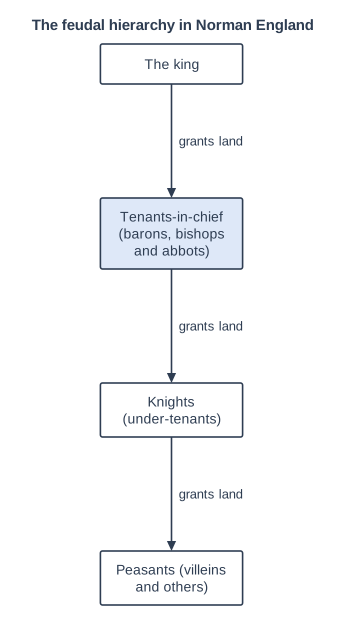
Explain why tenants-in-chief were so important to William I in the years 1066-87. The diagram shows their place in the feudal hierarchy.

You may use the following in your answer:
- knight service
- the king's council

You must also use information of your own.

The feudal hierarchy in Norman England. Block diagram with four parts in seven rows. Top row: a box "The king". Third row: a box "Tenants-in-chief (barons, bishops and abbots)" (shaded). Fifth row: a box "Knights (under-tenants)". Bottom row: a box "Peasants (villeins and others)". Connections: an arrow from "The king" to "Tenants-in-chief (barons, bishops and abbots)", labelled "grants land"; an arrow from "Tenants-in-chief (barons, bishops and abbots)" to "Knights (under-tenants)", labelled "grants land"; an arrow from "Knights (under-tenants)" to "Peasants (villeins and others)", labelled "grants land".

Model answer

Tenants-in-chief were the men who held land directly from the king, at the top of the feudal hierarchy below William himself. They were vital to him because they provided his army, controlled the land and its people, and helped him to govern a kingdom he was often away from.

One key reason was knight service. When William granted land to a tenant-in-chief, he fixed a quota of knights that the tenant-in-chief had to provide. Across England this probably came to around 5,000 knights, so William could call up a large army of trained, mounted soldiers without paying them. He needed this army because Norman rule was constantly threatened: by English rebellions between 1068 and 1071, by Danish fleets in 1069-70 and 1075, and by the threat of a Danish invasion in 1085. Without the tenants-in-chief, William would not have had the force to hold England.

Tenants-in-chief were also important because of how much land they held. By 1086, fewer than 200 great lay landholders held nearly half of England's land. As there were only a few thousand Norman settlers among perhaps 1.5 to 2 million English people, William relied on these men to control the countryside. They built castles on their estates, garrisoned them with their knights and held courts for their own tenants. The Marcher earls, for example, held the lands along the Welsh border and defended it. In this way the king's authority reached every area through his tenants-in-chief.

They mattered to government too. The leading tenants-in-chief attended the king's council, which met when William wore his crown at Winchester, Westminster and Gloucester. William needed their advice and support before making major decisions: in 1085 he ordered the Domesday survey after 'very deep consultation' with his council at Gloucester. Because William spent most of his time in Normandy after 1072, he also relied on loyal tenants-in-chief to keep control while he was away. In 1075, men such as Bishop Odo and William de Warenne defeated the Revolt of the Earls without the king needing to return.

Finally, their importance made their loyalty essential. They had done homage and could forfeit their land if they rebelled, but the 1075 revolt showed that a powerful tenant-in-chief such as Earl Roger of Hereford could use his lands and knights against the king. William therefore had to choose them carefully and bind them to him with land, oaths and the threat of forfeiture.

Tenants-in-chief were so important because William depended on them for his army, his control of the land and the government of England.

Explanation

Level 4 answers explain several reasons why tenants-in-chief mattered to William, such as the knights they owed, the land and castles they controlled and their place on the king's council, and link each one back to his needs. Describing the feudal hierarchy shown in the diagram, or listing what tenants-in-chief did without explaining why it mattered, keeps an answer in the lower levels, and answers that use only the two stimulus points cannot reach Level 4.

Mark scheme
  1. 12 marks

    Levels of response (12 marks). AO2: 6 marks. AO1: 6 marks.
    Level 4 (10-12 marks): An analytical explanation is given which is directed consistently at the conceptual focus of the question, showing a line of reasoning that is coherent, sustained and logically structured. [AO2] Accurate and relevant information is precisely selected to address the question directly, showing wide-ranging knowledge and understanding of the required features or characteristics of the period studied. [AO1] No access to Level 4 for answers that do not address three or more aspects of content.
    Level 3 (7-9 marks): An explanation is given, showing some analysis, which is mainly directed at the conceptual focus of the question. It shows a line of reasoning that is generally sustained, although some passages may lack coherence and organisation. [AO2] Accurate and relevant information is included, showing good knowledge and understanding of the required features or characteristics of the period studied. [AO1] Maximum 8 marks for answers that do not address three or more aspects of content.
    Level 2 (4-6 marks): An explanation is given, showing limited analysis and with implicit or unsustained links to the conceptual focus of the question. It shows some development and organisation of material, but a line of reasoning is not sustained. [AO2] Accurate and relevant information is included, showing some knowledge and understanding of the period. [AO1]
    Level 1 (1-3 marks): A simple or generalised answer is given, lacking development and organisation. [AO2] Limited knowledge and understanding of the topic is shown. [AO1]
    0 marks: No rewardable material.
    Performance in AO1 and AO2 is interdependent. An answer displaying no qualities of AO2 cannot be awarded more than the top of Level 1, no matter how strong performance is in AO1; markers should note that the expectation for AO1 is that candidates demonstrate both knowledge and understanding.

    Indicative content (not a checklist; credit other valid points): Tenants-in-chief provided the king's army: each owed a fixed quota of knights, in total perhaps 5,000-6,000, so William could raise a large force without paying it, which he needed against English rebellions (1068-71, 1075) and the Danish threats of 1069-70, 1075 and 1085. They controlled most of the land: by 1086 fewer than 200 great lay landholders held nearly half of England's landed wealth (the Church about a quarter, the king and his family about a fifth), so William depended on them to control the countryside and its people. They built and garrisoned castles on their estates and held frontier areas such as the Welsh borders, where the Marcher earls at Chester, Shrewsbury and Hereford defended the kingdom. They ran their lands: they held courts for their tenants, collected rents and organised the peasants' labour, so royal authority reached into every locality. They advised the king at his council: the great men attended him when he wore his crown at Winchester, Westminster and Gloucester, and the Domesday survey was ordered after 'very deep consultation' with the council at Gloucester at Christmas 1085. They kept control while William was in Normandy, where he spent most of his time after 1072: in 1075 loyal tenants-in-chief such as Bishop Odo, Geoffrey of Coutances, William de Warenne and Richard fitzGilbert put down the Revolt of the Earls. Bishops and abbots were tenants-in-chief too, providing knights and educated administrators. Their loyalty was crucial because of their power: they had done homage and could forfeit their lands, but Earl Roger of Hereford's rebellion in 1075 showed that a disloyal tenant-in-chief could turn his knights against the king. Accept about 150-200, 'fewer than 200' or 'a small group' for the number of great lay landholders, and 'about half', 'nearly half' or 'two-fifths to a half' for their share of the land. Do not credit confusion with Anglo-Saxon earls and thegns before 1066, or claims that tenants-in-chief owned their land outright (they held it from the king).

    Pearson's marking instructions: The middle mark in each level may be achieved by stronger performance in either AO1 or AO2.

Question 3

12 marks

Explain why many English towns changed in the years 1066-87.

You may use the following in your answer:
- castles
- French settlers

You must also use information of your own.

Model answer

Many English towns changed after 1066 because the Normans needed to control them, because new settlers and trading links arrived from France, and because the reform of the Church moved important institutions into towns.

Castles were the most visible change. Towns were centres of population, wealth and roads, so controlling them meant controlling the surrounding region. The Normans therefore built castles inside or beside towns such as York, Lincoln, Norwich, Exeter and London. Houses were pulled down to make room: Domesday Book records that 166 houses were destroyed at Lincoln. Townspeople now lived under the eyes of a Norman garrison, which changed both the shape of the town and the way it was ruled.

Rebellion and its suppression also changed towns. Exeter resisted William and was besieged in 1068. In 1069 the rebels and their Danish allies attacked York and destroyed its castles, and William's men responded with great violence. By the time of Domesday Book, many towns had large numbers of 'waste' houses, showing how much damage had been done.

French settlers brought further change. Norman, Breton and other French merchants and craftsmen moved into English towns, and in some places a new French borough was laid out beside the English town, as at Norwich by 1075 and at Nottingham. These settlers kept their own customs and links with home. William also brought Jewish merchants and moneylenders from Rouen to London.

These links encouraged trade with Normandy and France. Because many Norman lords held lands on both sides of the Channel, people, money and goods crossed more often. Wine was imported, and stone from Caen was shipped over for great building projects. Some towns that traded with the Continent gained from this.

The reform of the Church changed towns too. At councils in the 1070s it was agreed that bishops should have their seats in towns rather than villages, so the sees of Dorchester, Selsey, Sherborne and Lichfield moved to Lincoln, Chichester, Old Sarum and Chester. New cathedrals were begun in these towns, and great stone buildings such as the White Tower in London brought masons, craftsmen and labourers.

Finally, Norman rule brought heavy demands. The geld was collected at high rates, such as six shillings a hide in 1084, and by 1087 the Anglo-Saxon Chronicle complained of unjust tolls.

English towns changed because the Normans needed to hold them down, because conquest opened them to new settlers and trade, and because the reorganisation of the Church placed new centres of power in them.

Explanation

The best answers explain several causes of change, such as castle-building, the damage done during rebellions, French settlement and trade, and the moving of bishops' seats, with precise examples such as Lincoln's 166 lost houses. Simply describing what towns were like in 1087 does not explain why they changed.

Mark scheme
  1. 12 marks

    Levels of response (12 marks). AO2: 6 marks. AO1: 6 marks.
    Level 4 (10-12 marks): An analytical explanation is given which is directed consistently at the conceptual focus of the question, showing a line of reasoning that is coherent, sustained and logically structured. [AO2] Accurate and relevant information is precisely selected to address the question directly, showing wide-ranging knowledge and understanding of the required features or characteristics of the period studied. [AO1] No access to Level 4 for answers that do not address three or more aspects of content.
    Level 3 (7-9 marks): An explanation is given, showing some analysis, which is mainly directed at the conceptual focus of the question. It shows a line of reasoning that is generally sustained, although some passages may lack coherence and organisation. [AO2] Accurate and relevant information is included, showing good knowledge and understanding of the required features or characteristics of the period studied. [AO1] Maximum 8 marks for answers that do not address three or more aspects of content.
    Level 2 (4-6 marks): An explanation is given, showing limited analysis and with implicit or unsustained links to the conceptual focus of the question. It shows some development and organisation of material, but a line of reasoning is not sustained. [AO2] Accurate and relevant information is included, showing some knowledge and understanding of the period. [AO1]
    Level 1 (1-3 marks): A simple or generalised answer is given, lacking development and organisation. [AO2] Limited knowledge and understanding of the topic is shown. [AO1]
    0 marks: No rewardable material.
    Performance in AO1 and AO2 is interdependent. An answer displaying no qualities of AO2 cannot be awarded more than the top of Level 1, no matter how strong performance is in AO1; markers should note that the expectation for AO1 is that candidates demonstrate both knowledge and understanding.

    Indicative content (not a checklist; credit other valid points): Castles: the Normans built castles inside or beside many towns, such as York, Lincoln, Norwich, Exeter, Nottingham and London, because towns were centres of population, wealth and roads that had to be controlled; houses were pulled down to make room, for example 166 at Lincoln according to Domesday Book, and townspeople lived under the watch of a garrison. Rebellion and its suppression damaged some towns: Exeter was besieged in 1068, York was attacked by rebels and Danes in 1069 and William's men responded harshly, and Domesday Book records many 'waste' houses in towns. French settlers: Norman, Breton and other French merchants and craftsmen settled in English towns; new French boroughs were laid out beside the English towns, for example at Norwich (by 1075) and Nottingham, with their own customs; William brought Jewish merchants and moneylenders from Rouen to London. Trade with Normandy and France grew because the same lords held lands on both sides of the Channel: wine, stone from Caen and other goods were imported. Church reform brought change: bishops' seats were moved from villages to towns such as Lincoln, Chichester, Old Sarum and Chester in 1072-75, and huge new cathedrals and stone castles (the White Tower in London, Colchester) were built, bringing builders and craftsmen. Royal demands: the geld was collected heavily (six shillings a hide in 1084), and the Anglo-Saxon Chronicle complained of 'unjust tolls' by 1087. Credit answers that explain why some features did not change (mints, markets and London's position as the leading town), but this is not required. Do not credit castles described as stone keeps everywhere (most early town castles were motte and bailey), or the claim that towns were founded by the Normans for the first time.

    Pearson's marking instructions: The middle mark in each level may be achieved by stronger performance in either AO1 or AO2.

Question 4

16 marks

'Lanfranc's reform of the Church in England was a success.'

How far do you agree? Explain your answer.

You may use the following in your answer:
- Church councils
- married priests

You must also use information of your own.

Model answer

Lanfranc set out to reorganise the English Church and raise the standards of its clergy. I largely agree that his reforms were a success in organising and disciplining the Church's leadership, but they were much less successful in changing the parishes or in freeing the Church from royal control.

There is strong evidence of success. Lanfranc made Canterbury the head of the whole English Church. He insisted that Thomas of Bayeux, the new Archbishop of York, promise him obedience, and in 1072 the Accord of Winchester confirmed Canterbury's primacy. He also brought back Church councils, which the Council of London in 1075 said had fallen out of use in England for many years. These councils made important decisions: in 1075 simony was condemned, monks were ordered to keep the Rule of St Benedict, and bishops' seats were moved from small villages to towns, so that Sherborne moved to Old Sarum, Selsey to Chichester and Lichfield to Chester. In the 1070s separate Church courts were set up, where bishops judged spiritual cases by canon law. Lanfranc also gave the monks of Christ Church, Canterbury new rules and rebuilt the cathedral between 1070 and 1077.

However, some reforms only partly succeeded. Married priests are a clear example. At Winchester in 1076 Lanfranc ruled that canons must not marry and that married men could no longer be ordained, but parish priests who already had wives were allowed to keep them. Clerical marriage therefore remained common, and a complete ban came only in 1102. Canterbury's primacy was never confirmed by the pope, and the dispute with York broke out again after Lanfranc's death.

The reforms also left the Church firmly under the king. According to the monk Eadmer, William would not allow any pope to be recognised or any papal letter received without his permission, and a Church council could decide nothing he had not approved. The papacy wanted a Church free from control by kings, so by its standards Lanfranc's Church was not reformed. Bishops still acted as royal officials and even soldiers: in 1075 Bishop Geoffrey of Coutances fought against the rebel earls.

Finally, change in the parishes was limited. Village priests remained poorly educated and often married, and the forcing of Norman ways on English monks could cause violence, as at Glastonbury in 1083.

Overall, I largely agree with the statement. If the criterion is Lanfranc's main aim of organising and disciplining the Church's leadership, he succeeded: Canterbury led the Church, councils met regularly, bishops' seats were moved and monasteries were reformed. If the criterion is the papacy's wider aims, such as ending clerical marriage and freeing the Church from royal power, his success was limited. Because Lanfranc worked with the king rather than against him, his reforms achieved a great deal within the limits William set.

Explanation

Level 4 answers weigh what the reforms achieved (primacy, councils, moving sees, Church courts) against their limits (married priests keeping wives, the unresolved York dispute, royal control) and judge success against clear criteria such as Lanfranc's aims. Describing the reforms one by one without judging how far they succeeded is a common weakness.

Mark scheme
  1. 16 marks

    Levels of response (16 marks).
    Level 4 (13-16 marks): An analytical explanation is given which is directed consistently at the conceptual focus of the question, showing a line of reasoning that is coherent, sustained and logically structured. Accurate and relevant information is precisely selected to address the question directly, showing wide-ranging knowledge and understanding of the required features or characteristics of the period studied. Criteria for the required judgement are justified and applied in the process of reaching the overall judgement. No access to Level 4 for answers that do not address three or more aspects of content.
    Level 3 (9-12 marks): An explanation is given, showing some analysis, which is mainly directed at the conceptual focus of the question. It shows a line of reasoning that is generally sustained, although some passages may lack coherence and organisation. Accurate and relevant information is included, showing good knowledge and understanding of the required features or characteristics of the period studied. The overall judgement is given with some justification, but some criteria selected for the required judgement are left implicit or not validly applied. Maximum 11 marks for answers that do not address three or more aspects of content.
    Level 2 (5-8 marks): An explanation is given showing limited analysis and with implicit or unsustained links to the conceptual focus of the question. It shows some development and organisation of material, but a line of reasoning is not sustained. Accurate and relevant information is included, showing some knowledge and understanding of the period. The overall judgement is given but its justification is asserted or insecure.
    Level 1 (1-4 marks): A simple or generalised answer is given, lacking development and organisation. Limited knowledge and understanding of the topic is shown. The overall judgement is missing or asserted.
    0 marks: No rewardable material.

    Indicative content (not a checklist; credit other valid points): Points that support the statement: Canterbury's primacy: Thomas of Bayeux, Archbishop of York, made a profession of obedience, and the Accord of Winchester (1072) confirmed Canterbury's authority over York; regular Church councils were held again (1072, London 1075, Winchester 1076), after the Council of London noted they had fallen out of use for many years; the 1075 council condemned simony, ordered monks to keep the Rule of St Benedict and moved bishops' seats from villages to towns (Sherborne to Old Sarum, Selsey to Chichester, Lichfield to Chester; Dorchester to Lincoln in the 1070s); separate Church courts using canon law were set up in the 1070s; at Winchester in 1076 canons were forbidden to marry and married men could no longer be ordained; Lanfranc gave Christ Church, Canterbury new monastic rules and rebuilt the cathedral (1070-77); educated Norman bishops ran the dioceses; Lanfranc's close partnership with William meant the reforms had royal backing. Points that counter the statement: the pope never confirmed Canterbury's primacy and the dispute with York continued after Lanfranc's death; married parish priests were allowed to keep their wives, so clerical marriage remained common (a full ban came only in 1102); the Church stayed under royal control: according to Eadmer, no pope could be recognised and no papal letter received without William's permission, and councils could decide nothing he had not approved, so the papacy's aim of freeing the Church from lay power was not achieved; some moves of sees took years to complete; parish life and the education of village priests changed little; the harsh imposition of Norman customs caused conflict, as at Glastonbury in 1083; bishops still served as royal officials and even soldiers (Odo, Bishop of Bayeux and Earl of Kent; Geoffrey of Coutances fought the rebels in 1075). A substantiated judgement might argue that the reforms succeeded in organising and disciplining the Church's leadership but had limited effect in the parishes; or that success depended on the king, so the reforms were successful as royal policy but not as papal reform. Criteria might include Lanfranc's aims compared with the results, the level of the Church affected, and how long the changes lasted.

    Pearson's marking instructions (part of the mark scheme): AO2: 10 marks. AO1: 6 marks. In each level the first bullet point (the explanation and line of reasoning) is [AO2], the second (the information, knowledge and understanding) is [AO1] and the third (the overall judgement) is [AO2]. Performance in AO1 and AO2 is interdependent. An answer displaying no qualities of AO2 cannot be awarded more than the top of Level 1, no matter how strong performance is in AO1; markers should note that the expectation for AO1 is that candidates demonstrate both knowledge and understanding. The first two bullet points [AO1 and AO2] account for 3 of the 4 marks in the level and are equally weighted; the third bullet point [AO2] accounts for the remaining mark. Once the level has been found, there are two steps to follow to determine the mark within the level: Markers should consider bullet points 1 and 2 together. Strong performance (for the level) in both would be awarded all 3 marks, while 2 marks may be achieved by stronger performance in either bullet point; weak performance would be awarded 1 mark. The fourth mark in each level is allocated to the bullet point 3 and should be considered independently of the award of the other marks.

Ready to try the rest? Every answer you write is marked against the mark scheme, so you can see exactly where the marks are.

Study Helper Hints first, answers after you try

Stuck on this one? Ask for a hint and I’ll point you in the right direction, without giving the answer away. Once you’ve checked your answer, I’ll show you how the marks are awarded.