
Level:
Correct: 0
Incorrect: 0
Marks: 0/0
Exam Practice
Subject:
Topics:
Avg
score:
–
Topics
done:
0/9

The wider war

Practise 45 exam-style questions on The wider war for AQA GCSE History (Conflict and tension 1894-1918). Write your answer as you would in the exam and get it marked in seconds against the mark scheme, point by point, with an AI tutor on hand if you get stuck.

  • 45 questions
  • 1–20 marks each
  • Instant marking
  • No sign-up needed
20 questions, marked as you go

Sample questions with model answers

Here are 4 of the questions in this topic, each with a model answer, an explanation of why it earns the marks and the mark scheme an examiner would use.

Question 1

2 marks

Figure 1 is a timeline of the war at sea. Event A was the sinking of a British passenger liner by a German U-boat off the coast of Ireland, with the loss of about 1,200 lives. Event B was a change in German naval policy that led the USA to break off diplomatic relations with Germany.

Name the liner sunk in event A and describe the change in policy in event B.
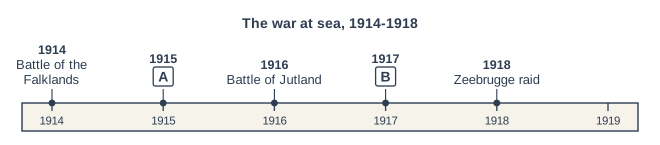
Horizontal timeline titled "The war at sea, 1914-1918", running from 1914 on the left to 1919 on the right, with the years marked every year (1914 to 1919). Events marked by dots on the line, in date order: 1914: Battle of the Falklands; 1915: label A; 1916: Battle of Jutland; 1917: label B; 1918: Zeebrugge raid.

Model answer

A was the sinking of the Lusitania (7 May 1915). B was Germany's decision to resume unrestricted submarine warfare from 1 February 1917, sinking any ship in the waters around Britain without warning, including neutral American ships.

Explanation

The Lusitania was sunk by U-20 off southern Ireland; about 1,200 people died, including 128 Americans, which turned American opinion against Germany. Germany limited its U-boat campaign after American protests, but in February 1917 it gambled on unrestricted warfare to starve Britain out; the USA broke off relations on 3 February and declared war on 6 April 1917.

Mark scheme
  1. 1 mark

    A: the Lusitania.

    Accept RMS Lusitania. Do not accept the Titanic, the Arabic or the Sussex.

  2. 1 mark

    B: Germany resumed (declared) unrestricted submarine warfare - U-boats would sink any ship, including neutral ships, in the war zone around Britain without warning (from 1 February 1917).

    Accept 'unrestricted U-boat warfare began again' or 'Germany would sink all ships without warning'. Do not accept the Zimmermann Telegram (not a naval policy).

Question 2

4 marks

Source A: a German postcard published in June 1916. (Written for practice.)
It shows a German battleship firing its guns while, in the background, two British warships sink in clouds of smoke. Above the picture is a portrait of Admiral Scheer surrounded by oak leaves. The caption reads: 'The Victory at the Skagerrak, 31 May 1916. The English fleet beaten!'

Source A presents the Battle of Jutland as a German triumph. How do you know?

Explain your answer by referring to Source A and your contextual knowledge.

Model answer

Source A presents Jutland as a German triumph because it shows British warships sinking in smoke while a German battleship fires at them, and the caption claims 'The English fleet beaten!' Admiral Scheer, the German commander, is shown surrounded by oak leaves, a German symbol of victory and strength, as if he were a national hero. The postcard was based on real German successes: at Jutland, which Germans called the Battle of the Skagerrak, Britain lost 14 ships, including three battlecruisers that blew up, and about 6,100 men, compared with German losses of 11 ships and about 2,550 men. The Kaiser celebrated a great victory and claimed the 'spell of Trafalgar' had been broken. However, the postcard was published in June 1916 to boost morale at home, when Germans were suffering from food shortages caused by the British blockade and from heavy losses at Verdun. It ignores the fact that the German fleet fled back to port and never again challenged the Grand Fleet, so Britain kept control of the North Sea.

Explanation

Level 2 needs analysis of the details (the sinking ships, Scheer's portrait, the caption) supported by knowledge of the battle's results and of why Germany wanted to celebrate it in June 1916. Pointing out what the postcard leaves out shows strong understanding of its purpose.

Mark scheme
  1. 4 marks

    Levels of response (4 marks).
    Level 2 (3-4 marks): Developed analysis of Source A: explains how the content (e.g. British ships sinking, the German battleship firing, Scheer honoured with oak leaves, the caption 'victory' and 'beaten') and/or the provenance (a German postcard of June 1916, intended to raise morale) present Jutland as a triumph, supported by relevant contextual knowledge (e.g. British losses were heavier, the Kaiser's claims of victory, but the German fleet returned to port and the blockade continued).
    Level 1 (1-2 marks): Simple analysis of Source A: identifies a relevant feature, e.g. 'the caption says it was a victory', with little or no supporting knowledge.
    0 marks: nothing worthy of credit.

    Indicative content (not a checklist; credit other valid points): British warships are shown sinking while the German battleship fires, suggesting German superiority; Scheer, the German commander, is honoured with oak leaves, a German symbol of victory and strength; the caption claims a 'victory' and that 'the English fleet' was 'beaten'; context - at Jutland (31 May-1 June 1916, called the Battle of the Skagerrak in Germany) Britain lost 14 ships, including three battlecruisers, and about 6,100 men, against German losses of 11 ships and about 2,550 men; the Kaiser and the German press celebrated a great victory, and the Kaiser claimed the 'spell of Trafalgar' had been broken; however, the High Seas Fleet escaped back to port, the Grand Fleet kept control of the North Sea and the blockade went on; provenance - a postcard published within weeks for a mass German audience, when Germans were suffering food shortages because of the blockade and huge losses at Verdun, so it was designed to boost morale and celebrate the navy, ignoring the strategic picture.

Question 3

12 marks

Source B: a summary of a letter written in September 1915 by Keith Murdoch, an Australian journalist, to the Australian Prime Minister, Andrew Fisher. Murdoch had spent a few days at Anzac Cove on his way to London.
Murdoch wrote that the campaign had been badly planned and badly led. He blamed British generals and staff officers for its failures, especially the failure at Suvla Bay in August, described widespread sickness and low morale among the troops, and praised the courage of the Australian soldiers. In London his letter was shown to British ministers.

Source C: a summary of part of 'The World Crisis', Winston Churchill's history of the war, published in the 1920s.
Churchill argued that the plan to force the Dardanelles had been sound and could have shortened the war. He blamed its failure on delays, on half-hearted support from other leaders, on the navy's decision not to renew its attack after 18 March 1915, and on troops being sent too late and in too small numbers.

How useful are Sources B and C to an historian studying why the Gallipoli campaign failed?

Explain your answer using Sources B and C and your contextual knowledge.

Model answer

Source B is useful because it shows several reasons why the campaign was failing, seen by someone who had visited Anzac Cove in 1915. Murdoch blames poor planning and leadership, especially the failure at Suvla Bay. This fits what we know: the Suvla landing in August met little resistance, but General Stopford failed to push inland quickly, so Turkish reinforcements occupied the hills and the offensive failed. Murdoch's description of sickness and low morale is also accurate; by late summer heat, flies, dysentery and shortages of water had left most of the men sick. Its provenance adds to its usefulness, because it was written while the campaign was still going on and was a private letter, not a censored newspaper report. It also shows the growing criticism of the campaign, since the letter reached British ministers and helped lead to Hamilton's recall in October 1915. However, Murdoch spent only a few days at Anzac, and as an Australian writing to his own Prime Minister he praised the Australians and blamed the British, so it is one-sided and exaggerated in places.

Source C is useful for a different set of reasons: decisions made at the top. Churchill is right that the navy did not renew its attack after 18 March 1915, when three battleships were sunk by mines, and that the landings came about five weeks later, giving the Turks and their German adviser Liman von Sanders time to strengthen their defences. Kitchener had delayed sending the 29th Division, and Fisher and others gave only half-hearted support. However, Churchill was the main supporter of the campaign and lost his post at the Admiralty because of it, so in the 1920s he wanted to show that the plan was good and that others had ruined it. He had access to official papers, but his account is a defence of himself.

Overall the two sources are useful together: B shows the failures on the ground and C the failures of planning and support in London. However, both writers blame others, and neither says much about the most important reason of all, the determination of the Turkish defenders, led by commanders like Mustafa Kemal, who held the high ground. An historian would need to use them alongside other evidence.

Explanation

For Level 4, evaluate each source's content against your knowledge (Suvla, conditions, the naval attack, the delay) and its provenance (a critical Australian journalist in 1915; the campaign's champion defending himself in the 1920s), then reach a judgement about how useful they are together. Noticing what both leave out, such as Turkish resistance, strengthens the judgement.

Mark scheme
  1. 12 marks

    Levels of response (12 marks).
    Level 4 (10-12 marks): Complex evaluation of both sources with sustained judgement based on content and provenance: explains how Source B is useful for showing failures of command, sickness and morale as seen by a critical eyewitness journalist in 1915, and how Source C is useful for showing the strategic and political reasons for failure as argued by the campaign's main supporter defending his reputation, tests both against accurate contextual knowledge (e.g. the failed naval attack, the delay before the landings, the Anzac and Helles landings, Suvla, conditions, Hamilton's recall) and reaches a substantiated judgement, e.g. that together they show both the military and political causes of failure, but each is limited by its author's purpose.
    Level 3 (7-9 marks): Developed evaluation of both sources based on content and/or provenance, supported by relevant contextual knowledge.
    Level 2 (4-6 marks): Simple evaluation of one or both sources based on content and/or provenance.
    Level 1 (1-3 marks): Basic analysis of one or both sources: describes the content or makes general comments about bias, with little or no knowledge.
    0 marks: nothing worthy of credit.

    Indicative content (not a checklist; credit other valid points): Source B content - supports knowledge of poor leadership, especially at Suvla Bay (6-7 August 1915), where General Stopford failed to push inland while the hills were lightly held; sickness (dysentery, flies, heat, shortage of water) weakened the army - most men were sick by the late summer; morale fell after the failure of the August offensive; Source B provenance - Murdoch was an eyewitness, though only for a few days and at Anzac only; as a journalist he was outside military censorship in his private letter; written in September 1915, while the campaign was still going on; Australian national feeling - he praised Australians and blamed the British, so it is one-sided; his letter reached British ministers and helped lead to Hamilton's recall in October 1915, so it is also useful as evidence of growing criticism; it contained exaggerations; Source C content - supports knowledge that the naval attack of 18 March was called off by de Robeck after three battleships were sunk by mines, that the army took about five weeks to assemble (giving the Turks time to prepare), that Kitchener delayed sending the 29th Division, and that Fisher and others had doubts; useful on strategic and political decisions in London; Source C provenance - Churchill was First Lord of the Admiralty and the main champion of the plan; he lost his post in May 1915 and was blamed for the failure, so writing in the 1920s he wanted to defend his reputation; he had access to official documents and could take a long view; he says little about Turkish strength or conditions on the peninsula; both sources ignore the strength and determination of the Turkish defenders (Mustafa Kemal holding the heights) and the difficult terrain; judgement - B is useful for military failings on the ground in 1915, C for decisions at the top; each blames others, so together they are useful but must be balanced with evidence about the Turkish defence.

Question 4

20 marks

'The Battle of Jutland was a victory for Germany.'

How far do you agree with this statement?

Explain your answer.

[16 marks] [SPaG 4 marks]

Model answer

On 31 May and 1 June 1916 the British Grand Fleet and the German High Seas Fleet fought the Battle of Jutland, the only full-scale clash of battle fleets in the war. Judged by the losses on the day, Germany did better. However, judged by what the battle changed, Britain was the real winner. I therefore only partly agree with the statement.

There is strong evidence for a German victory in the battle itself. Britain lost 14 ships, including three battlecruisers, Indefatigable, Queen Mary and Invincible, which blew up with almost all their crews, while Germany lost 11 ships, mostly smaller. About 6,100 British sailors were killed, more than twice the German figure of about 2,550, and Britain lost nearly twice the tonnage. German gunnery was accurate, and British weaknesses were exposed: the battlecruisers had thin armour, cordite had been stored unsafely to speed up firing, and signalling was poor. Admiral Scheer also escaped from a much larger British fleet, slipping behind it during the night. The Kaiser claimed that 'the spell of Trafalgar has been broken', and the German public celebrated a great victory.

However, Germany did not achieve what it set out to do. Scheer had hoped to trap and destroy part of the Grand Fleet to reduce Britain's advantage in numbers, but Britain still had far more dreadnoughts after the battle, and Jellicoe's fleet was ready for action again within days. The High Seas Fleet, by contrast, retreated to port and, although it came out a few times afterwards, never again risked a full battle. This meant that Britain kept control of the North Sea and the blockade of Germany continued, causing growing food shortages that undermined German morale. Admiral Scheer himself admitted to the Kaiser that even a successful sea battle would not force Britain to make peace, and that only U-boat attacks on British trade could do so. This led to the decision to resume unrestricted submarine warfare in 1917, which brought the USA into the war against Germany. The idle German fleet also became a centre of discontent, and sailors' mutinies in 1918 helped spark the German revolution. As one American newspaper put it, the German fleet had attacked its jailer but was still in jail.

In conclusion, Jutland was a German tactical success, because Germany sank more ships and killed more men, but it was not a German victory in any sense that mattered. Jellicoe, whom Churchill described as the only man who could lose the war in an afternoon, avoided disaster, and the balance of naval power was unchanged. Because Britain kept control of the seas and the blockade went on, while Germany was pushed into the U-boat gamble that brought America into the war, Jutland was a strategic victory for Britain.

Explanation

Level 4 separates the short-term tactical result (heavier British losses) from the long-term strategic consequences (British control of the North Sea, the blockade, the turn to U-boats) and reaches a judgement based on that distinction. Accurate figures and named ships support the argument.

Mark scheme
  1. 16 marks

    Levels of response (16 marks).
    Level 4 (13-16 marks): Complex explanation of the evidence that Jutland was a German victory (e.g. heavier British losses, the escape of the High Seas Fleet, German claims) and of the evidence that it was a British strategic victory (e.g. continued British control of the North Sea and the blockade, the German fleet's failure to challenge again, Germany's turn to U-boats), supported by extended, accurate knowledge, leading to a sustained judgement that distinguishes short-term tactical results from long-term strategic consequences.
    Level 3 (9-12 marks): Developed explanation of the case for and against a German victory, supported by relevant, accurate knowledge; a judgement may be given but is not fully sustained.
    Level 2 (5-8 marks): Simple explanation of one side of the argument, with some relevant knowledge.
    Level 1 (1-4 marks): Basic explanation: general statements about the battle, with limited knowledge.
    0 marks: nothing worthy of credit.

    Indicative content (not a checklist; credit other valid points): for a German victory - Britain lost 14 ships, including three battlecruisers (Indefatigable, Queen Mary, Invincible), against 11 German ships; about 6,100 British sailors were killed against about 2,550 Germans; British tonnage lost was nearly twice the German (about 113,000 to 62,000 tons); German gunnery, armour and shells performed better, and British battlecruisers were vulnerable because of thin armour and unsafe cordite handling; poor British signalling; Scheer escaped a much larger fleet; the Kaiser claimed a victory ('the spell of Trafalgar has been broken') and the German public celebrated; against - Germany had not destroyed part of the Grand Fleet as Scheer planned; the High Seas Fleet fled back to port, and Jellicoe reported the Grand Fleet ready for action again within days; Britain still had far more dreadnoughts; the High Seas Fleet put to sea only a few times afterwards and never again sought a full battle; Britain kept control of the North Sea, so the blockade continued, causing hunger in Germany; Scheer told the Kaiser that only U-boat warfare against trade could defeat Britain, leading to unrestricted submarine warfare in 1917 and the USA's entry into the war; idle German sailors became discontented, leading to the mutinies of 1918; an American newspaper is often quoted as saying that the German fleet had assaulted its jailer but was still in jail; Jellicoe had avoided the risk of losing the war 'in an afternoon' (Churchill's phrase); possible judgements - a tactical German success but a strategic British victory; or a draw in the battle but a British victory in its consequences; or a German victory in propaganda only.

  2. 4 marks

    SPaG. High performance (4 marks): spells and punctuates with consistent accuracy; uses rules of grammar with effective control of meaning overall; uses a wide range of specialist terms as appropriate.
    Intermediate performance (2-3 marks): spells and punctuates with considerable accuracy; uses rules of grammar with general control of meaning overall; uses a good range of specialist terms as appropriate.
    Threshold performance (1 mark): spells and punctuates with reasonable accuracy; uses rules of grammar with some control of meaning and any errors do not significantly hinder meaning overall; uses a limited range of specialist terms as appropriate.
    0 marks: the student writes nothing, or the response does not relate to the question, or errors severely hinder meaning.

    SPaG marks are awarded only if the answer relates to the question.

Ready to try the rest? Every answer you write is marked against the mark scheme, so you can see exactly where the marks are.

AI Tutor Hints first, answers after you try

Hi! Stuck? Ask me for a hint and I’ll help you work it out. Once you’ve checked your answer I can explain exactly where the marks are.