'Colonial rivalry was the main cause of tension between the Great Powers in the years 1900-1914.'
How far do you agree with this statement?
Explain your answer.
[16 marks] [SPaG 4 marks]
Model answer
Colonial rivalry caused several dangerous crises between 1900 and 1914 and helped to shape the alliances that divided Europe. However, many colonial disputes were settled peacefully, and by 1914 the most serious tensions came from the arms race, the alliance system and nationalism in the Balkans. So colonial rivalry was important, but not the main cause across the whole period.
Colonial rivalry certainly caused tension. Under Weltpolitik Germany demanded 'a place in the sun', but most of the world had already been claimed by Britain and France. During the Boer War (1899-1902) most of Europe sympathised with the Boers, which showed Britain how isolated it was. The most dangerous colonial crises were in Morocco. In 1905 the Kaiser visited Tangier and declared his support for Moroccan independence, challenging France. At the Algeciras Conference in 1906 Germany was isolated, supported only by Austria-Hungary, and Britain backed France. In 1911 Germany sent the gunboat Panther to Agadir, and Lloyd George warned in his Mansion House speech that Britain would not be pushed aside. Germany backed down, receiving only part of the French Congo. These crises increased Anglo-German hostility and drew Britain and France closer, leading to military talks and the naval agreement of 1912. The Berlin-Baghdad railway also worried Britain and Russia, and Italy's seizure of Libya from the Ottoman Empire in 1911 encouraged the Balkan states to attack the Ottomans in 1912.
However, colonial disputes could be solved. The Entente Cordiale of 1904 ended decades of Anglo-French colonial quarrels by exchanging Egypt for Morocco, and the Anglo-Russian Entente of 1907 settled disputes over Persia, Afghanistan and Tibet. Even Britain and Germany reached agreements over the Portuguese colonies in 1913 and the Baghdad railway in 1914. By 1914 colonial issues were calmer than at any time in the previous twenty years.
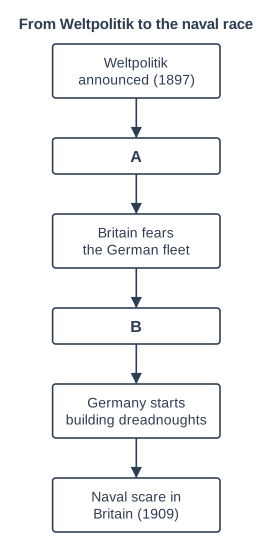
Other causes of tension were more dangerous by 1914. The naval race made Britain see Germany as its main enemy: the Navy Laws of 1898 and 1900, HMS Dreadnought in 1906 and the naval scare of 1909 created deep mistrust. From 1912 there was also a land arms race, with the German Army Law and the French Three-Year Law of 1913 and Russia's Great Programme. The alliance system turned disputes into confrontations between two armed blocs, the Triple Alliance and the Triple Entente, so that a crisis involving one power drew in the others. Most importantly, nationalism in the Balkans caused the crises that led directly to war. Austria-Hungary's annexation of Bosnia in 1908 angered Serbia and Russia, the Balkan Wars of 1912-13 made Serbia stronger, and in 1914 a Bosnian Serb nationalist assassinated Archduke Franz Ferdinand at Sarajevo. France's wish to recover Alsace-Lorraine was another source of tension that had nothing to do with colonies.
Overall, I partly agree. Between 1900 and 1911 colonial rivalry was a major cause of tension, especially between Germany and the Entente powers, and the Moroccan crises helped to turn the ententes into a real partnership. But colonial rivalry was often resolved by agreement, and it did not cause the war. By 1914 the main causes of tension were in Europe itself: the arms race, the rival alliances and, above all, nationalism in the Balkans.
Explanation
A Level 4 answer explains colonial crises in detail (Morocco 1905 and 1911, the Baghdad railway) and weighs them against the arms race, alliances and Balkan nationalism, reaching a sustained judgement, for example that colonial rivalry mattered most before 1912 but was largely settled by 1914. A narrative of colonial crises without weighing other causes reaches Level 2 at most.