'Slav nationalism was the main reason for the outbreak of war in 1914.'
How far do you agree with this statement?
Explain your answer.
[16 marks] [SPaG 4 marks]
Model answer
Slav nationalism was the desire of the South Slav peoples, such as the Serbs, Croats and Slovenes, to unite in one state, led by Serbia. It was certainly a major cause of the crisis that led to war in 1914, because it created bitter hostility between Serbia and Austria-Hungary. However, I do not agree that it was the main reason for the outbreak of a general war. It explains why the war began in the Balkans, but not why it spread to the rest of Europe.
There is a strong case that Slav nationalism was crucial. Austria-Hungary was a multi-national empire in which Slavs made up nearly half the population, and its leaders feared that Serbian nationalism would tear it apart. Relations worsened after 1903, when a pro-Russian dynasty took power in Serbia, and during the Pig War from 1906. When Austria-Hungary annexed Bosnia in 1908, Serbian nationalists were furious, and societies such as Narodna Odbrana and the Black Hand worked to unite the South Slavs. Serbia almost doubled in size in the Balkan Wars of 1912-13, which alarmed Austria-Hungary even more. Finally, on 28 June 1914, Archduke Franz Ferdinand and his wife Sophie were assassinated in Sarajevo by Gavrilo Princip, a Bosnian Serb, and the Black Hand, a Serbian nationalist secret society, was linked to the plot. This began the July Crisis.
Slav nationalism also explains Russia's involvement. Russia saw itself as the protector of the Slavs, and Pan-Slavism made it determined not to abandon Serbia again after its humiliation over Bosnia in 1909. This is why Russia decided to back Serbia on 24-25 July and ordered general mobilisation on 30 July.
However, other factors were more important in turning a Balkan crisis into a world war. Austria-Hungary's leaders chose to use the assassination as an excuse to crush Serbia. At the Council of Ministers on 7 July they agreed to send demands designed to be rejected, and they declared war on 28 July even though Serbia had accepted most of the ultimatum. Germany's 'blank cheque' of 5-6 July gave Austria-Hungary the confidence to act, and Germany rejected Grey's proposal for a conference.
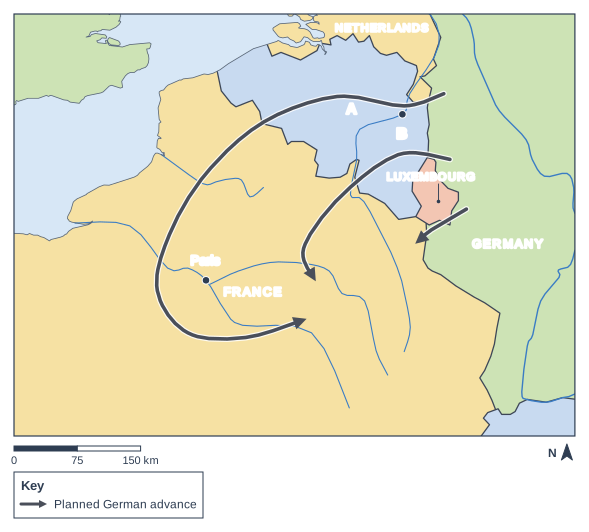
The alliance system and militarism explain why the war spread. Germany was bound to Austria-Hungary and France to Russia, so a war between Austria-Hungary and Serbia drew in the Great Powers. The Schlieffen Plan meant that Germany answered Russian mobilisation by declaring war on France on 3 August and invading Belgium, so a war that began in the Balkans was immediately fought in western Europe.
Finally, Britain's entry had nothing to do with Slav nationalism. Britain went to war on 4 August because Germany invaded Belgium, whose neutrality was guaranteed by the Treaty of London of 1839, and because of long-term Anglo-German rivalry, including the naval race and Germany's Weltpolitik, which had pushed Britain towards France and Russia.
In conclusion, Slav nationalism was the main long-term cause of the conflict between Austria-Hungary and Serbia, and without it there would have been no crisis in 1914. But it was not the main reason for the outbreak of a general war. That was caused by the decisions of the Great Powers, especially Austria-Hungary's determination to crush Serbia and Germany's support for it, and by the alliances and war plans that turned a local conflict into a European war.
Explanation
Level 4 explains specifically how Slav nationalism caused the Balkan crisis (Serbia, Bosnia, the Balkan Wars, Pan-Slavism, the assassination) and weighs it against the Great Power decisions, alliances and war plans that turned it into a general war. A one-sided answer or general statements about nationalism stay in Level 2-3.