Level:
Correct: 0
Incorrect: 0
Marks: 0/0
Exam Practice
Subject:
Topics:
Avg
score:
–
Topics
done:
0/9

The Alliance System

Practise 45 exam-style questions on The Alliance System for AQA GCSE History (Conflict and tension 1894-1918). Write your answer as you would in the exam and get it marked in seconds against the mark scheme, point by point, with an AI tutor on hand if you get stuck.

  • 45 questions
  • 1–20 marks each
  • Instant marking
  • No sign-up needed
20 questions, marked as you go

Sample questions with model answers

Here are 4 of the questions in this topic, each with a model answer, an explanation of why it earns the marks and the mark scheme an examiner would use.

Question 1

2 marks

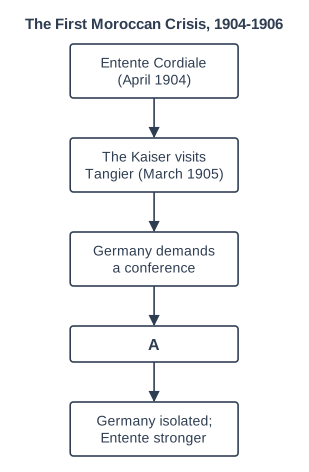
Figure 1 is a flow chart of the First Moroccan Crisis, 1904-1906.

Name the international conference labelled A, and name the only Great Power that supported Germany at this conference.

The First Moroccan Crisis, 1904-1906. Flow chart of 5 boxes joined by arrows, read from top to bottom. The first box is "Entente Cordiale (April 1904)", which leads to "The Kaiser visits Tangier (March 1905)", which leads to "Germany demands a conference", which leads to box A, which leads to "Germany isolated; Entente stronger".

Model answer

A is the Algeciras Conference of 1906. The only Great Power that supported Germany there was Austria-Hungary.

Explanation

Germany demanded the conference to show that France could not take over Morocco without Germany's agreement and to test the new Entente. At Algeciras (January-April 1906) Britain, Russia, Italy, Spain and the USA backed France and only Austria-Hungary supported Germany, so France gained control of the Moroccan police and bank and Germany was left isolated.

Mark scheme
  1. 1 mark

    A: the Algeciras Conference (1906).

    Accept: Algeciras. Do not accept: Berlin / The Hague / Agadir / Tangier.

  2. 1 mark

    Austria-Hungary.

    Accept: Austria. Do not accept: Italy (Italy, though a member of the Triple Alliance, sided with France) / Russia / Morocco.

Question 2

4 marks

Source A: from an article in a Russian nationalist newspaper published in St Petersburg in late March 1909. (Written for practice.)

'Russia has been forced to bow its head. Berlin did not argue with us; it simply told us to accept the theft of Bosnia or face the consequences. Our Serbian brothers have been abandoned, and the German Kaiser now struts about as the master of Europe. Russia must never again be so unprepared. Let us rebuild our army so that, the next time Berlin makes threats, we can answer them.'

Source A is critical of Germany. How do you know?

Explain your answer by referring to Source A and your contextual knowledge.

Model answer

Source A is critical of Germany because it accuses Berlin of bullying Russia: Germany 'did not argue' but 'simply told us' to accept the annexation 'or face the consequences'. It calls the annexation 'the theft of Bosnia', condemning the action that Germany supported, and mocks the Kaiser as strutting about 'as the master of Europe'. Its call to rebuild the army so that Russia can answer Berlin's threats next time shows it sees Germany as the enemy.

This reflects what happened in March 1909. Austria-Hungary had annexed Bosnia-Herzegovina in October 1908, and Russia had backed Serbia's protests. Germany stood firmly behind Austria-Hungary and in March 1909 Chancellor Bülow demanded a clear answer from Russia, implying that Germany would support Austria if it came to war. Russia, still weakened by its defeat against Japan in 1904-05 and the 1905 Revolution, had to give way, leaving Serbia to accept the annexation. The provenance explains the bitter tone: it was written by Russian nationalists, who saw Russia as the protector of the Serbs and Slavs, just days after this national humiliation.

Explanation

Germany's demand of March 1909 forced a weakened Russia to accept the annexation, and Russian nationalists blamed Germany for the humiliation. Level 2 needs developed analysis of phrases such as 'the theft of Bosnia' or the threats from Berlin, supported by knowledge of the German demand and Russia's weakness.

Mark scheme
  1. 4 marks

    Levels of response (4 marks).
    Level 2 (3-4 marks): Developed analysis of Source A: explains how its content and/or provenance show criticism of Germany, supported by contextual knowledge, e.g. it accuses Germany of bullying Russia, which refers to the German demand of March 1909 that Russia accept the annexation of Bosnia-Herzegovina; it was written by Russian nationalists who felt humiliated because Russia, weakened by defeat against Japan, had to abandon Serbia.
    Level 1 (1-2 marks): Simple analysis of Source A based on content and/or provenance, e.g. 'it says Berlin made threats' or 'it is Russian so it is anti-German'.
    0 marks: nothing worthy of credit.

    Indicative content (not a checklist; credit other valid points): content - Germany 'did not argue' but gave orders, suggesting bullying; 'the theft of Bosnia' condemns the annexation that Germany supported; the Kaiser 'struts about as the master of Europe' mocks Wilhelm II's arrogance; calls to rebuild the army to answer future German threats. Provenance - a Russian nationalist newspaper, written in the days after Russia gave way (23 March 1909), expressing anger and humiliation; nationalists saw Russia as the protector of fellow Slavs such as the Serbs. Context - Austria-Hungary annexed Bosnia-Herzegovina in October 1908; Izvolsky had agreed to this at Buchlau in return for Austrian support over the Straits, but felt tricked; Serbia was outraged and Russia backed Serbia's protests; Germany gave Austria-Hungary full support (Moltke assured Conrad in January 1909 that Germany would mobilise if Russia did); in March 1909 Bülow demanded that Russia give a clear answer accepting the annexation, implying Germany would back Austria in a war; Russia, still weak after the Russo-Japanese War (1904-05) and the 1905 Revolution, backed down; Serbia accepted the annexation on 31 March 1909; Russia began rebuilding its armed forces and was determined not to back down again (1914).

Question 3

12 marks

Source B: a summary of the main terms of the treaty of alliance signed by Germany and Austria-Hungary on 7 October 1879 (the Dual Alliance). The treaty was kept secret until Bismarck published it in 1888 as a warning to Russia.

The treaty stated that its purpose was purely defensive and that the two emperors wished to preserve peace. If either empire was attacked by Russia, the other was bound to come to its aid with the whole of its forces, and they would make peace only together. If either was attacked by another power, the other would at least remain neutral in a friendly way - unless the attacker was supported by Russia, in which case both would fight.

Source C: from a speech by an Italian member of parliament in the Italian Chamber of Deputies, March 1882. (Written for practice.)

'France has taken Tunis under our very noses, and not one Great Power raised a finger to help us. Italy stands alone, and a nation that stands alone is despised. I do not love Austria - who among us could, while Trento and Trieste remain in her hands? But we must sit at the table of the strong, with Berlin and Vienna, or others will go on dividing the Mediterranean without us.'

How useful are Sources B and C to an historian studying why the Triple Alliance was formed?

Explain your answer using Sources B and C and your contextual knowledge.

Model answer

Source B is useful because it shows what the original core of the Triple Alliance, the Dual Alliance of 1879, was designed to do. Its terms are aimed squarely at Russia: if either Germany or Austria-Hungary was attacked by Russia, the other would help with all its forces, but if the attacker was another power, it would only remain neutral. This fits the context. After the Congress of Berlin in 1878 Russia felt cheated and blamed Germany, and in 1879 the Tsar sent the Kaiser an angry letter, so Bismarck turned to Austria-Hungary for protection. As a secret treaty, Source B is reliable about the obligations the two powers accepted and frank about the enemy they feared. However, its provenance also limits it. A treaty states official aims, such as being 'purely defensive' and wishing to 'preserve peace', but does not explain the motives behind it, such as Bismarck's wider aim of keeping France isolated. It also says nothing about Italy, so it explains only the first stage of the alliance.

Source C fills that gap by showing why Italy joined in 1882. The speaker is angry that 'France has taken Tunis', which France made a protectorate in 1881, and fears that Italy 'stands alone' and will be 'despised'. This matches the context: Italy had many settlers in Tunis, felt humiliated and wanted the security and status of an alliance with the strongest powers. The source also reveals something important that weakens the alliance: the speaker does 'not love Austria' because it still held Trento and Trieste. This helps explain why Italy was always the least reliable member. The provenance needs care, though. It is a speech in parliament designed to persuade other deputies, so it may exaggerate the danger of isolation, and it gives the view of one Italian politician rather than of the government that negotiated the secret treaty in May 1882.

Overall, the sources are most useful together. Source B shows that fear of Russia brought Germany and Austria-Hungary together, while Source C explains why Italy, angry with France, chose to join them. Neither fully explains Bismarck's own thinking, especially his aim of isolating France after 1871, so an historian would need other evidence, but between them they cover the motives of all three members and even hint at the alliance's main weakness.

Explanation

The Dual Alliance was Bismarck's defence against Russia after 1878, and Italy joined in 1882 because France's seizure of Tunis left it isolated. Level 4 needs a sustained judgement on both sources that weighs content AND provenance (a formal treaty's official language; a persuasive speech) against specific contextual knowledge.

Mark scheme
  1. 12 marks

    Levels of response (12 marks).
    Level 4 (10-12 marks): Complex evaluation of both sources with a sustained judgement about their usefulness for studying why the Triple Alliance was formed, based on content AND provenance and supported by contextual knowledge, e.g. Source B shows that the alliance began as a German-Austrian defence against Russia after the Congress of Berlin, but as a formal treaty it gives official aims and not Bismarck's wider aim of isolating France; Source C shows Italy's motives after Tunis (1881) but is a speech meant to persuade and also reveals the rivalry with Austria that made Italy unreliable.
    Level 3 (7-9 marks): Developed evaluation of both sources based on content and/or provenance, supported by relevant knowledge.
    Level 2 (4-6 marks): Simple evaluation of one or both sources based on content and/or provenance, e.g. 'Source B is useful because it is the actual treaty'.
    Level 1 (1-3 marks): Basic analysis of one or both sources: describes what they say without explaining usefulness.
    0 marks: nothing worthy of credit.

    Indicative content (not a checklist; credit other valid points): Source B content - the alliance is defensive and aimed at Russia (full help if attacked by Russia; only neutrality against others), showing fear of Russia was the core of the German-Austrian partnership; it does not mention Italy or France directly. Source B provenance - an official treaty, so reliable about the obligations; secret, so frank about who the enemy was; but treaties give official aims ('purely defensive', 'preserve peace') and do not explain the motives behind them; published in 1888 to warn Russia, showing its deterrent purpose. Source C content - Italy's motives: anger at France over Tunis (1881), isolation, the wish to be treated as a Great Power, fears about the Mediterranean; also hostility to Austria over Trento and Trieste. Source C provenance - a speech in parliament two months before the treaty (20 May 1882), intended to persuade deputies, so it may exaggerate Italy's danger; it reflects one view (practice source); the treaty itself was secret. Context - Bismarck feared French revenge after 1871 and wanted to keep France isolated; Russia was angry after the Congress of Berlin (1878) and the Tsar's angry letter of 1879; the Three Emperors' League; France made Tunis a protectorate in May 1881; the Triple Alliance promised Italy help if attacked by France and Italy's help to Germany against France; it also protected Austria's southern flank. Judgement - together useful: B explains why Germany and Austria allied, C why Italy joined; neither shows Bismarck's own aim of isolating France, and C's hostility to Austria shows why the alliance was always fragile.

Question 4

20 marks

'The Bosnian Crisis of 1908-1909 did more than the Moroccan Crises to increase tension between the Great Powers.'

How far do you agree with this statement?

Explain your answer.
[16 marks] [SPaG 4 marks]

Model answer

Both the Moroccan Crises and the Bosnian Crisis increased tension between the Great Powers, but in different ways. The Moroccan Crises hardened the division between Germany and the Entente powers, especially Britain. The Bosnian Crisis, however, did more to increase tension, because it humiliated Russia, enraged Serbia and tied Germany to Austria-Hungary in the region where war eventually broke out.

The Moroccan Crises certainly made relations worse. In 1905 the Kaiser's visit to Tangier was an attempt to break the Entente Cordiale. It backfired at the Algeciras Conference in 1906, where Germany was supported only by Austria-Hungary, and it led Britain to begin secret military talks with France. British officials such as Eyre Crowe came to see Germany as a threat, and Germans began to fear 'encirclement', especially after the Anglo-Russian Convention of 1907. The Agadir Crisis of 1911 was even more dangerous. When Germany sent the gunboat Panther to Agadir and demanded the French Congo, Lloyd George warned in his Mansion House speech that Britain would not be pushed aside, and the Royal Navy was prepared for action. Germany backed down, but its humiliation led to a new Navy Law in 1912, while Britain planned to send an army to France and agreed naval arrangements with France in 1912. These crises therefore drew Britain into the confrontation with Germany and intensified the naval race.

However, the Bosnian Crisis created deeper and more dangerous tensions. When Austria-Hungary annexed Bosnia-Herzegovina in October 1908, it broke the Treaty of Berlin, and the Russian Foreign Minister, Izvolsky, felt tricked because he had expected Austrian support over the Straits in return. Serbia was furious, because many Bosnians were Serbs. The crisis ended in March 1909 only when Germany demanded that Russia accept the annexation, and Russia, still weak after its defeat by Japan, gave way. This 'diplomatic Tsushima' left Russia determined never to back down again; it rearmed, later adopting the 'Great Programme', and encouraged the Balkan League, which fought the Balkan Wars of 1912-13.

The crisis also turned Serbia into a bitter enemy of Austria-Hungary. Nationalist groups such as the Narodna Odbrana spread anti-Austrian propaganda, and in 1911 the secret Black Hand society was formed, whose members later helped plan the assassination at Sarajevo. Finally, the crisis bound Germany to Austria-Hungary more closely than before. Moltke promised Conrad in 1909 that Germany would mobilise if Russia came to Serbia's aid, even if Austria attacked first, and Bülow spoke of Germany's 'Nibelung loyalty'.

The key difference is that the Moroccan Crises were about colonies, where the Great Powers could compromise, as they did in 1906 and 1911. The Bosnian Crisis involved the vital interests of Austria-Hungary and Russia in the Balkans, where neither could easily give way, and it created exactly the pattern of July 1914: Austria-Hungary against Serbia, Russia backing Serbia, and Germany backing Austria.

In conclusion, I largely agree. The Moroccan Crises did more to divide Britain from Germany and to strengthen the Entente, and without them Britain might not have joined the war. But the Bosnian Crisis did more to increase tension between the Great Powers, because it left Russia humiliated and determined, Serbia hostile and Germany committed to Austria-Hungary, making the next Balkan crisis far more likely to end in war.

Explanation

The Moroccan Crises divided Britain from Germany, but the Bosnian Crisis humiliated Russia, enraged Serbia and tied Germany to Austria-Hungary, creating the pattern of July 1914. Level 4 needs a sustained comparative judgement, supported by specific knowledge of both the Bosnian and the Moroccan crises; SPaG is assessed separately.

Mark scheme
  1. 16 marks

    Levels of response (16 marks).
    Level 4 (13-16 marks): Complex explanation of the effects of the Bosnian Crisis and of the Moroccan Crises (1905 and 1911) on relations between the Great Powers, leading to a sustained judgement about which did more to increase tension, e.g. that the Moroccan Crises hardened the Anglo-German divide and the Entente, but the Bosnian Crisis was more dangerous because it humiliated Russia, enraged Serbia and tied Germany to Austria-Hungary in the region where war actually began; supported by a range of accurate, specific knowledge.
    Level 3 (9-12 marks): Developed explanation of the Bosnian Crisis and the Moroccan Crises, with accurate supporting knowledge; any judgement is not fully sustained.
    Level 2 (5-8 marks): Simple explanation of the Bosnian Crisis or the Moroccan Crises, e.g. explains that Russia was humiliated in 1909.
    Level 1 (1-4 marks): Basic explanation with limited knowledge, e.g. 'both crises made countries angry'.
    0 marks: nothing worthy of credit.

    Indicative content (not a checklist; credit other valid points): For (Bosnia) - Austria-Hungary annexed Bosnia-Herzegovina (6 October 1908) in breach of the Treaty of Berlin; Izvolsky felt tricked after Buchlau; Serbia was outraged, Narodna Odbrana founded (1908) and the Black Hand (1911); Germany backed Austria-Hungary (Moltke-Conrad letters, January 1909; Bülow's 'Nibelung loyalty'); Germany's demand of March 1909 forced Russia to back down - a 'diplomatic Tsushima'; Russia rearmed (later the 'Great Programme', 1913) and resolved not to back down again; Russia encouraged the Balkan League (1912) leading to the Balkan Wars; it involved Great Powers whose interests clashed directly (Austria and Russia in the Balkans) and set up the pattern of July 1914 (Austria v Serbia, Russia backing Serbia, Germany backing Austria). Against (Morocco) - 1905: the Kaiser at Tangier, Delcassé's fall, Algeciras (1906) isolated Germany; secret Anglo-French military talks began (1906); British suspicion of Germany grew (Crowe Memorandum, 1907); helped lead to the Anglo-Russian Convention (1907) and German fear of encirclement; 1911: the Panther at Agadir, Lloyd George's Mansion House speech, the Royal Navy prepared; Germany humiliated and passed a new Navy Law (1912) and army increases; Britain planned to send the army to France (CID, August 1911); Anglo-French naval arrangements (1912); Britain was drawn into the alliance system, which turned a continental war into a world war; the crises intensified the naval race. Judgement - e.g. the Moroccan Crises did more to divide Britain from Germany, but the Bosnian Crisis did more to create the conditions for war in 1914; or the Moroccan Crises mattered more because two crises built up the Entente.

  2. 4 marks

    SPaG. High performance (4 marks): spells and punctuates with consistent accuracy; uses rules of grammar with effective control of meaning overall; uses a wide range of specialist terms as appropriate.
    Intermediate performance (2-3 marks): spells and punctuates with considerable accuracy; uses rules of grammar with general control of meaning overall; uses a good range of specialist terms as appropriate.
    Threshold performance (1 mark): spells and punctuates with reasonable accuracy; uses rules of grammar with some control of meaning and any errors do not significantly hinder meaning overall; uses a limited range of specialist terms as appropriate.
    0 marks: the student writes nothing, or the response does not relate to the question, or errors severely hinder meaning.

    SPaG marks are awarded only if the answer relates to the question.

Ready to try the rest? Every answer you write is marked against the mark scheme, so you can see exactly where the marks are.

AI Tutor Hints first, answers after you try

Hi! Stuck? Ask me for a hint and I’ll help you work it out. Once you’ve checked your answer I can explain exactly where the marks are.