Level:
Correct: 0
Incorrect: 0
Marks: 0/0
Exam Practice
Subject:
Topics:
Avg
score:
–
Topics
done:
0/9

Changes in the Allied Forces

Practise 45 exam-style questions on Changes in the Allied Forces for AQA GCSE History (Conflict and tension 1894-1918). Write your answer as you would in the exam and get it marked in seconds against the mark scheme, point by point, with an AI tutor on hand if you get stuck.

  • 45 questions
  • 1–20 marks each
  • Instant marking
  • No sign-up needed
20 questions, marked as you go

Sample questions with model answers

Here are 4 of the questions in this topic, each with a model answer, an explanation of why it earns the marks and the mark scheme an examiner would use.

Question 1

2 marks

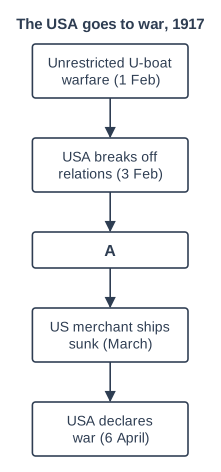
Figure 1 is a flow chart showing events in early 1917 that led the USA into the war.

Name the event labelled A and state what it proposed.

The USA goes to war, 1917. Flow chart of 5 boxes joined by arrows, read from top to bottom. The first box is "Unrestricted U-boat warfare (1 Feb)", which leads to "USA breaks off relations (3 Feb)", which leads to box A, which leads to "US merchant ships sunk (March)", which leads to "USA declares war (6 April)".

Model answer

A is the Zimmermann Telegram. It proposed that if the USA entered the war, Germany and Mexico should become allies, and Mexico would regain its lost territory in Texas, New Mexico and Arizona.

Explanation

The telegram was sent in January 1917 by the German Foreign Secretary, Arthur Zimmermann, intercepted and decoded by British naval intelligence (Room 40) and passed to the Americans. Its publication on 1 March 1917 caused fury in the USA, especially in the south-west, and Zimmermann admitted it was genuine.

Mark scheme
  1. 1 mark

    A: the Zimmermann Telegram (published 1 March 1917).

    Accept the Zimmermann note or 'the telegram from the German Foreign Secretary to Mexico'.

  2. 1 mark

    It proposed an alliance between Germany and Mexico if the USA entered the war, with Mexico to regain its lost territory in Texas, New Mexico and Arizona.

    Accept 'Germany would help Mexico attack the USA and get back Texas, New Mexico and Arizona'. Also accept that it suggested Mexico should invite Japan to join. A vague answer such as 'Germany wanted help from Mexico' is not enough.

Question 2

4 marks

Source A: from the Decree on Peace, drafted by Lenin and approved by the Congress of Soviets on 8 November 1917, the day after the Bolsheviks seized power in Russia. (Translated.)
'The government considers it the greatest of crimes against humanity to continue this war over the issue of how to divide among the strong and rich nations the weak nationalities they have conquered.' It called on all the warring nations to agree to 'an immediate peace without annexations' (the seizure of foreign lands) 'and without indemnities'.

Source A opposes the continuation of the war. How do you know?

Explain your answer by referring to Source A and your contextual knowledge.

Model answer

Source A opposes the continuation of the war because it calls the war 'the greatest of crimes against humanity'. It describes the war as a struggle among 'strong and rich nations' to share out the peoples they have conquered, which reflects the Bolshevik view that it was an imperialist war fought for the benefit of the ruling classes, not ordinary people. It demands 'an immediate peace without annexations and without indemnities', meaning the fighting should stop at once without any country gaining land or money. This reflects the situation in Russia: millions of Russian soldiers had been killed, wounded or captured, the army had suffered defeats such as Tannenberg and the Great Retreat of 1915, and the cities were short of food and fuel. The Provisional Government had kept fighting, and the failure of the Kerensky Offensive in July 1917 boosted the Bolsheviks, whose slogan was 'Peace, Land and Bread'. The provenance shows how important peace was to them: this was the new government's first decree, approved the day after the Bolsheviks seized power. They agreed an armistice with Germany in December 1917 and signed the Treaty of Brest-Litovsk in March 1918.

Explanation

Level 2 needs you to explain what the decree's language means and why the Bolsheviks wanted peace, using knowledge of Russia's losses, war-weariness and 'Peace, Land and Bread'. Noting that this was the government's very first decree is strong use of provenance.

Mark scheme
  1. 4 marks

    Levels of response (4 marks).
    Level 2 (3-4 marks): Developed analysis of Source A: explains how the content (e.g. calling the war 'the greatest of crimes against humanity', describing it as a war of rich nations over conquered peoples, the call for an immediate peace without annexations or indemnities) and/or the provenance (the first decree of the new Bolshevik government, November 1917) show opposition to continuing the war, supported by relevant contextual knowledge (e.g. Russian defeats and losses, war-weariness, the Bolshevik slogan 'Peace, Land and Bread', the armistice of December 1917 and the Treaty of Brest-Litovsk).
    Level 1 (1-2 marks): Simple analysis of Source A: identifies a relevant feature, e.g. 'it calls the war a crime', with little or no supporting knowledge.
    0 marks: nothing worthy of credit.

    Indicative content (not a checklist; credit other valid points): calling the war 'the greatest of crimes against humanity' condemns it in the strongest terms; describing it as a struggle among 'strong and rich nations' to divide conquered peoples presents it as an imperialist war fought for the profit of the ruling classes, the Bolshevik view; demanding 'an immediate peace without annexations and without indemnities' calls for the fighting to stop at once with no country gaining land or money; context - Russia had suffered millions of casualties, defeats at Tannenberg and in the Great Retreat of 1915, shortages of food and fuel and the collapse of the army's morale; the Provisional Government kept fighting and the Kerensky Offensive (July 1917) failed, increasing support for the Bolsheviks, who promised 'Peace, Land and Bread'; provenance - this was the first decree of the new Bolshevik government, issued the day after it seized power, showing peace was its top priority; it was also propaganda aimed at war-weary soldiers and workers in all countries; the Bolsheviks agreed an armistice with Germany in December 1917 and, when no general peace followed, signed the Treaty of Brest-Litovsk (March 1918).

Question 3

12 marks

Source B: a summary of President Woodrow Wilson's speech to the US Congress on 2 April 1917, asking it to declare war on Germany.
Wilson said that 'the present German submarine warfare against commerce is a warfare against mankind'. He described the intercepted German note to Mexico as evidence that Germany meant 'to stir up enemies against us at our very doors', welcomed the recent revolution in Russia, and declared that 'the world must be made safe for democracy'. He said the USA had 'no selfish ends to serve'.

Source C: from an editorial in a German-language newspaper published in the American Midwest, April 1917. (Written for practice.)
'Our readers are loyal Americans, but they will not be fooled. Britain's blockade has broken the freedom of the seas as surely as any U-boat, yet no one in Washington talks of war against Britain. The truth is that the bankers of Wall Street have lent the Allies billions, and they want American boys to protect their money. This is not a war for democracy; it is a war for profit.'

How useful are Sources B and C to an historian studying why the USA entered the war in 1917?

Explain your answer using Sources B and C and your contextual knowledge.

Model answer

Source B is useful because it gives the official reasons for war in the President's own words at the decisive moment. Wilson's claim that German submarine warfare was 'a warfare against mankind' fits the immediate cause: Germany resumed unrestricted submarine warfare on 1 February 1917, the USA broke off relations two days later, and in March U-boats sank several American merchant ships. His reference to the 'intercepted note' to Mexico is the Zimmermann Telegram, published on 1 March, in which Germany offered Mexico Texas, New Mexico and Arizona. His welcome for the Russian Revolution is also significant, because the overthrow of the Tsar in March 1917 meant Wilson could present the war as democracy against autocracy, 'to make the world safe for democracy'. However, the speech was designed to persuade Congress and the American public, so it stresses noble reasons and does not mention the American economy.

Source C is useful because it gives a very different view and points to the economic background. It is true that American banks had lent the Allies about 2.3 billion dollars by 1917, compared with about 27 million to Germany, and that trade with Britain and France had boomed, so an Allied defeat would have been a disaster for American business. It is also true that the British blockade had caused disputes over American trade. Some members of Congress, such as Senator George Norris, made the same argument that the USA was going to war for money. However, the provenance limits it: a German-language newspaper was likely to be sympathetic to Germany, and it completely ignores the U-boat sinkings and the Zimmermann Telegram. It is most useful as evidence of the views of some German-Americans and opponents of the war, who were a small minority: the Senate voted for war by 82 votes to 6.

Overall, Source B is more useful for the immediate reasons why the USA declared war in April 1917, because it shows how German actions triggered the decision. Source C is useful for the longer-term economic ties and for showing that not all Americans accepted Wilson's reasons. Together they suggest that German actions caused the declaration, but economic interest and Wilson's ideals help explain why the USA was ready to act.

Explanation

Level 4 evaluates the President's speech as both an accurate guide to the immediate causes and a persuasive document that leaves out economic motives, and the editorial as evidence of economic ties and of opposition but one-sided. The judgement should weigh their usefulness for explaining US entry.

Mark scheme
  1. 12 marks

    Levels of response (12 marks).
    Level 4 (10-12 marks): Complex evaluation of both sources with sustained judgement based on content and provenance: explains how Source B is useful for the official reasons given by the President (U-boats, the Zimmermann Telegram, democracy), while weighing that it was a speech designed to win support, and how Source C is useful for a critical view that stresses economic motives and the opinions of German-Americans, while weighing its one-sidedness, tests both against accurate contextual knowledge (e.g. unrestricted submarine warfare, ships sunk, the Zimmermann Telegram, loans and trade, the Russian Revolution, opposition in Congress) and reaches a substantiated judgement.
    Level 3 (7-9 marks): Developed evaluation of both sources based on content and/or provenance, supported by relevant contextual knowledge.
    Level 2 (4-6 marks): Simple evaluation of one or both sources based on content and/or provenance.
    Level 1 (1-3 marks): Basic analysis of one or both sources: describes the content or makes general comments about bias, with little or no knowledge.
    0 marks: nothing worthy of credit.

    Indicative content (not a checklist; credit other valid points): Source B content - matches the main immediate causes: Germany resumed unrestricted submarine warfare on 1 February 1917, the USA broke off relations on 3 February, and several American merchant ships were sunk in March 1917; the Zimmermann Telegram (published 1 March) offered Mexico Texas, New Mexico and Arizona; the March Revolution had overthrown the Tsar, so Wilson could present the Allies as democracies fighting autocracy; 'safe for democracy' and 'no selfish ends' reflect Wilson's idealism and his wish to shape the peace (later the Fourteen Points and the League of Nations); Source B provenance - the President's own explanation at the decisive moment, so it shows the official reasons and how the war was justified to Americans; but it was designed to persuade Congress and the public, so it stresses moral reasons and does not mention American loans and trade; Source C content - the British blockade had also interfered with American trade, causing disputes in 1914-16; American banks had lent the Allies about 2.3 billion dollars by 1917 (about 27 million to Germany) and trade with the Allies had boomed, so economic ties were real; Senators such as George Norris made the same argument ('the command of gold'); Source C provenance - a German-language newspaper, likely sympathetic to Germany and opposed to war against it; written in April 1917 when war was being declared; it shows the views of some German-Americans and anti-war Americans (the Senate voted 82-6, the House 373-50); one-sided and ignores the U-boat sinkings and the Zimmermann Telegram; written for practice; judgement - B is more useful for the immediate causes and official reasons; C useful for the economic background and for opposition; together they show that the decision combined German actions, idealism and economic interest.

Question 4

20 marks

'The entry of the USA into the war was the main reason why Germany was defeated in 1918.'

How far do you agree with this statement?

Explain your answer.

[16 marks] [SPaG 4 marks]

Model answer

The entry of the USA was one of the most important reasons why Germany was defeated in 1918, because it gave the Allies an advantage in manpower and resources that Germany could never match. However, Germany was also defeated by the failure of its own Spring Offensive, by the military victories of the British, French and Commonwealth armies, by the blockade and by the collapse of its allies. I agree with the statement only partly.

The American contribution was significant in several ways. By the summer of 1918 around 10,000 American soldiers were arriving in France every day, and there were about 2 million by November, while Germany could not replace its losses. The prospect of these numbers forced Ludendorff to gamble on the Spring Offensive before the Americans arrived. American troops then helped to stop the Germans at Chateau-Thierry and Belleau Wood in June 1918 and in the Second Battle of the Marne in July, and in the autumn they fought at St Mihiel and in the Meuse-Argonne. At sea, American destroyers helped the convoys defeat the U-boats, and American loans and food kept the Allies going. Finally, Wilson's Fourteen Points gave the German government a basis on which to ask for an armistice in October 1918.

However, the Spring Offensive itself did enormous damage to Germany. It cost hundreds of thousands of men, many of them the best stormtroopers, and left the German army exhausted and over-extended. The Allied counter-attacks were mainly carried out by British, Commonwealth and French troops. At Amiens on 8 August 1918, tanks, aircraft, artillery and infantry working together broke through the German lines, and Ludendorff called it 'the black day of the German army'. In September the British broke the Hindenburg Line. These victories were made possible by better tactics and by Foch's unified command.

The situation in Germany was also collapsing. The British naval blockade had caused severe food shortages, leading to strikes, falling morale and, eventually, the naval mutinies at Kiel and the revolution of November 1918. At the same time Germany's allies gave up one by one: Bulgaria on 29 September, the Ottoman Empire on 30 October and Austria-Hungary on 3 November. The news of Bulgaria's collapse helped convince Ludendorff to demand an armistice at the end of September.

In conclusion, the entry of the USA was very important because it made German defeat certain in the long run and destroyed German morale. But it was not the main reason for defeat in 1918. The military victories of the Hundred Days, won mostly by British, French and Commonwealth troops, together with the effects of the blockade, actually forced Germany to seek an armistice in the autumn of 1918, before most American soldiers had seen serious fighting.

Explanation

This essay spans the whole of 1918, so Level 4 needs a full explanation of the American contribution and of other factors (the Spring Offensive's cost, the Hundred Days, the blockade, the collapse of Germany's allies), with a sustained judgement about which mattered most.

Mark scheme
  1. 16 marks

    Levels of response (16 marks).
    Level 4 (13-16 marks): Complex explanation of the American contribution and of other factors (e.g. the failure and cost of the Spring Offensive, Allied military improvements in the Hundred Days, the British naval blockade and the collapse of the German home front, the collapse of Germany's allies, Foch's unified command), supported by extended, accurate knowledge, leading to a sustained judgement about the main reason for Germany's defeat.
    Level 3 (9-12 marks): Developed explanation of the American contribution and of at least one other factor, supported by relevant, accurate knowledge; a judgement may be given but is not fully sustained.
    Level 2 (5-8 marks): Simple explanation of the American contribution or of other factors, with some relevant knowledge.
    Level 1 (1-4 marks): Basic explanation: general statements with limited knowledge.
    0 marks: nothing worthy of credit.

    Indicative content (not a checklist; credit other valid points): for the USA - fresh manpower: about 2 million American soldiers in France by November 1918, arriving at about 10,000 a day by the summer while Germany could not replace its losses; the prospect of American numbers forced Ludendorff into the gamble of the Spring Offensive; American troops helped stop the Germans at Chateau-Thierry and Belleau Wood (June 1918) and in the Second Battle of the Marne; St Mihiel and the Meuse-Argonne (September-November 1918); the US Navy helped defeat the U-boats (destroyers, convoys, the Northern Barrage); American loans, food and raw materials; boost to Allied morale and blow to German morale; Wilson's Fourteen Points gave Germany a basis to ask for an armistice (October 1918); other factors - the Spring Offensive cost Germany hundreds of thousands of its best troops and left it exhausted; Allied military improvements - combined use of tanks, aircraft, artillery and infantry, shown at Amiens (8 August 1918, Ludendorff's 'black day of the German army') and in breaking the Hindenburg Line (September); the British, French and Commonwealth armies did most of the fighting in the Hundred Days; Foch's unified command coordinated the Allied attacks; the British naval blockade caused hunger, strikes and collapsing morale in Germany; naval mutinies at Kiel and Wilhelmshaven (October-November 1918) and revolution in Germany; the collapse of Germany's allies - Bulgaria (29 September), the Ottoman Empire (30 October) and Austria-Hungary (3 November); influenza; Ludendorff's demand for an armistice (29 September); possible judgements - American entry was decisive because it made German defeat certain; or the Allied military victories of the Hundred Days, mainly won by British, French and Commonwealth forces, were the main reason; or the blockade and home front collapse; or a combination.

  2. 4 marks

    SPaG. High performance (4 marks): spells and punctuates with consistent accuracy; uses rules of grammar with effective control of meaning overall; uses a wide range of specialist terms as appropriate.
    Intermediate performance (2-3 marks): spells and punctuates with considerable accuracy; uses rules of grammar with general control of meaning overall; uses a good range of specialist terms as appropriate.
    Threshold performance (1 mark): spells and punctuates with reasonable accuracy; uses rules of grammar with some control of meaning and any errors do not significantly hinder meaning overall; uses a limited range of specialist terms as appropriate.
    0 marks: the student writes nothing, or the response does not relate to the question, or errors severely hinder meaning.

    SPaG marks are awarded only if the answer relates to the question.

Ready to try the rest? Every answer you write is marked against the mark scheme, so you can see exactly where the marks are.

AI Tutor Hints first, answers after you try

Hi! Stuck? Ask me for a hint and I’ll help you work it out. Once you’ve checked your answer I can explain exactly where the marks are.