Level:
Correct: 0
Incorrect: 0
Marks: 0/0
Exam Practice
Subject:
Topics:
AQA GCSE History (Conflict and tension in Asia 1950-1975) Smart practice A mixed round aimed at your weak spots
Unit 1
Part one: Conflict in Korea
Unit 2
Part two: Escalation of conflict in Vietnam
Unit 3
Part three: The ending of conflict in Vietnam
Avg
score:
–
Topics
done:
0/9

The US involvement

Practise 45 exam-style questions on The US involvement for AQA GCSE History (Conflict and tension in Asia 1950-1975). Write your answer as you would in the exam and get it marked in seconds against the mark scheme, point by point, with an AI tutor on hand if you get stuck.

  • 45 questions
  • 1–20 marks each
  • Instant marking
  • No sign-up needed
20 questions, marked as you go

Sample questions with model answers

Here are 4 of the questions in this topic, each with a model answer, an explanation of why it earns the marks and the mark scheme an examiner would use.

Question 1

2 marks

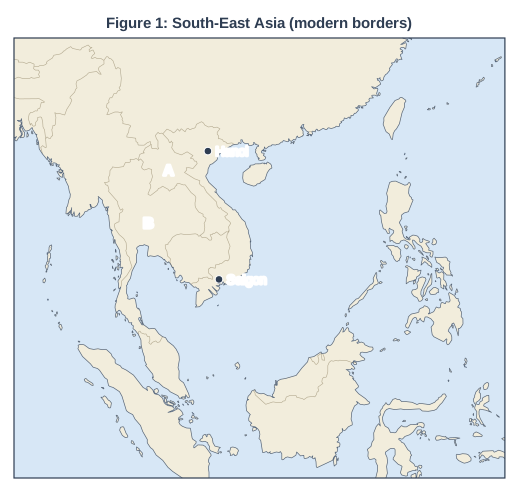
Figure 1 is a map of South-East Asia, drawn with modern borders. US leaders feared that if Vietnam fell to communism, its neighbours would follow.

Name the countries labelled A and B.

Map of the area from 90°E to 130°E and from 5°S to 30°N, titled "Figure 1: South-East Asia (modern borders)". Points: the letter A printed on the map in the top left of the map (about 30% of the way across from the left and 30% of the way down); the letter B printed on the map towards the left of the map (about 30% of the way across from the left and 40% of the way down); a dot labelled "Hanoi" in Vietnam; a dot labelled "Saigon" in Vietnam.

Model answer

A is Laos and B is Thailand.

Explanation

Laos borders Vietnam to the west and was itself the scene of a communist (Pathet Lao) challenge in 1960-62; Thailand lies beyond it. Under the Domino Theory, US leaders feared these would be the next 'dominoes' to fall after Vietnam, followed by Burma, Malaya and Indonesia.

Mark scheme
  1. 1 mark

    A: Laos.

  2. 1 mark

    B: Thailand.

    Accept: Siam for B.

Question 2

4 marks

Source A: a poster produced by the South Vietnamese government in 1962. (Written for practice.)

The poster shows a smiling peasant family standing in a neat village surrounded by a sharpened bamboo fence and a moat. Inside the fence are a new school, a clinic with a red cross and a young militiaman with a rifle in a watchtower. Outside the fence, a thin, scowling guerrilla dressed in black peers in hungrily. The slogan reads: 'The strategic hamlet - our fortress against the communists!'

Source A supports the Strategic Hamlets programme. How do you know?

Explain your answer by referring to Source A and your contextual knowledge.

Model answer

Source A supports the Strategic Hamlets programme because it shows a smiling peasant family living safely inside a fortified village, protected by a bamboo fence, a moat and a militiaman in a watchtower. This reflects the programme's aim: from 1962 the government, led by Diem's brother Nhu, moved peasants into defended hamlets to separate them from the Vietcong. The thin, hungry guerrilla outside the fence shows what the programme was meant to achieve - cutting the Vietcong off from the food, recruits and information they got from the villagers, as the British had done with their 'New Villages' in Malaya. The new school and clinic show the government's promise to improve peasants' lives and win their loyalty. The provenance confirms its support: it is a South Vietnamese government poster, so it is propaganda designed to persuade peasants to accept moving into the hamlets. In reality many were forced to move and the promised services often never arrived, but the poster presents only the positive side.

Explanation

Level 2 answers connect the details of the poster to the aims of the programme (separating the Vietcong from the peasants, winning loyalty through services) and recognise it as government propaganda.

Mark scheme
  1. 4 marks

    Levels of response (4 marks).
    Level 2 (3-4 marks): Developed analysis of Source A, explaining how its details and/or provenance support the programme (e.g. the happy, protected family, the school and clinic, the hungry guerrilla shut outside, the slogan), supported by relevant contextual knowledge of the programme's aims and methods, such as cutting the Vietcong off from the peasants, the role of Nhu or the British example in Malaya.
    Level 1 (1-2 marks): Simple analysis of Source A, identifying basic features (e.g. 'the family looks happy'), with little or no contextual knowledge.
    0 marks: nothing worthy of credit.

    Indicative content (not a checklist; credit other valid points): content - a smiling, safe family inside the defences suggests the hamlets protected peasants; the school and clinic suggest the government would improve their lives; the militiaman shows villagers defending themselves; the thin, hungry guerrilla outside shows the Vietcong cut off from food and support; the slogan calls the hamlet a 'fortress against the communists'. Provenance - a government poster, so propaganda designed to persuade peasants to accept moving into the hamlets. Context - the programme began in 1962, run by Ngo Dinh Nhu with US support and advice from the British expert Robert Thompson, based on the 'New Villages' used in Malaya; its aim was to separate the Vietcong from the peasants who gave them food, recruits and information; hamlets were surrounded by fences, moats and stakes and defended by local militia; the government promised schools, clinics and other services; in practice many peasants were forced to move and the promised services often did not appear.

Question 3

12 marks

Study Sources B and C.

Source B: from a television interview given by President Kennedy to the American NBC network on 9 September 1963. He was asked whether he had any reason to doubt the 'domino theory'.
'No, I believe it. I believe it... China is so large, looms so high just beyond the frontiers, that if South Viet-Nam went, it would not only give them an improved geographic position for a guerrilla assault on Malaya but would also give the impression that the wave of the future in Southeast Asia was China and the Communists.'

Source C: from the memoirs of a former official of the US State Department, published in 1995. (Written for practice.)
'In those years we saw Asia as a row of dominoes, not as a collection of nations with their own histories. Vietnam's communists were nationalists first; their people had resisted Chinese domination for a thousand years. But no politician in Washington wanted to be accused of losing Vietnam, as Truman had been accused of losing China. The domino theory was as much about elections at home as about Asia.'

How useful are Sources B and C to an historian studying the importance of the Domino Theory in shaping US policy towards Vietnam?

Explain your answer using Sources B and C and your contextual knowledge.

Model answer

Source B is useful because it shows that the Domino Theory was still at the heart of US policy in 1963. Kennedy says firmly, 'I believe it. I believe it', and explains his fear that if South Vietnam fell, China would gain 'an improved geographic position' for attacking Malaya and communism would look like 'the wave of the future' in Asia. This fits my knowledge: Kennedy had called Vietnam 'the cornerstone of the Free World in Southeast Asia' as early as 1956, and as President he increased the number of US advisers from about 900 to about 16,000. The provenance is valuable, because these are the President's own words. However, it was a public television interview given in September 1963, in the middle of the Buddhist crisis, so Kennedy may have stressed the theory to justify US involvement to Americans and to signal to Hanoi and Saigon that the USA would not simply withdraw. It shows what he said publicly, not necessarily all his private reasons.

Source C is useful because it suggests other reasons behind the theory. The official argues that US leaders ignored Vietnamese nationalism and Vietnam's long history of resisting China, and that the theory was 'as much about elections at home as about Asia', because no politician wanted to be blamed for 'losing' Vietnam as Truman had been blamed for 'losing' China. This is supported by my knowledge: after 1949 Republicans and Senator McCarthy attacked Truman's government over China, and Kennedy himself was criticised after the Bay of Pigs and his acceptance of a neutral Laos. The provenance gives C insider knowledge of how policy was made. But it was written in 1995, long after the USA had lost the war and after communist Vietnam had fought a war against China in 1979, so the author is writing with hindsight and perhaps regret, and it is only one official's opinion.

Overall, both sources are useful and they work well together. Source B shows that the Domino Theory was genuinely believed and was the main public justification for US policy, even in 1963. Source C suggests that the theory was reinforced by fear of the political cost of 'losing' Vietnam. I think B is more useful as direct evidence of the theory's importance, because it comes from the President at the time, while C is useful for showing its weaknesses and the domestic pressures behind it.

Explanation

Level 4 answers judge B as direct, contemporary evidence from the President (but a public justification) and C as a reflective insider view shaped by hindsight. The best answers use context - China in 1949, attacks on Truman, Kennedy's escalation - to test both and reach a clear judgement.

Mark scheme
  1. 12 marks

    Levels of response (12 marks).
    Level 4 (10-12 marks): Complex evaluation of both sources, reaching a sustained judgement about their usefulness for studying the importance of the Domino Theory, based on their content AND provenance (e.g. B as the President's own public statement of belief at a key moment in 1963; C as a later, reflective insider view that questions the theory and stresses domestic politics), supported by relevant contextual knowledge.
    Level 3 (7-9 marks): Developed evaluation of both sources based on their content and/or provenance, supported by relevant contextual knowledge.
    Level 2 (4-6 marks): Simple evaluation of one or both sources based on content and/or provenance, with some contextual knowledge.
    Level 1 (1-3 marks): Basic analysis of one or both sources, mainly describing what they say, with limited knowledge.
    0 marks: nothing worthy of credit.

    Indicative content (not a checklist; credit other valid points): Source B content - Kennedy says he believes the theory; he fears China's power and that losing South Vietnam would expose Malaya and make communism seem 'the wave of the future'. Source B provenance - the President himself in a public television interview in September 1963, at the height of the Buddhist crisis, so first-hand evidence of the official justification for US policy; but a public statement aimed at Americans and at Diem and Hanoi, so it may stress the theory to justify involvement (and to signal that the USA would not withdraw). Source C content - US leaders ignored Vietnamese nationalism and Vietnam's history of resisting China; the theory was driven by fear of being blamed for 'losing' Vietnam - domestic politics. Source C provenance - a former insider, so knows how decisions were made; written in 1995 with hindsight, after the USA had lost the war and Vietnam had fought China (1979), so may reflect later regret; one official's view. Context - the theory grew from the communist victory in China (1949) and the Korean War; Eisenhower used the domino image in 1954; the USA set up SEATO and backed Diem; Kennedy called Vietnam 'the cornerstone' in 1956 and raised advisers to about 16,000 by 1963; Truman had been attacked by Republicans and McCarthy for 'losing' China; Kennedy faced criticism after the Bay of Pigs and Laos. Judgement - B shows the theory was genuinely believed and publicly central; C suggests other motives; together very useful; B is stronger evidence of what leaders said, C of why they may have said it.

Question 4

20 marks

'The Strategic Hamlets programme was a complete failure.'

How far do you agree with this statement?

Explain your answer.

[16 marks] [SPaG 4 marks]

Model answer

The Strategic Hamlets programme, launched in 1962 and run by Diem's brother Ngo Dinh Nhu with American money, aimed to cut the Vietcong off from the peasants and to win the peasants' loyalty. Judged against these aims, it was a failure, and in many ways it made the situation worse. However, it was not a complete failure in every respect, and the idea behind it was not hopeless.

The main evidence for failure is that it did not separate the Vietcong from the peasants. Peasants were forced to leave their homes and fields, and many had to abandon the graves of their ancestors, which caused deep resentment in a society where ancestor worship was central. They were made to dig moats and build fences, often unpaid, while their crops suffered. Corrupt officials stole money and materials, and the schools, clinics and elected councils promised by the government often never appeared. As a result, the programme turned many peasants against the government and towards the Vietcong.

The programme was also badly carried out. Nhu pushed it forward far too fast and claimed that thousands of hamlets had been completed, but many existed only on paper or were poorly defended. Vietcong supporters were often already living inside the hamlets, and the Vietcong attacked weaker hamlets, captured the militia's weapons and recruited young men from resentful families. By 1963 the Vietcong were stronger in many areas than before the programme began, and when Diem and Nhu were overthrown in November 1963 the programme collapsed, with peasants tearing down many of the hamlets themselves.

However, there is some evidence that the programme was not a complete failure. In 1962, in some areas, the Vietcong were temporarily disrupted, and American officials believed the programme was working. Vietcong leaders treated it as a serious threat and made destroying the hamlets a priority, which suggests that it worried them. Where hamlets were built carefully in areas that were already secure, they did provide some protection, and some villagers received weapons and services.

It is also important that the idea itself had worked elsewhere. The British had used similar 'New Villages' successfully against communist guerrillas in Malaya, and the British expert Robert Thompson advised that hamlets should spread slowly from secure areas. The failure in Vietnam was largely a failure of execution - the speed, corruption and force with which it was carried out - and of conditions that were very different from Malaya, where the guerrillas came mainly from the Chinese minority and could be isolated more easily.

In conclusion, I largely agree with the statement. The programme had some limited and temporary successes, and the concept was not doomed from the start, so 'complete' failure is a slight exaggeration. But it failed in its central aim of separating the Vietcong from the peasants, and worse, it actually strengthened the Vietcong by giving peasants new reasons to hate the government. A programme that ended up helping the enemy it was designed to defeat must be judged an almost complete failure.

Explanation

For 'complete failure' questions, Level 4 answers judge against the programme's aims and test the word 'complete': they weigh the clear failures (resentment, corruption, infiltration, collapse) against limited successes (temporary disruption, Vietcong alarm, the Malayan precedent) and reach a sustained judgement.

Mark scheme
  1. 16 marks

    Levels of response (16 marks).
    Level 4 (13-16 marks): Complex explanation of the failures of the Strategic Hamlets programme and of any successes or achievements (e.g. temporary disruption of the Vietcong in some areas, the alarm it caused Vietcong leaders, some services provided), leading to a sustained judgement about how far it was a complete failure, supported by extended, accurate and relevant knowledge.
    Level 3 (9-12 marks): Developed explanation of failures and of any successes, supported by a range of accurate knowledge.
    Level 2 (5-8 marks): Simple explanation of failures or successes, supported by some relevant knowledge.
    Level 1 (1-4 marks): Basic explanation, with limited knowledge and little or no analysis.
    0 marks: nothing worthy of credit.

    Indicative content (not a checklist; credit other valid points): aims - to cut the Vietcong off from the peasants' food, recruits and information, and to win peasants' loyalty with security and services, copying British methods in Malaya (advice from Robert Thompson); run by Ngo Dinh Nhu from 1962 with US funding. Arguments for failure - forced removal from homes, land and ancestors' graves caused deep resentment; peasants built defences unpaid; corruption - officials stole money and materials; promised schools, clinics and elected councils often did not appear; Nhu rushed the programme and claimed thousands of completed hamlets, many existing only on paper; many hamlets were poorly defended and the Vietcong had supporters inside them; the Vietcong attacked hamlets, captured militia weapons and gained recruits; by 1963 the Vietcong were stronger in much of the countryside; the programme collapsed after Diem's overthrow in November 1963 and many hamlets were torn down; it gave Vietcong propaganda a powerful weapon. Arguments against 'complete' failure - in 1962 some areas saw the Vietcong temporarily disrupted, and US officials believed it was working; Vietcong leaders treated the programme as a serious threat and made destroying hamlets a priority, suggesting it worried them; some hamlets, built carefully in secure areas, did provide protection and services; it gave some villagers weapons and local militia; the idea had worked in Malaya, which suggests the concept was not hopeless, only the way it was carried out. Possible judgements - an almost complete failure because it not only failed in its aims but strengthened the Vietcong; or a failure in execution rather than in concept; 'complete' is too strong because of limited, temporary successes.

  2. 4 marks

    SPaG. High performance (4 marks): spells and punctuates with consistent accuracy; uses rules of grammar with effective control of meaning overall; uses a wide range of specialist terms as appropriate.
    Intermediate performance (2-3 marks): spells and punctuates with considerable accuracy; uses rules of grammar with general control of meaning overall; uses a good range of specialist terms as appropriate.
    Threshold performance (1 mark): spells and punctuates with reasonable accuracy; uses rules of grammar with some control of meaning and any errors do not significantly hinder meaning overall; uses a limited range of specialist terms as appropriate.
    0 marks: the student writes nothing, or the response does not relate to the question, or errors severely hinder meaning.

    SPaG marks are awarded only if the answer relates to the question.

Ready to try the rest? Every answer you write is marked against the mark scheme, so you can see exactly where the marks are.

AI Tutor Hints first, answers after you try

Hi! Stuck? Ask me for a hint and I’ll help you work it out. Once you’ve checked your answer I can explain exactly where the marks are.