Level:
Correct: 0
Incorrect: 0
Marks: 0/0
Exam Practice
Subject:
Topics:
AQA GCSE History (Conflict and tension in Asia 1950-1975) Smart practice A mixed round aimed at your weak spots
Unit 1
Part one: Conflict in Korea
Unit 2
Part two: Escalation of conflict in Vietnam
Unit 3
Part three: The ending of conflict in Vietnam
Avg
score:
–
Topics
done:
0/9

Nixon's War

Practise 44 exam-style questions on Nixon's War for AQA GCSE History (Conflict and tension in Asia 1950-1975). Write your answer as you would in the exam and get it marked in seconds against the mark scheme, point by point, with an AI tutor on hand if you get stuck.

  • 44 questions
  • 1–20 marks each
  • Instant marking
  • No sign-up needed
20 questions, marked as you go

Sample questions with model answers

Here are 4 of the questions in this topic, each with a model answer, an explanation of why it earns the marks and the mark scheme an examiner would use.

Question 1

2 marks

Describe two effects of the use of Agent Orange in Vietnam.

Model answer

Agent Orange stripped the leaves from huge areas of forest, removing the cover that the Vietcong used to hide. It also contained dioxin, which has been linked to cancers in people who were exposed and to birth defects in their children.

Explanation

Under Operation Ranch Hand (1962-1971) about 20 million US gallons of herbicides were sprayed over South Vietnam, more than half of it Agent Orange. Its effects on the environment and on the health of Vietnamese people and US veterans lasted long after the war.

Mark scheme
  1. 2 marks

    Two effects, 1 mark each: it stripped the leaves from forests and mangroves, removing cover used by the Vietcong / it destroyed crops, causing food shortages and forcing peasants off their land / it poisoned soil and water with dioxin, and some areas (such as former US air bases) were still contaminated decades later / it caused cancers and other serious illnesses among Vietnamese people and US veterans / it has been linked to birth defects in the children of people who were exposed / it caused long-term damage to the environment, such as soil erosion and loss of wildlife.

    Max 2. Credit two different effects. A simple statement ('it killed trees') earns the mark.

Question 2

4 marks

Source A: from a television address by President Nixon on 30 April 1970.
'This is not an invasion of Cambodia. The areas in which these attacks will be launched are completely occupied and controlled by North Vietnamese forces... If, when the chips are down, the world's most powerful nation, the United States of America, acts like a pitiful, helpless giant, the forces of totalitarianism and anarchy will threaten free nations and free institutions throughout the world.'

Source A defends the decision to send US troops into Cambodia. How do you know?

Explain your answer by referring to Source A and your contextual knowledge.

Model answer

Source A defends the decision because Nixon insists that 'this is not an invasion of Cambodia', which plays down the operation. He had promised to wind the war down through Vietnamisation, so he needed to avoid looking as if he was widening it. He argues that the areas being attacked were already 'occupied and controlled by North Vietnamese forces'. This was partly true: North Vietnam used bases, or 'sanctuaries', in eastern Cambodia, such as the 'Fishhook' and 'Parrot's Beak', close to Saigon, and the aim was to destroy them and the communist headquarters, protecting US troops as they withdrew. He also warns that if the USA acts like 'a pitiful, helpless giant', communism would threaten free nations, appealing to American pride and Cold War credibility. The provenance shows why he chose these words: it was a television address to win public support at the start of the operation, after the pro-American Lon Nol had overthrown Prince Sihanouk and North Vietnamese forces were advancing in Cambodia. Nixon clearly expected opposition, and he was right: protests broke out on campuses, and four students were killed at Kent State on 4 May 1970.

Explanation

For Level 2, explain how Nixon justifies the operation (not an invasion, enemy-controlled areas, American credibility) using knowledge of the sanctuaries, the Lon Nol coup and Vietnamisation, and/or explain the purpose of a televised presidential address at the start of an unpopular operation.

Mark scheme
  1. 4 marks

    Levels of response (4 marks).
    Level 2 (3-4 marks): Developed analysis of Source A: explains how the content (e.g. denying it was 'an invasion', claiming the target areas were controlled by North Vietnamese forces, warning that the USA must not act like 'a pitiful, helpless giant') and/or the provenance (the President justifying the operation on national television as it began) defend the decision, supported by relevant contextual knowledge (e.g. the North Vietnamese sanctuaries and supply routes, the Lon Nol coup, Vietnamisation, the reaction at home).
    Level 1 (1-2 marks): Simple analysis of Source A: identifies a relevant feature, e.g. 'he says it is not an invasion', with little or no supporting knowledge.
    0 marks: nothing worthy of credit.

    Indicative content (not a checklist; credit other valid points): 'This is not an invasion' plays down the operation to avoid the charge of widening the war - Nixon had promised to wind the war down; he argues the areas were already 'occupied and controlled by North Vietnamese forces' - North Vietnam used bases ('sanctuaries') in eastern Cambodia, such as the 'Fishhook' and 'Parrot's Beak', and supplies came through Cambodia; he presents the attack as protecting US troops and Vietnamisation by destroying these bases and the communist headquarters (COSVN); 'pitiful, helpless giant' appeals to American pride and Cold War credibility - the USA must show strength to the communist world; context - Prince Sihanouk had been overthrown by the pro-American Lon Nol in March 1970, and North Vietnamese forces were advancing in Cambodia; secret US bombing of Cambodia (Operation Menu) had begun in March 1969; provenance - a presidential television address at the start of the operation, intended to win public support; it shows he expected opposition - campuses erupted, and four students were killed at Kent State on 4 May 1970; US troops were withdrawn by the end of June 1970.

Question 3

12 marks

Source B: a summary of remarks made by President Nixon to journalists on the island of Guam in July 1969, which became known as the Nixon Doctrine.
Nixon said that the USA would keep all its treaty commitments and would protect its allies with its nuclear weapons if a nuclear power threatened them. But in other kinds of attack, the USA would provide military and economic aid, and would expect the Asian nation under threat to provide the soldiers for its own defence.

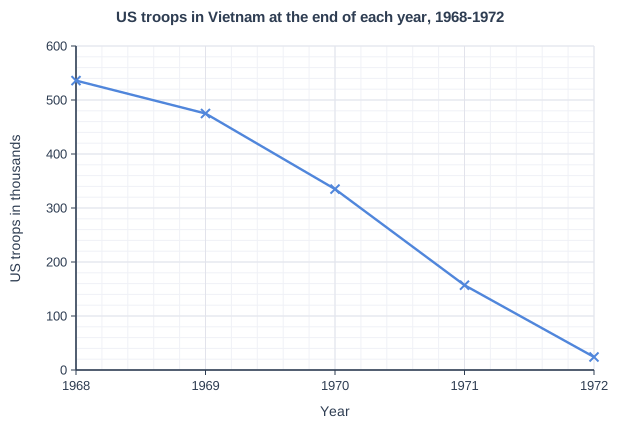
Source C is Figure 1: a graph of the number of US troops in Vietnam at the end of each year from 1968 to 1972, drawn from US Department of Defense figures.

How useful are Sources B and C to an historian studying Nixon's policy of Vietnamisation?

Explain your answer using Sources B and C and your contextual knowledge.

US troops in Vietnam at the end of each year, 1968-1972. Line graph of US troops in thousands (y-axis, 0 to 600) against year (x-axis, 1968 to 1972). The line joins the points (1968, 536), (1969, 475), (1970, 335), (1971, 157), (1972, 24).

Model answer

Source B is useful because it explains the thinking behind Vietnamisation. Nixon says that the USA would keep its treaty commitments and provide military and economic aid, but would expect an Asian nation under threat 'to provide the soldiers for its own defence'. In Vietnam this meant exactly what Vietnamisation tried to do: the ARVN was expanded to over a million men and given modern weapons, while American troops went home. The nuclear shield shows that Nixon was not abandoning the policy of containment, only changing how it was carried out. The provenance adds to its usefulness. These are the President's own words, spoken in July 1969, just a month after he had announced the first withdrawal of 25,000 troops, so it shows his intentions at the very start of the policy. However, it is a general statement of principle for all of Asia, not a description of how the policy worked in Vietnam. As a public statement it also leaves out Nixon's political motives, such as the pressure of the anti-war movement and his wish to be re-elected.

Source C is useful because it shows how Vietnamisation was carried out in practice. US troop numbers fell from about 536,000 at the end of 1968 to about 335,000 at the end of 1970 and only about 24,000 at the end of 1972. As official Department of Defense figures, the numbers are reliable. The graph also shows that the withdrawal was gradual, taking four years, which fits my knowledge that more than 20,000 Americans died in Vietnam during Nixon's presidency. However, Source C shows only one half of Vietnamisation. It says nothing about the growth and performance of the ARVN, the increased reliance on American bombing, or the widening of the war into Cambodia in 1970 and Laos in 1971.

Overall, both sources are useful, and they complement each other: Source B explains what Vietnamisation was meant to achieve, and Source C shows that American troops really did leave. However, neither source shows whether the policy succeeded in its main aim of making South Vietnam able to defend itself. Events such as the ARVN's costly retreat from Laos in 1971 and its dependence on US bombing in the Easter Offensive of 1972, and the fall of South Vietnam in 1975, suggest that it did not. So the sources are very useful for the American side of Vietnamisation, but an historian would need other evidence about the ARVN to judge the policy fully.

Explanation

Source B gives the principle behind Vietnamisation (allies provide their own soldiers, with US aid); Source C measures the US withdrawal. Level 4 uses content AND provenance for both and judges what they can and cannot show - neither tells us whether the ARVN could really replace American forces.

Mark scheme
  1. 12 marks

    Levels of response (12 marks).
    Level 4 (10-12 marks): Complex evaluation of both sources with sustained judgement based on content and provenance: explains how useful Source B is for the thinking behind Vietnamisation (a statement of principle by the President at the start of the policy) and how useful Source C is for how the policy was carried out (official figures showing the scale and speed of withdrawal), tests both against accurate contextual knowledge (e.g. the first withdrawals of 1969, the expansion of the ARVN, the continued bombing, Lam Son 719, the Easter Offensive, the fall of South Vietnam in 1975), and reaches a substantiated judgement, e.g. that both show the US side of Vietnamisation but not whether the ARVN could really replace US forces.
    Level 3 (7-9 marks): Developed evaluation of both sources based on content and/or provenance, supported by relevant contextual knowledge.
    Level 2 (4-6 marks): Simple evaluation of one or both sources based on content and/or provenance.
    Level 1 (1-3 marks): Basic analysis of one or both sources: describes the content or makes general comments, with little or no knowledge.
    0 marks: nothing worthy of credit.

    Indicative content (not a checklist; credit other valid points): Source B content - shows the principle behind Vietnamisation: the USA would supply aid and keep its commitments, but Asian allies must provide their own soldiers - in Vietnam this meant expanding the ARVN (to over a million men) while US troops withdrew; the nuclear shield shows the USA was not abandoning containment; Source B provenance - Nixon himself, speaking in July 1969, a month after announcing the first withdrawal of 25,000 troops at Midway; informal remarks to journalists that were later set out formally (e.g. in the 'silent majority' speech of November 1969); useful as evidence of the President's intentions, but a public statement of principle that does not show how the policy worked or the political motives behind it (opposition at home, the 1972 election); not specifically about Vietnam; Source C content - shows the policy in practice: troops fell from about 536,000 (end 1968) to about 475,000 (1969), 335,000 (1970), 157,000 (1971) and 24,000 (1972); the fall was gradual - over four years, during which more than 20,000 Americans died; Source C provenance - official Department of Defense figures, reliable for numbers; limitations - shows only US withdrawal, not the other half of the policy (the growth and performance of the ARVN), and not the increased reliance on bombing or the widening of the war into Cambodia (1970) and Laos (1971); context - Lam Son 719 (1971) and the Easter Offensive (1972) showed the ARVN depended on US air power; South Vietnam fell in April 1975; judgement - B explains the aim and C measures the withdrawal; together they show what the USA intended and did, but neither shows whether Vietnamisation succeeded in making South Vietnam able to defend itself.

Question 4

20 marks

'The US use of chemical weapons in Vietnam was a failure.'

How far do you agree with this statement?

Explain your answer.

[16 marks] [SPaG 4 marks]

Model answer

The USA used chemical weapons in Vietnam on a huge scale. Under Operation Ranch Hand, from 1962 to 1971, about 20 million US gallons of herbicides, more than half of it Agent Orange, were sprayed over South Vietnam, and napalm was dropped in vast quantities. These weapons achieved some limited military aims, but I largely agree that they were a failure, because they did not help the USA win the war and they caused enormous harm, both to the people of Vietnam and to America's own cause.

Chemical weapons did have some military successes. Herbicides stripped the leaves from the jungle along roads, rivers and canals and around US bases, making it harder for the Vietcong to set ambushes in those areas, and they exposed some base camps to air attack. Spraying crops, sometimes with Agent Blue, destroyed rice that could have fed the Vietcong. Napalm was a powerful weapon in close air support: when US or ARVN troops were under attack, napalm strikes could destroy enemy positions, and CS gas was used to flush out tunnels. Military commanders at the time believed that defoliation saved American lives.

However, these successes did not change the course of the war. The Vietcong adapted by moving their camps, using tunnels and travelling at night, and the Ho Chi Minh Trail kept carrying men and supplies through Laos and Cambodia. Defoliation could not reach every part of the jungle, and the Vietcong's real strength was their support among the peasants, which chemicals could not destroy. By the time spraying ended in 1971, the USA was withdrawing from a war it had failed to win.

In fact, chemical weapons damaged the American cause. Crop destruction hit peasants far more than Vietcong fighters, causing hunger and driving people from their land into camps and cities. This turned many against the Americans and the Saigon government, undermining the aim of winning 'hearts and minds'. Chemical weapons also became a propaganda gift for North Vietnam and brought international condemnation. In the USA, students protested against Dow Chemical, which made napalm, and images such as Nick Ut's photograph of nine-year-old Kim Phuc running from a napalm attack in June 1972 shocked the world and strengthened opposition to the war.

The long-term harm was even greater. Agent Orange contained dioxin, which has been linked to cancers and to birth defects in the children of people exposed. The Vietnamese Red Cross has estimated that up to a million people were affected. American veterans suffered too, winning a 180-million-dollar settlement from the chemical companies in 1984. Large areas of forest and mangrove were destroyed, and former US bases such as Da Nang were still contaminated with dioxin decades later.

The clearest sign of failure is that the USA itself abandoned these weapons. The government restricted Agent Orange in 1970 after studies suggested it caused birth defects, ended spraying in 1971, and in 1975 President Ford renounced the first use of herbicides in war.

In conclusion, chemical weapons achieved some short-term tactical aims, such as clearing cover and supporting troops in battle. But they did not stop the Vietcong or the flow of supplies from the North, and they alienated the people the USA was trying to win over, damaged America's reputation and caused suffering that lasted for decades. Measured against the aim of winning the war, they were a failure, and their costs far outweighed any military gains.

Explanation

Judge chemical weapons against their aims (removing cover, destroying crops, supporting troops). A strong answer weighs the limited tactical gains against the failure to stop the Vietcong and the Trail, the alienation of peasants, the damage to world and American opinion, and the long-term harm to people and the environment, and sustains a judgement - for example, that the USA's own decision to stop and renounce them shows they failed.

Mark scheme
  1. 16 marks

    Levels of response (16 marks).
    Level 4 (13-16 marks): Complex explanation of the ways in which chemical weapons achieved US military aims (e.g. removing cover along roads and around bases, exposing camps, destroying crops, the battlefield power of napalm, flushing tunnels) and the ways in which they failed or did more harm than good (e.g. the Vietcong and the Ho Chi Minh Trail were not stopped, peasants were alienated, international and domestic opinion turned against the war, long-term harm to Vietnamese people, US veterans and the environment, the programme had to be restricted and ended), supported by extended, accurate knowledge, leading to a sustained judgement.
    Level 3 (9-12 marks): Developed explanation of success and failure, or a well-developed explanation of one side with some reference to the other, supported by relevant, accurate knowledge; a judgement may be given but is not fully sustained.
    Level 2 (5-8 marks): Simple explanation of the success or failure of chemical weapons, with some relevant knowledge.
    Level 1 (1-4 marks): Basic explanation: general statements, with limited knowledge.
    0 marks: nothing worthy of credit.

    Indicative content (not a checklist; credit other valid points): aims - to remove jungle cover used by the Vietcong, expose bases and supply routes, destroy crops that fed them, and support troops in battle; success - Operation Ranch Hand (1962-1971) sprayed about 20 million US gallons of herbicides, clearing vegetation along roads, rivers and around bases, which made ambushes harder in some areas and exposed some camps to air attack; crop destruction caused the Vietcong supply problems in some areas; napalm was a powerful weapon in close air support, helping US and ARVN troops under attack; CS gas helped flush out tunnels; failure - the Vietcong adapted, moving camps and using tunnels; the Ho Chi Minh Trail kept operating; the war was not won; crop destruction hit peasants hardest, causing hunger and refugees and turning people against the USA and Saigon - undermining 'hearts and minds'; chemical weapons became a propaganda gift to North Vietnam and brought international condemnation; protests in the USA targeted Dow Chemical (makers of napalm and Agent Orange), and images such as Nick Ut's photograph of Kim Phuc (June 1972) turned opinion against the war; long-term harm - Agent Orange contained dioxin, linked to cancers and birth defects; the Vietnamese Red Cross estimates up to a million people affected; US veterans affected (1984 settlement, 1991 Agent Orange Act); environmental damage to forests and mangroves, and contaminated former bases; the US government restricted Agent Orange in 1970, ended spraying in 1971, and President Ford renounced the first use of herbicides in war (1975); possible judgements - a failure because tactical gains were small and temporary while the political, human and moral costs were huge; or a partial tactical success that failed strategically; or a failure measured by the fact that the USA itself abandoned and renounced it.

  2. 4 marks

    SPaG. High performance (4 marks): spells and punctuates with consistent accuracy; uses rules of grammar with effective control of meaning overall; uses a wide range of specialist terms as appropriate.
    Intermediate performance (2-3 marks): spells and punctuates with considerable accuracy; uses rules of grammar with general control of meaning overall; uses a good range of specialist terms as appropriate.
    Threshold performance (1 mark): spells and punctuates with reasonable accuracy; uses rules of grammar with some control of meaning and any errors do not significantly hinder meaning overall; uses a limited range of specialist terms as appropriate.
    0 marks: the student writes nothing, or the response does not relate to the question, or errors severely hinder meaning.

    SPaG marks are awarded only if the answer relates to the question.

Ready to try the rest? Every answer you write is marked against the mark scheme, so you can see exactly where the marks are.

AI Tutor Hints first, answers after you try

Hi! Stuck? Ask me for a hint and I’ll help you work it out. Once you’ve checked your answer I can explain exactly where the marks are.