'The Communist victory in China in 1949 was the most important reason for the outbreak of the Korean War in 1950.'
How far do you agree with this statement?
Explain your answer.
[16 marks] [SPaG 4 marks]
Model answer
The Communist victory in China in October 1949 transformed the situation in Asia, and it helps explain why war broke out in Korea in 1950 rather than earlier. However, it was not the most important reason. The direct causes were Kim Il Sung's determination to reunify Korea and Stalin's decision to support him, which China's revolution encouraged but did not create on its own.
There is a strong case for the Chinese victory. When Mao Zedong proclaimed the People's Republic of China on 1 October 1949, North Korea gained a powerful communist neighbour that could help if an invasion went wrong. This mattered greatly to Stalin, who did not want to risk Soviet troops: when he approved the invasion in April 1950, he made it conditional on Mao's agreement, which Kim obtained in Beijing in May. China's revolution also strengthened Kim directly, as tens of thousands of Korean soldiers who had fought for the Chinese Communists returned to join the North Korean army. The Sino-Soviet Treaty of February 1950 made the communist bloc look stronger and more united than ever.
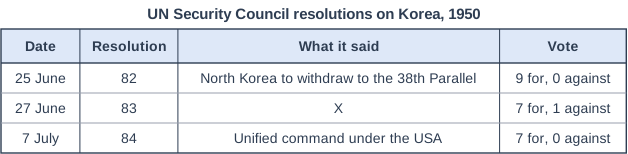
The victory in China also shaped the American side of the war. In the USA, Republicans accused Truman of 'losing China', and Senator McCarthy's attacks from February 1950 made it politically impossible for Truman to lose another Asian country. The USA's refusal to let Mao's government take China's UN seat led to the Soviet boycott of the Security Council, which allowed the UN to intervene without a Soviet veto. In this sense China's revolution helped turn a Korean invasion into an international war.
However, other factors were more directly responsible. Kim Il Sung was the driving force behind the war: he had asked Stalin for permission to invade in March 1949, before Mao's victory, and kept pressing until Stalin agreed. Stalin's approval was the decisive condition, and it was influenced by several other developments as well as China. US troops had left South Korea by June 1949, the USSR tested its first atomic bomb in August 1949, and in January 1950 Acheson's speech left Korea outside the American defensive perimeter. All of these made Stalin believe that the USA would not intervene. Soviet tanks, aircraft and advisers, not Chinese help, made the invasion possible.
The deeper cause was the division of Korea in 1945. The 38th Parallel, chosen hastily by American officers, hardened into a border between two hostile states in 1948, each claiming the whole peninsula. Syngman Rhee's harsh rule and threats to 'march north', and the clashes along the parallel in 1949, made war increasingly likely regardless of events in China.
In conclusion, I disagree with the statement, although the Chinese victory was very important. It explains why Stalin was willing to take the risk in 1950 rather than 1949 and why the USA reacted so strongly. But it was one of several changes, alongside the Soviet bomb, the US withdrawal and Acheson's speech, that persuaded Stalin, and the war itself came from Kim's ambition to reunify a divided Korea. The Chinese victory was an important trigger, not the main cause.
Explanation
Mao's victory gave Kim an ally, satisfied Stalin's condition and hardened US attitudes, but Kim's ambition, Stalin's approval (also shaped by the Soviet bomb, US withdrawal and Acheson's speech) and the division of Korea were more direct causes. Level 4 needs a sustained judgement that weighs China's role against these factors with specific knowledge.