Level:
Correct: 0
Incorrect: 0
Marks: 0/0
Exam Practice
Subject:
Topics:
AQA GCSE History (Conflict and tension in Asia 1950-1975) Smart practice A mixed round aimed at your weak spots
Unit 1
Part one: Conflict in Korea
Unit 2
Part two: Escalation of conflict in Vietnam
Unit 3
Part three: The ending of conflict in Vietnam
Avg
score:
–
Topics
done:
0/9

The development of the Korean War

Practise 44 exam-style questions on The development of the Korean War for AQA GCSE History (Conflict and tension in Asia 1950-1975). Write your answer as you would in the exam and get it marked in seconds against the mark scheme, point by point, with an AI tutor on hand if you get stuck.

  • 44 questions
  • 1–20 marks each
  • Instant marking
  • No sign-up needed
20 questions, marked as you go

Sample questions with model answers

Here are 4 of the questions in this topic, each with a model answer, an explanation of why it earns the marks and the mark scheme an examiner would use.

Question 1

2 marks

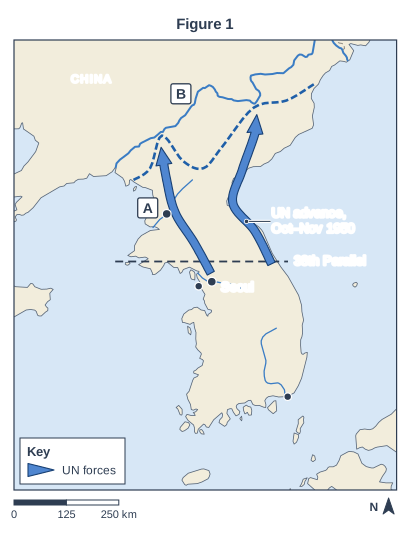
Figure 1 shows the United Nations advance into North Korea in October and November 1950.

Name the city labelled A, which UN forces captured on 19 October 1950, and the river labelled B.

Map of a peninsula with arrows and lines showing a war. The heading reads "Figure 1". Map (north at the top) with a scale bar and north arrow, showing a peninsula about 1,000 km long running south from the mainland, with a sea on each side and islands to the south-east. In the north-west a river forms the border with the mainland. A straight dashed line crosses the peninsula from west to east a little less than halfway up. Dots mark places: two larger dots, one north and one just south of the dashed line, a dot on the coast just west of the southern larger dot, and a dot at the south-eastern tip. Blue arrows point north from near the dashed line, one in the west passing the larger dot in the north-west and one up the east side, towards the river border; a dashed blue line runs across the north of the peninsula close to the river border. The scale bar shows 250 km. A key shows a blue block arrow: "UN forces". Label A points to the larger dot in the west of the northern half of the peninsula; label B points to the river forming the border in the north-west, between the peninsula and the mainland; the label "38th Parallel" points to the straight dashed line across the peninsula; the label "Seoul" points to the larger dot near the west coast just south of the dashed line; the label "UN advance, Oct–Nov 1950" points to the blue arrows pointing north from near the dashed line towards the river border; the label "CHINA" is written on the mainland to the north-west, beyond the river.

Model answer

A is Pyongyang, the capital of North Korea. B is the Yalu River, the border between North Korea and China.

Explanation

After crossing the 38th Parallel in early October 1950, UN forces captured Pyongyang on 19 October and pushed on towards the Yalu River. Their approach to China's border was a key reason why Mao Zedong sent Chinese troops into Korea.

Mark scheme
  1. 1 mark

    A: Pyongyang.

    Accept: P'yongyang; the North Korean capital.

  2. 1 mark

    B: the Yalu River.

    Accept: the Yalu. Do not accept the Han, Taedong or Naktong.

Question 2

4 marks

Source A: a Chinese poster from the early 1950s, described in words. (Written for practice.)

A young soldier in a padded cotton uniform and fur hat stands on a bridge, rifle raised, facing south across a river. Behind him are a smiling peasant family, wheat fields and factory chimneys. Across the river, a Korean village burns under aeroplanes marked with American stars. The slogan at the top reads: 'Resist America, aid Korea, protect our homes and defend our country!'

Source A supports China's intervention in the Korean War. How do you know?

Explain your answer by referring to Source A and your contextual knowledge.

Model answer

Source A supports China's intervention because it shows a Chinese soldier standing guard on a bridge, which represents the Yalu River between China and North Korea. Behind him are a happy peasant family, farmland and factories, while in front of him a Korean village is burning under American aircraft. The message is that the Chinese 'volunteers' are protecting China's peaceful homes from American aggression. This links to the events of October 1950, when UN forces led by the USA crossed the 38th Parallel and advanced right up to the Yalu, which made Mao fear an attack on Manchuria, China's industrial heartland.

The slogan 'Resist America, aid Korea, protect our homes and defend our country' was used by the Chinese government in its campaign to win support for the war. As official propaganda from the new communist government, the poster presents the intervention as both helping a fellow communist country and defending China itself.

Explanation

Level 2 explains the symbols (the bridge as the Yalu, Chinese homes behind, American bombers in front) and links them to why China intervened and how the government justified it. Saying only that it is propaganda is Level 1.

Mark scheme
  1. 4 marks

    Levels of response (4 marks).
    Level 2 (3-4 marks): Developed analysis of Source A, based on its content and/or provenance, supported by relevant contextual knowledge, e.g. explains that the soldier on the bridge is a Chinese 'volunteer' guarding the Yalu, with China's peaceful homes and factories behind him and Korea burning under American bombers in front, so intervention is shown as defending China against American aggression, and links this to the UN advance to the Yalu in October-November 1950 and the government's mass campaign to win support for the war.
    Level 1 (1-2 marks): Simple analysis of the source based on its content and/or provenance, e.g. 'the slogan says aid Korea' or 'it is Chinese propaganda'.
    0 marks: nothing worthy of credit.

    Indicative content (not a checklist; credit other valid points): content - the soldier wears the padded uniform of the Chinese People's Volunteers, who entered Korea from 19 October 1950; the bridge and river stand for the Yalu, the border; behind him are a family, farms and factories - Manchuria was China's main industrial region, close to the border; the burning village and aircraft with American stars show US bombing of North Korea, presenting the USA as the aggressor; the slogan links helping Korea with defending China's own homes; provenance - an official poster of the new People's Republic (founded October 1949), part of the 'Resist America, Aid Korea' campaign used to mobilise support, recruits and money; context - UN forces crossed the 38th Parallel in October 1950 and reached the Yalu; the US Seventh Fleet had been protecting Taiwan since June 1950; China warned it would intervene; Mao presented the war as defending the revolution.

Question 3

12 marks

Source B: from the memoirs of a US Navy officer who helped to plan the Inchon landing, published in 1960. (Written for practice.)

'Inchon had every problem a landing from the sea could face. The tide rose and fell by over thirty feet, so the main force had a few hours on a single evening to get ashore. One sunken ship could block the channel. Instead of beaches there were sea walls. At the Tokyo conference MacArthur did not answer our objections one by one. He talked for nearly an hour about history and destiny, and when he finished, nobody wanted to argue.'

Source C: from General MacArthur's memoirs, Reminiscences, published in 1964. MacArthur describes the conference in Tokyo on 23 August 1950 at which senior army and navy commanders raised objections to his plan. He writes that he argued that the very difficulties they listed would guarantee surprise, because the North Koreans would think nobody would attempt such a landing, and that capturing Inchon and Seoul would cut the enemy's supply lines and win the campaign quickly. He presents the success of the landings as proof that he had been right.

How useful are Sources B and C to an historian studying the decision to land at Inchon in 1950?

Explain your answer using Sources B and C and your contextual knowledge.

Model answer

Source B is useful because it shows why so many senior commanders opposed the landing. The officer lists the dangers: tides that rose and fell by over thirty feet, a channel that one sunken ship could block, and sea walls instead of beaches. This fits what I know: Inchon's tides were among the largest in the world, so the Marines had to take the island of Wolmi-do on the morning tide and wait until the evening tide for the main landing. The provenance adds to its value, because he helped to plan the operation and so knew the risks at first hand. It is also useful for showing how the decision was made: he says MacArthur did not answer the objections but overwhelmed the meeting with a speech about 'history and destiny'. However, it was written in 1960, after the landing had succeeded and after MacArthur's dismissal, so the officer may exaggerate the dangers to make the planners' achievement look greater, or be less respectful of MacArthur than he was at the time.

Source C is useful for a different reason: it gives MacArthur's own explanation of why he insisted on Inchon. He argued that the difficulties would ensure surprise, and that taking Seoul would cut the North Korean supply lines. My knowledge shows this reasoning was sound: the landing on 15 September 1950 took the North Koreans completely by surprise, Seoul was recaptured by 28 September and the North Korean army around Pusan collapsed. However, the provenance limits its usefulness. MacArthur wrote his memoirs in 1964, thirteen years after Truman sacked him, and wanted to defend his reputation. He presents himself as a genius proved right, and naturally does not mention that he later ignored Chinese warnings with disastrous results.

Overall, the sources are most useful together. Source B shows the genuine risks and the doubts of the planners, while Source C explains the strategic thinking behind the decision. Source C is the more one-sided, but it is the best evidence of MacArthur's motives; Source B balances it by showing that the decision was a gamble that MacArthur pushed through by force of personality.

Explanation

Level 4 needs a sustained judgement using both content and provenance: B is a first-hand account of the risks written with hindsight, C is MacArthur's self-justifying explanation of his reasoning. Saying simply that MacArthur is 'biased' without explaining how this affects the source's usefulness is Level 2.

Mark scheme
  1. 12 marks

    Levels of response (12 marks).
    Level 4 (10-12 marks): Complex evaluation of both sources, with a sustained judgement about their usefulness for studying the decision to land at Inchon, based on content and provenance and supported by contextual knowledge, e.g. explains that B is useful for the genuine dangers (tides, channel, sea walls) and the way MacArthur's personality overrode the planners, while C is useful for MacArthur's strategic reasoning (surprise, Seoul as the supply hub) but is self-justifying and written with hindsight; reaches a judgement that together they show both the risks and the reasoning, or that one is more useful, with reasons.
    Level 3 (7-9 marks): Developed evaluation of both sources based on content and/or provenance, supported by relevant contextual knowledge, e.g. explains what each shows about the decision and how its author's position affects it.
    Level 2 (4-6 marks): Simple evaluation of one or both sources based on content and/or provenance, e.g. 'Source B is useful because the officer helped plan it' or 'Source C is biased because MacArthur wants to look good'.
    Level 1 (1-3 marks): Basic analysis of one or both sources: describes content or makes general comments about provenance without evaluating usefulness.
    0 marks: nothing worthy of credit.

    Indicative content (not a checklist; credit other valid points): Source B content - the tides (a range of about 10 metres, among the highest in the world), the narrow channel that could be blocked, sea walls instead of beaches; MacArthur won the argument by force of personality and rhetoric rather than by answering objections; confirmed by knowledge: the Joint Chiefs and US Navy doubted the plan; the island of Wolmi-do had to be taken on the morning tide and the main landing made on the evening tide; provenance - a planner with first-hand knowledge of the risks; written in 1960, after the success, so he may exaggerate the dangers to make the planners' achievement look greater, or be critical of MacArthur after his dismissal (1951); Source C content - MacArthur's reasons: surprise, and Seoul as the hub of North Korean supply lines; confirmed by knowledge: the landing on 15 September 1950 with about 70,000 troops was a complete surprise, Seoul was retaken by 28 September and the North Korean army collapsed; provenance - MacArthur's own memoirs, published in 1964 (the year he died), long after his dismissal; he wanted to defend his reputation, so he presents himself as a genius proved right and says nothing of later failures such as ignoring Chinese warnings; useful for his motives and the arguments used at the conference; judgement - both are useful together: B for the risks and the planners' view, C for the strategic logic; C is the more one-sided but the most direct evidence of why the decision was made; neither tells us about North Korean preparations or the role of the Joint Chiefs' approval.

Question 4

20 marks

'The United Nations' decision to advance into North Korea in October 1950 was a serious mistake.'

How far do you agree with this statement?

Explain your answer.

[16 marks] [SPaG 4 marks]

Model answer

There are strong reasons to see the advance into North Korea as a serious mistake. By crossing the 38th Parallel, the UN changed its aim from defending South Korea to conquering the North, and it did so despite China's clear warnings. Zhou Enlai warned publicly on 30 September 1950 and, through the Indian ambassador on 2-3 October, said China would intervene if American troops crossed the Parallel. The warnings were dismissed as bluff. From 19 October around 200,000-300,000 Chinese troops entered Korea, and their offensive from 25 November drove the UN out of the North in the longest retreat in American military history. Seoul fell again in January 1951.

The consequences were very serious. A war that seemed almost won in October 1950 lasted until July 1953, much of it in a bloody stalemate near the line where it had started. The risk of a third world war grew: on 30 November Truman told reporters that the atomic bomb had always been under consideration, which caused alarm among America's allies. The advance also led directly to the clash between Truman and MacArthur and to two decades of hostility between the USA and China. On this view, the decision turned a successful limited war into a disaster.

However, the decision made sense at the time. After Inchon the North Korean army was collapsing, and it seemed possible to unite Korea at little cost. Leaving that army intact behind the Parallel might have allowed it to rebuild and invade again. Syngman Rhee demanded unification, and South Korean troops crossed on 1 October. The UN General Assembly gave its backing on 7 October, calling for a unified, democratic Korea. American intelligence and MacArthur, at Wake Island, believed Chinese intervention was unlikely, and Truman faced strong political pressure after being accused of 'losing China' in 1949. Some historians also argue that Mao had been preparing to intervene for months and might have acted anyway.

It can also be argued that the real mistake was not crossing the Parallel but the way the advance was carried out. In November 1950 Britain proposed stopping short of the Yalu and leaving a buffer zone next to China's border, but MacArthur pressed on towards the river. He split his forces either side of the mountains, ignored the warning given by the first Chinese attacks in late October and early November, and launched his 'home-by-Christmas' offensive on 24 November straight into a trap.

Overall, I agree that the decision was a serious mistake, because its costs were enormous and the danger had been clearly signalled. Yet it was an understandable mistake, backed by the UN and based on poor intelligence and political pressure. The worst errors came afterwards: advancing to the Yalu and ignoring the first Chinese attacks turned a risky decision into a catastrophe.

Explanation

Level 4 weighs the consequences of the advance against the reasons it seemed sensible at the time, and may distinguish between crossing the Parallel and advancing to the Yalu. A one-sided answer that only lists the bad consequences cannot reach the top level.

Mark scheme
  1. 16 marks

    Levels of response (16 marks).
    Level 4 (13-16 marks): Complex explanation of arguments for and against the statement (e.g. it provoked Chinese intervention, prolonged the war and caused huge losses, against the case that destroying the North Korean army and uniting Korea was a reasonable aim backed by the UN and that the real mistake was the manner of the advance), leading to a sustained judgement, supported by a range of accurate, specific knowledge.
    Level 3 (9-12 marks): Developed explanation of arguments on both sides, or a developed explanation of several arguments on one side, supported by relevant knowledge, without a sustained judgement.
    Level 2 (5-8 marks): Simple explanation of arguments for or against, e.g. 'it was a mistake because China joined the war'.
    Level 1 (1-4 marks): Basic explanation: general statements with limited knowledge.
    0 marks: nothing worthy of credit.

    Indicative content (not a checklist; credit other valid points): for (a mistake) - it changed the aim from containment to rollback and ignored China's clear warnings (Zhou Enlai, 30 September; through Panikkar, 2-3 October); it brought around 200,000-300,000 Chinese troops into the war from 19 October; the offensive from 25 November drove the UN out of North Korea in the longest retreat in US military history; Seoul fell again on 4 January 1951; the war lasted until July 1953 with huge casualties, much of it fought in stalemate; it raised the risk of a third world war (Truman's atomic bomb comment, 30 November 1950); it led to the clash between Truman and MacArthur and MacArthur's dismissal; it poisoned relations between the USA and China for two decades; against (not a mistake) - the North Korean army was collapsing after Inchon and unification seemed achievable; leaving it intact risked another invasion; Syngman Rhee and the South Koreans wanted unification and South Korean troops had already crossed on 1 October; the UN General Assembly backed unification on 7 October; intelligence at the time (and MacArthur at Wake Island) judged Chinese intervention unlikely; American politics - Truman could not appear soft after the 'loss of China'; Pyongyang was captured on 19 October; some historians argue China might have intervened anyway; the real mistake was the manner of the advance - MacArthur splitting his forces, ignoring the first Chinese attacks in late October and pressing on to the Yalu instead of halting further south (in November 1950 Britain proposed a buffer zone short of the Chinese border); judgement may distinguish between crossing the Parallel and advancing to the Yalu.

  2. 4 marks

    SPaG. High performance (4 marks): spells and punctuates with consistent accuracy; uses rules of grammar with effective control of meaning overall; uses a wide range of specialist terms as appropriate.
    Intermediate performance (2-3 marks): spells and punctuates with considerable accuracy; uses rules of grammar with general control of meaning overall; uses a good range of specialist terms as appropriate.
    Threshold performance (1 mark): spells and punctuates with reasonable accuracy; uses rules of grammar with some control of meaning and any errors do not significantly hinder meaning overall; uses a limited range of specialist terms as appropriate.
    0 marks: the student writes nothing, or the response does not relate to the question, or errors severely hinder meaning.

    SPaG marks are awarded only if the answer relates to the question.

Ready to try the rest? Every answer you write is marked against the mark scheme, so you can see exactly where the marks are.

AI Tutor Hints first, answers after you try

Hi! Stuck? Ask me for a hint and I’ll help you work it out. Once you’ve checked your answer I can explain exactly where the marks are.