Level:
Correct: 0
Incorrect: 0
Marks: 0/0
Exam Practice
Subject:
Topics:
AQA GCSE History (Conflict and tension in Asia 1950-1975) Smart practice A mixed round aimed at your weak spots
Unit 1
Part one: Conflict in Korea
Unit 2
Part two: Escalation of conflict in Vietnam
Unit 3
Part three: The ending of conflict in Vietnam
Avg
score:
–
Topics
done:
0/9

The end of the war

Practise 44 exam-style questions on The end of the war for AQA GCSE History (Conflict and tension in Asia 1950-1975). Write your answer as you would in the exam and get it marked in seconds against the mark scheme, point by point, with an AI tutor on hand if you get stuck.

  • 44 questions
  • 1–20 marks each
  • Instant marking
  • No sign-up needed
20 questions, marked as you go

Sample questions with model answers

Here are 4 of the questions in this topic, each with a model answer, an explanation of why it earns the marks and the mark scheme an examiner would use.

Question 1

2 marks

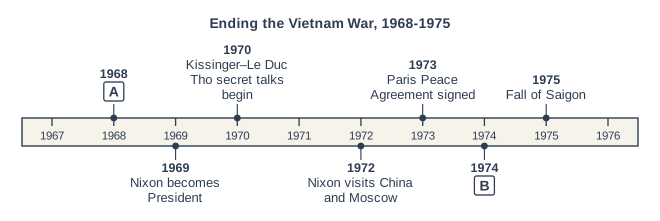
Figure 1 is a timeline of the ending of the Vietnam War.

Event A, in May 1968, began formal negotiations between the USA and North Vietnam. Event B, in August 1974, removed the President who had agreed the peace settlement. What should replace A and B?

Horizontal timeline titled "Ending the Vietnam War, 1968-1975", running from 1967 on the left to 1976 on the right, with the years marked every year (1967 to 1976). Events marked by dots on the line, in date order: 1968: label A; 1969: Nixon becomes President; 1970: Kissinger–Le Duc Tho secret talks begin; 1972: Nixon visits China and Moscow; 1973: Paris Peace Agreement signed; 1974: label B; 1975: Fall of Saigon.

Model answer

A: formal peace talks began in Paris. B: President Nixon resigned because of the Watergate affair.

Explanation

After the Tet Offensive, President Johnson announced on 31 March 1968 that he would limit the bombing and seek talks; the Paris talks opened on 13 May 1968 but made little progress for four years. Nixon resigned on 9 August 1974. His secret promises to defend South Vietnam died with his presidency, which encouraged North Vietnam to launch its final offensive in 1975.

Mark scheme
  1. 1 mark

    A: Peace talks begin in Paris

    Accept 'the Paris peace talks open' or similar. Do not accept 'the Paris Peace Agreement' (signed in 1973).

  2. 1 mark

    B: President Nixon resigns (because of the Watergate affair)

    Accept 'Nixon resigns' or 'Watergate forces Nixon out'.

Question 2

4 marks

Source A: a cartoon published in an American newspaper in October 1973, soon after the Nobel Peace Prize was awarded to Henry Kissinger and Le Duc Tho. (Written for practice.)
The cartoon shows Kissinger and Le Duc Tho standing on a stage, each holding one side of a huge medal labelled 'Nobel Peace Prize' and smiling for photographers. Through a window behind them, soldiers can be seen still fighting in a landscape labelled 'Vietnam'. The caption reads: 'Peace? What peace?'

Source A is critical of the award of the Nobel Peace Prize in 1973. How do you know?

Explain your answer by referring to Source A and your contextual knowledge.

Model answer

Source A criticises the award because it contrasts the two smiling prize-winners with the war still going on behind them. Through the window soldiers are still fighting in Vietnam, and the caption 'Peace? What peace?' suggests that there was no real peace to reward. The huge medal and the photographers suggest the prize is more about publicity than achievement. This fits what happened. The Paris Peace Agreement of January 1973 set up a ceasefire, but fighting between the South Vietnamese army and North Vietnamese and Viet Cong forces began again almost at once, as both sides tried to seize territory. When the award was announced in October 1973, Le Duc Tho refused to accept his prize, saying that peace had not yet been established in South Vietnam, and two members of the Nobel committee resigned in protest. Many critics also remembered that Kissinger had backed the Christmas bombing only ten months earlier. The cartoon was published in an American newspaper during the Watergate scandal, when many Americans had become cynical about claims made by their leaders.

Explanation

Level 2 needs the cartoon's message analysed (the contrast between the prize and the continuing fighting) and supported with knowledge such as the breakdown of the ceasefire or Le Duc Tho's refusal of the prize. Describing the picture alone is Level 1.

Mark scheme
  1. 4 marks

    Levels of response (4 marks).
    Level 2 (3-4 marks): Developed analysis of Source A based on its content and/or provenance, supported by relevant contextual knowledge, e.g. explains that the cartoon contrasts the smiling prize-winners with the fighting still going on in Vietnam, and links this to the breakdown of the January 1973 ceasefire, Le Duc Tho's refusal of the prize and/or the protests against the award.
    Level 1 (1-2 marks): Simple analysis of Source A, e.g. says the caption suggests there is no peace, with little or no contextual knowledge.
    0 marks: nothing worthy of credit.

    Indicative content (not a checklist; credit other valid points): Content: the caption 'Peace? What peace?' questions whether there is any peace to reward; the soldiers still fighting behind the stage show the war goes on; the smiling men and the huge medal suggest vanity and that the prize is a publicity stunt. Context: the Paris Peace Agreement (27 January 1973) set up a ceasefire, but fighting between the ARVN and North Vietnamese/Viet Cong forces continued almost at once (the 'war of the flags'); the award was announced in October 1973; Le Duc Tho refused the prize, saying peace had not yet been established in South Vietnam; two members of the Nobel committee resigned in protest; Kissinger did not go to the ceremony; critics remembered the Christmas bombing of December 1972 and the secret bombing of Cambodia; the songwriter Tom Lehrer joked that political satire had become obsolete. Provenance: an American newspaper in late 1973, when the Watergate scandal had made many Americans cynical about their government's claims.

Question 3

12 marks

Source B: from a radio and television broadcast to the American people by President Nixon on 23 January 1973, the day the peace agreement was initialled in Paris.
'I have asked for this radio and television time tonight for the purpose of announcing that we today have concluded an agreement to end the war and bring peace with honor in Vietnam and in Southeast Asia.'
Nixon went on to say that the people of South Vietnam had been guaranteed the right to decide their own future, and that the USA would continue to recognise Thieu's government as the only legitimate government of South Vietnam.

Source C: from a report by a British journalist in Saigon, published in a London newspaper in March 1973. (Written for practice.)
'Two months after the ceasefire, the war has not stopped; it has only changed its name. Each morning the army announces fresh clashes in the Mekong Delta and the Central Highlands. On the night before the ceasefire both sides rushed to plant their flags in villages to claim them. The last American soldiers are packing to leave, and many South Vietnamese officers dread the day they will be on their own while North Vietnamese divisions remain inside the country.'

How useful are Sources B and C to an historian studying the Paris Peace Agreement of January 1973?

Explain your answer using Sources B and C and your contextual knowledge.

Model answer

Source B is useful because it shows how President Nixon wanted Americans to see the Paris Peace Agreement. He claims that the agreement will 'end the war and bring peace with honor', and he stresses that the people of South Vietnam can decide their own future and that the USA will continue to recognise Thieu's government. This tells the historian what the USA said it had achieved: an end to American involvement without abandoning its ally. The provenance makes it valuable as evidence of the official view, because it is the President speaking to the whole nation on the day the agreement was initialled. However, the provenance also limits its reliability. Nixon had promised 'peace with honor' since 1968, and after the heavy criticism of the Christmas bombing he needed to present the agreement as a success. He does not mention that the agreement allowed about 150,000 North Vietnamese troops to remain in the South, or that the PRG was given a political role, concessions that President Thieu had bitterly opposed. Nor does he mention his secret promises to Thieu that the USA would respond if North Vietnam broke the agreement.

Source C is useful because it shows how the agreement worked in practice. The journalist reports that 'the war has not stopped', with fresh clashes every day, and describes how both sides rushed to plant their flags in villages just before the ceasefire, which matches what historians call the 'war of the flags'. He also identifies the agreement's central weakness: the Americans were leaving while North Vietnamese divisions remained inside South Vietnam. This was accurate, since the last US combat troops left on 29 March 1973 and the North Vietnamese troops stayed, which made the eventual collapse of the South possible. The provenance adds to its value. The writer was a British journalist, not directly involved in the war, who was reporting what he could see in Saigon two months after the ceasefire. However, it describes only the first weeks of the agreement and mainly reflects the fears of South Vietnamese officers, so it does not show the American or North Vietnamese view.

Overall, the sources are most useful when used together. Source B shows what the agreement was meant to achieve and how it was presented to the American people, while Source C shows the gap between those claims and reality. With contextual knowledge, an historian can see that the agreement achieved Nixon's main aims - US withdrawal and the return of the prisoners of war - but did not bring peace to Vietnam, as the collapse of South Vietnam in 1975 proved.

Explanation

Source B is the official American view, useful for US aims but one-sided because Nixon wanted to claim success; Source C is an outsider's report of the ceasefire failing, useful for the agreement's weaknesses. Level 4 needs evaluation of both sources' content and provenance with a judgement about their usefulness together.

Mark scheme
  1. 12 marks

    Levels of response (12 marks).
    Level 4 (10-12 marks): Complex evaluation of both sources, with a sustained judgement about their usefulness for studying the Paris Peace Agreement, based on content and provenance and supported by contextual knowledge, e.g. Source B is useful for how Nixon wanted Americans to see the agreement ('peace with honor') but is a one-sided public statement; Source C is useful for the agreement's weaknesses in practice (continuing fighting, North Vietnamese troops left in the South) from an outside observer, though it covers only the first months.
    Level 3 (7-9 marks): Developed evaluation of both sources based on content and/or provenance, supported by relevant contextual knowledge.
    Level 2 (4-6 marks): Simple evaluation of one or both sources based on content and/or provenance.
    Level 1 (1-3 marks): Basic analysis of one or both sources; describes or paraphrases them with little evaluation.
    0 marks: nothing worthy of credit.

    Indicative content (not a checklist; credit other valid points): Source B content: Nixon claims the agreement ends the war and brings 'peace with honor'; stresses South Vietnam's right to decide its future and continued US support for Thieu - showing what the USA wanted the agreement to achieve. Source B provenance: the President addressing the nation on the day the agreement was initialled (23 January; signed 27 January 1973); he had promised 'peace with honor' since 1968 and wanted to present the result as a success, after the criticism of the Christmas bombing; it leaves out the concessions - about 150,000 North Vietnamese troops stayed in the South, and the PRG gained a political role - and his secret promises to Thieu. Source C content: the ceasefire is not working - fresh clashes, the 'war of the flags'; Americans leaving; South Vietnamese officers fear being left alone with North Vietnamese divisions in the country. Source C provenance: a British journalist in Saigon - an outside observer, not directly involved, writing two months after the ceasefire, when the last US troops were leaving (29 March 1973); it is written for a British audience and reflects what he saw and heard in Saigon. Limitations: it describes the first weeks only and the South Vietnamese view. Context: terms - ceasefire, US withdrawal within 60 days, POWs released (591 returned), Thieu kept in power, National Council of Reconciliation, ICCS; Thieu had opposed the terms and was pressured to accept; fighting continued and the agreement collapsed by 1975. Judgement: B is most useful for US aims and how the agreement was presented; C for its weaknesses; together they show the gap between the claims and reality.

Question 4

20 marks

'The Paris Peace Agreement of 1973 was a success for the USA.'

How far do you agree with this statement?

Explain your answer.

[16 marks] [SPaG 4 marks]

Model answer

In some important ways the Paris Peace Agreement was a success for the USA. Nixon's main aim by 1972 was to get American forces out of Vietnam without appearing to be defeated, and the agreement achieved this. All remaining US troops were to leave within 60 days, and the last combat troops left on 29 March 1973. Just as important to Americans, all prisoners of war were to be released, and in Operation Homecoming 591 prisoners were flown home. American deaths in Vietnam stopped and the draft ended. The agreement also kept President Thieu in power, so the USA could claim it had not abandoned its ally, and Nixon told the nation on 23 January 1973 that he had achieved 'peace with honor'. At home, the end of American involvement calmed the bitter divisions that had led to the protests and the shootings at Kent State. In the short term, then, the agreement gave the USA what it most wanted.

However, the terms show that the USA had to make major concessions. About 150,000 North Vietnamese troops were allowed to remain in the South, and the PRG was given a political role through the National Council of National Reconciliation and Concord. Thieu had opposed these terms so strongly that he had demanded 69 changes and had to be pressured into signing by the Christmas bombing, by Nixon's secret promises and by Nixon's threat to sign without him. The agreement therefore left South Vietnam in a dangerous position.

The agreement also failed to bring peace. The ceasefire was broken almost at once in the 'war of the flags', and the international commission set up to supervise it was powerless. Nixon's secret promises to take 'swift and severe retaliatory action' if Hanoi broke the agreement could not be kept, because Congress passed the Case-Church Amendment in 1973 and Nixon resigned over Watergate in August 1974. When North Vietnam attacked in 1975, the USA did nothing, and Saigon fell on 30 April 1975.

In the long term, therefore, the agreement was a failure for the USA's wider aims. Since 1954 the USA had tried to keep South Vietnam independent and non-communist as part of its policy of containment. By 1975 not only South Vietnam but also Laos and Cambodia were communist. Pictures of helicopters evacuating the US Embassy damaged American prestige around the world, and about 58,000 Americans had died for a cause that was lost. Some critics argued that similar terms might have been available years earlier, which would have saved thousands of lives, and some historians believe Nixon and Kissinger accepted that South Vietnam might fall after a 'decent interval'.

Overall, I agree with the statement only to a limited extent. The agreement was a success in Nixon's narrow and short-term aims: it got American troops and prisoners home and ended the war for the USA. But it was not a success for the USA's original aims in Vietnam, because it left North Vietnamese troops in the South, did not bring peace and led within two years to the communist victory the USA had fought to prevent. It may have been the best deal available to a country that was determined to leave, but that is not the same as a success.

Explanation

The agreement achieved Nixon's immediate aims - withdrawal, the return of the prisoners and Thieu left in power - but it left North Vietnamese troops in the South, the ceasefire collapsed and South Vietnam fell in 1975, defeating the USA's long-term aims. Level 4 needs a sustained judgement, often by distinguishing short-term from long-term success or Nixon's aims from the USA's original aims.

Mark scheme
  1. 16 marks

    Levels of response (16 marks).
    Level 4 (13-16 marks): Complex explanation of ways in which the agreement was a success for the USA (withdrawal of troops, return of prisoners, Thieu left in power, the claim of 'peace with honor', an end to division at home) and ways in which it was not (North Vietnamese troops left in the South, the ceasefire's collapse, the fall of South Vietnam in 1975 and the failure of containment, damage to US credibility), supported by precise knowledge, leading to a sustained judgement - e.g. distinguishing between short-term and long-term success, or between Nixon's immediate aims and the USA's original aims.
    Level 3 (9-12 marks): Developed explanation of the agreement's successes and failures for the USA, supported by relevant knowledge.
    Level 2 (5-8 marks): Simple explanation of either successes or failures, with some accurate knowledge.
    Level 1 (1-4 marks): Basic explanation; general statements with little specific knowledge.
    0 marks: nothing worthy of credit.

    Indicative content (not a checklist; credit other valid points): Success: all remaining US forces left within 60 days - the last combat troops on 29 March 1973; all US prisoners of war released (591 in Operation Homecoming); a ceasefire; Thieu's government stayed in power and was still recognised by the USA; Nixon claimed 'peace with honor' (23 January 1973); the draft ended (January 1973); American deaths stopped; the end of the war calmed division at home; détente with China and the USSR survived. Failure: about 150,000 North Vietnamese troops were allowed to stay in the South; the PRG/Viet Cong gained a political role; the ceasefire was broken at once ('war of the flags'); the ICCS was powerless; Thieu felt betrayed - he had been pressured to sign; Nixon's secret promises to defend South Vietnam were not kept after Case-Church (1973) and his resignation (1974); South Vietnam fell on 30 April 1975 - the USA's aim since 1954 of keeping South Vietnam independent and non-communist (containment) failed; Laos and Cambodia also fell to communists in 1975; US credibility and prestige damaged; about 58,000 Americans died; some critics argued that similar terms might have been reached years earlier, saving lives; the 'decent interval' view. Judgement: a success in Nixon's narrow, short-term aims (getting out and getting the prisoners back) but a failure in the USA's wider, long-term aims; credit the view that it was the best available outcome for a USA determined to leave.

  2. 4 marks

    SPaG. High performance (4 marks): spells and punctuates with consistent accuracy; uses rules of grammar with effective control of meaning overall; uses a wide range of specialist terms as appropriate.
    Intermediate performance (2-3 marks): spells and punctuates with considerable accuracy; uses rules of grammar with general control of meaning overall; uses a good range of specialist terms as appropriate.
    Threshold performance (1 mark): spells and punctuates with reasonable accuracy; uses rules of grammar with some control of meaning and any errors do not significantly hinder meaning overall; uses a limited range of specialist terms as appropriate.
    0 marks: the student writes nothing, or the response does not relate to the question, or errors severely hinder meaning.

    SPaG marks are awarded only if the answer relates to the question.

Ready to try the rest? Every answer you write is marked against the mark scheme, so you can see exactly where the marks are.

AI Tutor Hints first, answers after you try

Hi! Stuck? Ask me for a hint and I’ll help you work it out. Once you’ve checked your answer I can explain exactly where the marks are.